Sunday, August 7, 2011

Book Review: The Next Decade

The Next Decade: Where We've Been . . . and Where We're Going is George Friedman's follow up to his well received "The next 100 years", and attempts to make some more precise predictions about the way the next decade will play out on the world stage.

Overall I liked it, but not because I agreed with everything Friedman has to say. I agreed with perhaps half, with the remainder falling between disagreeing and not knowing enough to say either way.

The bulk of the book centers around Friedman's assertion that America is an "accidental empire", making comparisons to the Roman and British empires, but asserting that while those were created through might, America's was a mix of that, economic might, culture, and a melange of historical accidents. There's some validity to his claims about America's place on the world stage (e.g. 5% of the world's population counting for 25% of the world's GDP), but the analogy is strained at best.

In addition to this analogy being strained, a couple other things I disliked:
  • The author assumes (at least by the weight given in the book) that 99% of what shapes the world stage is politics. Perhaps I'm naive but I believe that the old institutions don't carry the weight they used to and will carry less going forward.
  • Technology in particular, is given only passing mention. When looking at the growth of high tech in places like India and China; or at the recent twitter-fueled uprising in the middle east, it seems there should be more consideration given on this front.

On the other hand, some things I did like:
  • I learned much about the political dynamics in some parts of the world about which I had little history.
  • He asserts that leaders, and the US President in particular, need to lie. That they need to do things that won't be popular and that sometimes this means saying one thing and doing another. I believe this is true, and to believe otherwise is naive.

In short, I recommend it, but to be taken with a considerably sized grain of salt.

Thursday, July 28, 2011

Book Review: SVK

I've been real busy lately, so posts have been lacking and book reviews are backlogged a bit as well. I did, however, want to post about SVK, a really cool comic book release I got my hands on recently.


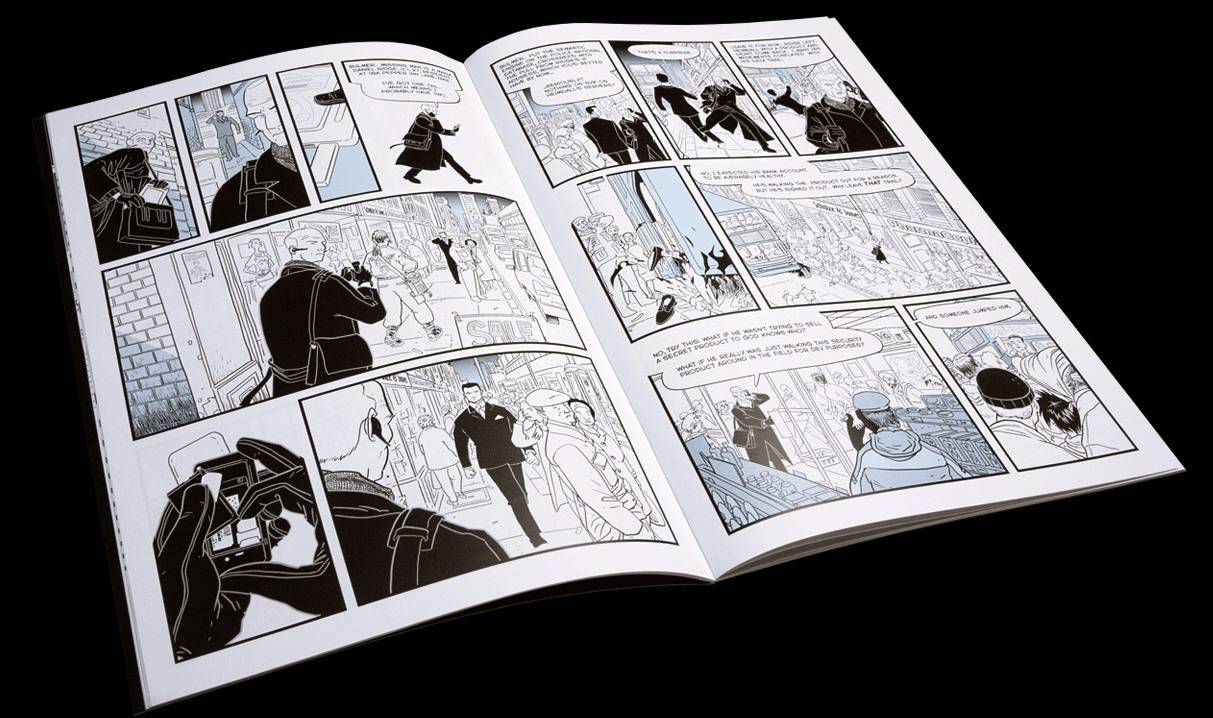
SVK is an attractively and minimalistically-styled, dark sci-fi comic by Warren Ellis & D'Israeli, about unchecked government control, with an augmented reality theme.

The story centers on a gun-for-hire, hired to clean up a problem for a government security agency. While doing so, he uncovers the roots of what the real problem is and what they are trying to hide. The story is good but by no means unique.

The thing that really sets SVK apart, however, is that it comes with a credit-card sized UV-flashlight, which you shine on the comic to reveal the augmented reality world that the protagonist is seeing. See the pics below.

To add icing to an already delicious cake, the directives at the start of the book, the fictional ads directed at the reader, and the fact that the UV light is make to look like a secret SVK device, all conspire to poke at the 4th wall a bit, making the reader a secret agent of the future, if only for a for an hour.


Monday, July 11, 2011

Book Review: Edward R Murrow and the Birth of Broadcast Journalism

Many people are familiar with Edward R Murrow, mainly in the context of his role in challenging McCarthyism, as portrayed in the film Good Night and Goodluck. Even prior to this film, many are familiar with his role in shaping journalism and in particular with his barn-burner speech that I referenced here.


I, for one, wasn't familiar with his life up to that point, and so when I came across the audiobook version of Edward R. Murrow and the Birth of Broadcast Journalism, I decided to pick it up.

Highly recommended, especially in audiobook form.

First off, the book is a good study of how Murrow's principles guided his actions. He was able to steer a course in complex scenarios because he had a clear view of what he believed was right. Still, there were times where he decided to pick his battles, but this was more about astute politics than it was any wavering in his principles.

Secondly, it's also a lesson about people passionate about a new medium (two actually, radio and then television) experimented to find it's potential. There are lessons here for games as a medium, especially for serious fare.

Finally, the audiobook uses some original recordings which are well worth hearing. Murrow's recount of riding shotgun on a British bomber on a bombing run over Berlin is electrifying, white-knuckle listening, even sixty-plus years later.

My only complaint about the book is that the author, in his conclusion, claims we'll never have another Murrow because the mediums have already been invented - there'll never be another 'birth' period to live through. This is of course untrue. We are still in the midst of the reforming of journalism for the Internet, for one. And games as a medium for news journalism and editorial are even earlier in their development, with folks like Ian Bogost, Molleindustria, and others helping the form to take it's first steps.

I still recommend it as it's easy enough to ignore the author's assertion here and think about what a "Murrow of Games" would challenge us to do with our "Lights in a Box".

Edward R. Murrow and the Birth of Broadcast Journalism (Turning Points in History)

Tuesday, July 5, 2011

Book Review: Do The Work

Lately, I've been doing 4-5 books in parallel. A book in the gear bag, a book on the night table, one floating around the house, one on the iPad, and something lightweight on the phone.

The latter of these, my pick for the iphone, needn't be lightweight in sense of subject matter, but rather for phone use I tend favor books digestible in short chunks. Books by Seth Godin, Hugh McLeod or Guy Kawasaki come to mind. It was in this vein that I came across Do the Work by Steven Pressfield and thought I'd add it to my reading list.

I was really rather disappointed by the book.

It's a sort of motivational book about execution, and pushing through resistance (outside and self-inflicted) to complete creative works.

While this is a topic that can help many, the problem is that the book doesn't have a lot of substance to it. Unlike Godin, who draws many on-point analogies from experience, or McCleod's ability to cut through to tell-it-like-it-is fact, Pressfield's book is filled with labored rhetoric, repetitive truisms and the like.

I didn't find it of much use. YMMV.

Do the Work

Friday, July 1, 2011

3 Problems Hiding in Zynga's IPO filing

[I'm not a lawyer nor an accountant. My opinions are mine and not my employers, etc, etc]

Zynga's S-1 filing is really interesting reading. Tech Crunch has a (rather short) post on it here, and VentureBeat has a better post looking at some of the details here. Hit the bullet points on the VB post if you want the TL;DR version, but most of this will leap out at you from the S1 filing anyway. Short version:
  • 600M revenue in 2010, almost 4X 2009. $235M revenue Q1 this year alone.
  • Profits growing, with revenue (Q1-Q1: 135%), but...
  • R&D up sharply (160%)
  • marketing costs up (130%)
  • but on the plus side, Cost of Revenue (mostly operating costs) up 110%, suggesting they are getting efficient, or benefits of scale, or both
So, all in all they are doing very well, and it certainly looks like a better investment than GroupOn or any of these other crazy IPOs that have people crying bubble.

But hang on a second. It still smells funny. Look at it from 10,000 feet. The company is HIGHLY dependent on one platform/vendor (Facebook), they don't have nearly the revenue or war chest that the incumbent publishers have, etc.

So, I thought I'd read through some of the fine print. I think the S1 doesn't address three important areas:

  1. Allocation of R&D costs: Details on R&D are sparse, and the statement just cites increases in headcount, etc. What it doesn't say is whether that's because of a broadening portfolio of games (that would spread risk) or whether individual game title budgets are growing, which would suggest an increase in risk, as each title becomes a bigger gamble.
  2. Risks posed by entry of EA and other incumbents: As the major publishers awaken to social games, this could have a three-sided effect on Zynga: (i) R&D costs go up to compete on product quality, (ii) possible loss of MSS as the publishers bring major titles to market, and (iii) user acquisition costs go up as the competition drives CPMs on FB's ad network up.
  3. Terms of Facebook credits agreement. To Zynga's credit, they DO call out the move to the Facebook credits system that took place last year, where they went from giving up 2-10% of revenue for payment processing to giving up 30%. However, they didn't just move to Facebook's credit system. They did so after a bit of a fight, and they signed a five year agreement. What are the terms? I'd like to know, for example...
  • Do they get preferential ad pricing and/or placement as a result?
  • Although signed in July 2010, the S1 states the migration was only completed April 2011, so how much of the revenue from 2010 and 1Q11 was earned at 95 points on the dollar vs 70 points?
With any company, it'd be possible to ask infinite numbers of questions to learn or infer more. In this case though, I think there are at least a couple key things that investors should consider.

Food for thought over your long weekend...

Friday, June 24, 2011

The Seven Skills

There was one part of Seth Godin's Linchpin that resonated very strongly with me, and that I wanted to riff on a bit.


Seth has a section on factors that make one indispensable within one's network or organization. I struck me that while these do apply anywhere, in large company environments in particular, Seth really nailed the blueprint.

Here's his list (in bold) with my commentary about how I've seen this apply at large companies like Microsoft and Intel.

I'm certainly not claiming I rate super high on any or all of these. But, where I've had successes, it was from delivering along one or more of these vectors. Similarly, where I've failed it was because I required one of these and fell short.

  1. Provide a unique interface between other members of the organization: Complex organizations inevitably get divided into groups to work on different functions. Sometimes that split is vertical (by product or market segment), sometimes horizontal (by functional area), often both. This necessitates meetings or processes by which decisions get made and priorities managed. Being the person that manages that process, runs the meeting, etc, even if not the person that makes the decision, is a valuable function. That person ends up being the person who knows who is doing what, has all the history of what was assigned to whom, etc.
  2. Deliver Unique Creativity: This is that person in your organization that can synthesize a problem, and provide unique creativity to one element of it. "Sara is the best at coming up with compelling business plan pitches", or "No one comes up with out-of-box ad concepts like Fred".
  3. Manage a Situation, Project, Product or Organization of Great Complexity: The larger the project, be it hardware, software, game, or whatever, the more likely that there will be very complex tradeoffs and priorities to manage. It is VERY common for people to spin themselves into a circular holding pattern because they can't get past some tradeoff. Being the person that understands how to trade off features, schedule, cost and priorities, keeps their eye on fundamental product goals, understands what decisions can be made at a low level and which have to go to the top, and who does/doesn't need to be involved in making it -all of these are valuable skills, especially in aggregate. It also involves recognizing that you can't be the domain expert on every area, so when someone asserts "we must do A", you bring in the expert on the contrarian view and manage the debate.
  4. Lead Customers: There are two angles to this, in my point of view, one is salesmanship, in the most positive sense of the word - understanding customers needs, and helping lead them to a solution. The other one is internal, acting as an effective customer advocate, which means not just "they are asking for feature X", but understanding why, helping internal product teams understand the benefits or consequences of not doing so.
  5. Inspire Staff: People need leadership. At large companies in particular, there are a lot of people that never leave the building. Inspiring them with a mission and a view of how they can have impact, well, I think we can all think of how rare the examples of this are in each of our work histories.
  6. Provide Deep Domain Knowledge: "The smartest guy in the room on topic X". Pretty self evident. Hint: There's no amount of reading that substitutes for actually doing it. e.g. There are sports commentators that are huge fact repositories. There are those that were players or coaches themselves. Those that have both are the ones that have life-long careers.
  7. Possess a Unique Talent: Easier said than done. "She's the only person that can...". The weak form of this is "He's the only person that can access our database because he's never trained anyone on it's structure". That's not a unique talent, that's protectionism. I remember a friend introduced me to a senior guy at EA a few years back and told me "He's the best closer in the business". I asked what they meant, and they said "when a product is over budget and/or behind schedule, or not meeting goals, they send him in. And then it gets fixed".
Anyhow, it struck me as a good list. Chances are you have abilities and challenges along all seven of these points. Good to think about how you can improve and which ones you can make your best ones.

Thursday, June 23, 2011

Riffing on the Popcap acquisition rumor

Yesterday Techcrunch broke this story:


Popcap to be acquired for $1+B, which started a rumor mill going. Who could it be? Story points to potential buyers as: Zynga (discounts them as not having stomach for the price & multiple, EA, DeNA, Tencent.

I tweeted about it saying I thought EA just as a gut call. Later though, I started wondering why no one had asked if it could be Google, or even more credibly, Microsoft.

Techcrunch added a story about rumors that it was likely EA.

And then today, VentureBeat had this story pointing to EA (nothing new, just citing the techcrunch article), but being skeptical about it and pointing at other potential buyers: Zynga, DeNA, Media companies like Fox, Activision/Blizzard, and throwing water on any "stingy" chinese companies.

(WTF, why is VentureBeat also not mentioning Microsoft? Does everyone assume they are broke after buying Skype?)

The interesting thing about these pieces is that they are looking at the market rather naively. Techcrunch refers to Popcap as a startup while at the same time mentioning that they've been in business since 2000. VentureBeat mentions their social games but barely mentions mobile let alone all the other platforms they are on.

Anyhow, I believe the EA rumor is most likely accurate (though I still have a side bet on a surprise that it's Microsoft, but I'm crazy like that).

Just for grins and giggles though, here's some alternate takes on the headlines made possible by this acquisition, which I think make it more apparent that this isn't such a bad buy. Allow me my editorial liberties:

If it's EA:
  • #1 iPhone games publisher buys #2(3?) iPhone games publisher to further cement leadership
  • #2 Facebook games publisher buys #3 facebook game publisher in bid to take lead position away from #1 FB games publisher
  • Leading western games publisher buys another entry ticket in race for China gaming market (Popcap has social games/portal play in China, a shanghai studio doing original IP, etc)
  • EA buys leading casual games dev, "Popcap is the Valve of casual games" says Someone.
If it were to be Microsoft
  • MS buys publisher of popular iPhone, iPad games in bid to secure exclusive content/features for MS phones/tablets
  • MS buys publisher of social games in bid to catch up in that race
  • See same two above points about traction in Asia and Popcap's production abilities, quality
In any case, my point is that there's a lot more value to Popcap than just "Plants vs Zombies on Facebook or iPad". They are a force in the mainstream games market with recognizable IP, real revenue, good distribution, top notch development talent, international portfolio of games and distribution, etc. You can play their games on almost every platform under the sun - even play bejewelled on airplane headrests!)

$1B is a lot of money, but Popcap is an awesome crew, and likely worth it. I sure hope whoever it is doesn't screw the magic formula.

Book Review: Linchpin

I've reviewed a bunch of Seth Godin books here, and while I'm a great admirer of his, my reviews have varied; with some medium-to-highly rated (Meatball Sundae, Poke the Box, Small is the New Big), and some less so (The Dip).

Linchpin is flawed, but valuable. I give it a recommendation, but only for those that understand that there'll be some repetitiveness, and some random jumping from topic to topic. Nevertheless, there are some good points made.

At a high level, it's Seth's take on what it takes to be essential - a linchpin - in your organization, network or community. His high level assertion is that the Internet, the attention economy, and other factors have fundamentally changed the nature of work. Being a quiet cog in a machine is a decreasingly viable path, and so people need to think about what factors make certain people indispensable.

By way of flaws, the book flits from topic to topic and back without a lot of structure. It's divided into sections, but then bounces between some of the same issues covered in other sections. Many of the anecdotes are detail and context free enough that they added little value or color.

The book is still valuable though. There are many points in the book that provide good food for thought, and several more structured entries that provide the kind of well articulated analysis that Godin is capable of and that I wish we'd see more in his recent books. At least one of these sections was valuable enough, and resonated with me enough, that I'm doing a separate post on it alone.

Thursday, June 16, 2011

Book Review: Panic!

I really enjoyed Michael Lewis' The Big Short, and so when I saw this previous work at the local library I picked it up.

Panic: The Story of Modern Financial Insanity, is *edited* by Lewis, but is really an anthology of articles from WSJ and other financial news outlets. The book takes a look the last few big financial market panics (the 'black monday' of '87, the Russian crisis, the southeast Asian currency crisis, the dot-com bubble, and the recent real estate crash) and takes select pieces of reporting from before, during, and after each of those panics.

When viewed as whole one is led inevitably conclude three things:

  1. That no matter how many instances of "irrational exuberance" we go through, we never learn. We have innate ability to believe that this time it's different. The ability for amateur investors, professional investors, economists and reporters to collectively lose touch with reality and start drinking each other's kool-aid is *amazing*.
  2. That after panic hits, after the bomb goes off, and when people finally pop their heads out again, everyone has an equally amazing ability to claim that they knew this was going to occur, and that they called it ahead of time. This level of revisionist history is somewhat akin to how every friend you have that went to Vegas has convinced themselves that they returned "up a couple bucks" (they didn't. Somone is paying for those hotels).
  3. That in both the run up to the peak and in the panic afterward, the press is not only not objective, but possibly an even greater contributor to the mob mentality than the investors they later blame for it. Examples from the dot-com era here were an awesome example, buying hook-line-and-sinker the pitch that fundamentals no longer applied and that it was about a land grab now in favor of user revenues later - the press *loved* this story and sang it to whomever would listen.

Some critics of the book claim that the analysis here isn't deep enough, and that solutions to the crisis (or future ones) weren't offered or expanded on. However, I don't think this is the point. I think the book is a valuable one if only to view how important it is to lift your head up from whatever current trending thought there is and ask yourself if there isn't myopic group think happening once again.

In this sense, the book serves it's purpose, and so provides insight as well as a fun little history lesson.

Sunday, June 12, 2011

Book Review: Team of Rivals

Before leaving for E3, I had the chance to finish Doris Kearn Goodwin's Team of Rivals: The Political Genius of Abraham Lincoln, and quite enjoyed it, despite a couple flaws.


The book is about Lincoln's relationship with his famed cabinet, made up of what had been some of his biggest rivals in the run up to his winning the republican party's nomination as presidential candidate. Much has been written about how he structured his cabinet out of people that would not only counsel him objectively, but take strong contrarian stances to his position on issues. This book explores those relationships, from the run up to the presidency until his assassination, and does so pretty deeply through letters, diaries, and other accounts of the communications between them.

Perhaps those that went to school in America are more well versed on Lincoln and on the history of the civil war than I am, but still I think there's a lot of depth here that offers some great lessons on character and leadership.

Also, again, because I don't know a lot of the history here, I found the accounts of the great battles and turning points of the civil war to be fascinating. I also didn't know that Lincoln's assassination was part of a triple assassination (the other two planned killings, of vice president Johnson and secretary of state Seward, were abandoned and unsuccessful, respectively).

The main complaint I have about the book is that in gushing praise upon Lincoln, it fails to make any criticism of him. Even while talking about his failed calls in selecting some of the leadership of his military leaders, it apologizes on his behalf. The book also gives disproportionate weight to some things in his life versus what must have been the heaviest at the time (e.g. social functions and the like, compared to war campaign decisions).

This critique aside, the book is still a good read and a good crash course and inside peek on a great leader in action.

Monday, June 6, 2011

Seven Fables Kickstarter project

Mark Stephen Meadows, a couple of who's books I've reviewed (here, here) has a cool new Kickstarter project project going, building an interactive iPad app and a leatherbound collector book around seven fables taking place around the sea.


I spent a little time last year on Mark's boat in Mexico and he's a pretty interesting character, and I'm confident the book and app are going to be marvelous. Go support it!

Sunday, June 5, 2011

Project Cafe Speculation

Since we're a couple days away from Nintendo's presser at E3, I'm calling last chance to speculate on what Nintendo has up their sleeves with "Project Cafe" that hasn't already been leaked.


The most fervent rumor discussion is around the controller, which is supposed to be some kind of tablet with a 6 inch screen, buttons and a d-pad on the side, and tilt sensors and the like.

Anyhow, here's my prediction:

- Nintendo will claim the controller can also play stand-alone games.
- They will position the controller as being a "tablet that comes free with your console" and will show some entertainment functions for it
- The 'comes free' is a bit of a ruse, as buying a second controller will have a hefty price tag
- They will put on a brave face about the 3DS and that business being alive and well

Over time, though, I believe they see the writing on the wall about their hand-held businesses being commoditize and subsumed by phones and tablets, and so this is their attempt to in turn commoditize those businesses. I think its a weak attempt to do so, but there's some logic to the strategy and should allow them to circle the wagons with their core base.

It'll be interesting to see whether Nintendo can pull off yet another hail-mary pass (like they did with the Wii and the DS).

Shh!! 3 Unspoken Lies About Social Games

The inimitable Greg Costikyan wrote an excellent piece for Gamasutra, lambasting Social Games, and claiming that they are in fact not very social at all.


I agree, and thought I'd add two more topics that came up in conversation at Login recently, and in conversations with a couple social games developer friends.

So let's give Greg Credit for calling out the first lie on my list:

Lie #1. Social games are social games. (Truth - they aren't very social at all)

And to this I'll level two more accusations.

Lie #2. Social games are viral. (Truth - they aren't)

Social games are often cited as "viral", or having the opportunity to be so, because of the social network on which they reside. However, short of the early days in which FB allowed apps to spam a user's friends list, this just isn't the case.

Companies like Zynga are rumored to spend many millions on advertising within FB to acquire users, but if the games were truly viral, they would spread on their own, being recommended whole-heartedly by friends via word of mouth.

The fact that few social games have been able to exceed the virality of the average dog-on-skateboard Youtube video - let alone the virality of an Angry Birds - is proof that they aren't viral. (Some examples do come to mind though. Parking wars and Cow Clicker certainly got a lot of watercooler talk.)

Lie #3: Social Game Publishers are building Games, not Products. (Truth - most have little respect for the medium other than as a revenue generator).

I'll cut to the chase: To my knowledge large publishers in this space, like Zynga and Playdom, don't have developer credits listed in their games.

I wasn't able to find them anyway. I had a couple developer friends lament about the fact that there were no game credits and that when they'd asked management at these companies, they'd been told no.

I think that speaks volumes about those publishing these games and what they think of the people working on them, and of their contributions. "It's just a product, and you are just a cog".

There are a few companies out there doing the right thing (I'm looking at you Brenda!), but I fear these are the exception.

With all the excitement around 'Social Games' these days, it's important that we don't delude ourselves about some of the lies being told.

//rant off

Wednesday, June 1, 2011

Beyond Aperture: Unofficial Portal 1 Epilogue

BoingBoing points us to this beautiful Portal (1) epilogue. Well made, clever.


Thursday, May 26, 2011

Book Review: Anathem

Very few people are going to like ALL of Neal Stephenson's books. I've read a number of them, and usually, but not always, like them (I loved Snowcrash and Diamond Age, was ambivilent about Zodiac, disliked Cryptonomicon, and loved the System of the World trilogy).


One thing I've found is that the time he takes in building up to the action is pretty consistently one quarter of the way in. The problem is that in a book like Anathem - a thousand page monster - this means it's quite some time before you get to the action.

In this case, it's still worth it. The long slow build-up does two things. First, the main character is part of a monastically-styled class in the book's world, and this long deliberate build lets the reader get immersed in the slow, pensive, pace that the 'monks' move and live. Secondly, It really takes the reader on a long and deep journey so that you find yourself - like the main character - gaping in wonder at how far you've come in the journey since the start.

And in that journey, well, it does go quite a ways. Picture somethings on the order of a Dune or Lord of the Rings; starting in Name of the Rose, but ending up in 2001: A Space Odyssey.

The book also serves as backdrop for commentary on what I believe is Stephenson's distaste for the growing rift between the literati and the 'illiterati' in modern society.

As I said above, it's a long and arduous read. If you can get through long and deep sci-fi reads, though, you'll find a really great adventure here.

Wednesday, May 25, 2011

Does LA Noire represent the next 3 years of AAA game innovation?

I started playing through LA Noire a few nights ago and am digging it thus far. As Red Dead Redemption taught me, the combination of Rockstar's immense game worlds and my limited gaming time, I won't likely finish it until sometime in 2012. Still there are a few initial thoughts I thought worth writing up.

The game doesn't have me *loving* it yet. Not in a Portal 2 (which I loved start to finish) kind of way, or even in a Red Dead Redemption (which I had 'moments of swooning' for) kind of way. That said, I think it offers some interesting hints on future direction.

LA Noire is very much a Rockstar game. Like both GTA and RDR, it offers a large 'open' world, many side-quests and missions, in-game mini-game type activities. The story is - so far anyway, I'm only five cases into it -more linear than GTA and RDR.

Still, there's no reason that this game needed to be anything other than 'Grand Detective Auto', just as many people labelled RDR 'Grand Theft Horsie'. It could have been the good-guy version of GTA, with lots of cops and robbers shootouts in a late 1940's setting. And they'd have sold tons of it.

Still Rockstar chose to take a couple risks in straying from the usual, in trying to make not a cops-n-robbers game, but a detective game.

The first is that the game has an element of point-and-click-adventure to it. Searching crime scenes, finding bits of evidence, writing these in your notebook, and then recalling them at the right time later to solve a puzzle - these are all reminiscent of the best of early 90's Lucasarts titles. More in keeping with the theme, and more unique in today's market vs the plethora of shooters.

The second, and bolder, risk they took was in making interrogation a core element of the game. The facial animation that's been much talked about, together with what must have been a massive spend on voice-and-mocap acting, were needed to add a more innovative - and thus risky element to the game. The game asks you to interview witnesses and suspects, and then lets you decide whether to believe, doubt, or accuse them of lying. Doing so requires that you look at the evidence you've got thus far, as well as reading the characters faces and body language. In doing so, it not only bumps into the uncanny valley - it throws the player headlong into it. Is it perfect? No.

I don't like the way this guy avoids eye contact!


The interesting thought to ponder here is where Rockstar chose to invest and/or innovate.

It certainly feels like we're near the asymptote on performance that can be extracted out of the current generation of consoles, and next generation isn't coming until (depending who you beleive) 2014.

That means another 3 years or more of making AAA titles, in which the publishers/developers need to garner interest in their titles, and they can't use screenshots alone to do it.

So, what do you do if you are trying to make money in this space. Well, for one, you focus on efficiency. Aside from that, you invest in content production (like all the voice acting in this case, and the more detailed facial models), and in innovations in gameplay (like the lie detection element; or the revisiting of point-n-click adventure).

I think this is a good indication of how others will be spending their money too. Production quality, art, and innovation in gameplay. I hope we'll see more big budget titles with experimentation along these lines over the next few years. Kudos to Rockstar for taking these risks.

VaioS laptop

Early in the year, I said that one of the trends we'd see was what I called more 'bespoke' design in our computers & electronics. More looking like items of fine craftsmanship, less prominent branding (or - gasp - no branding at all), simplicity and elegance over LEDs & complexity.


The new Vaio S series is certainly an example in that direction. Unfortunately, it still has the logo/branding, but on the plus side, it has a brown/gold option that immediately made me think of Robin Williams life-editing cutter laptop in The Final Cut (an awesome sci-fi flick, if you haven't seen it) which I've pointed to before.

Sony Viao S

A replica of the Final Cut laptop

Williams holding the prop from the movie.

Monday, May 23, 2011

Game Journalism in the Age of Digital Books

Last year I authored a number of posts (like this one) on the future of ebooks, and also did a few book reviews and comments on digital typography (like this one), as well as pointing at the excellent thinking on the subject by guys like Craig Mod and James Bridle.


Suffice it to say that digital books and digital reading is a very exciting area of development, one ripe for many years of innovation. I'm continually surprised at how many people look at the iPad - essentially the industry's second take on a digital reader after the Kindle - and are calling it done.

It took us a few thousand years to get print into decent shape. I think we should at least give this one the decade, ok folks?

Anyhow, I was encouraged to see my areas of interest overlap when seeing two different experiments in taking game journalism into the new age of digital print.

The first is The Final Hours of Portal 2, by Geoff Keighley. Keighley spent three years with behind-the-scenes access to Valve & the Portal 2 team, and delivers a fifteen thousand word ebook/application. Less a review and more a gushing fan souvenir, it's nevertheless an interesting experiment - taking the lengthy text on the game and embedding video, interactive application elements, etc, to deliver an in-depth experience any fanboy would love.

I'll post a longer review when I'm done getting through it, but regardless of any flaws, I recommend you spend the $2 to download this to get an idea of (some of) what's possible.

The second example I came across is the Kill Screen Review of Infinity Blade. Great use of interactive typography to actually convey a key element of the game - in the text layout itself, not just in the text.

Go check out both of them, as I'm sure you'll be entertained and inspired.

Saturday, May 21, 2011

Book Review: You Are Not A Gadget

I found a few of the ideas in Jaron Lanier's You Are Not a Gadget interesting and provocative. Despite that, I can't recommend the book.


The high level goal of Lanier's manifesto is to call into question the unbridled enthusiasm of the Pro-Internet, Web 2.0 movement, without taking the luddite stance that some do when taking issue with the same technology and progress. Lanier believes in technology's power, he just isn't naive enough to think that only good can come of it.

Some of the concerns he raises include whether we should consider the influence that system architectures have upon us and our culture, the cost of software & hardware design lock-in, and whether open source and open content models can innovate as well or in as many ways as traditional methods.

These are all good topics, worthy of discourse. Unfortunately, I found Lanier's screed to be a long-winded ranty and poorly structured attempt at doing so. Your time is better spent reading The Master Switch, or Bill Patry's book for starters.

Saturday, May 14, 2011

Splitting the iPhone vs DS argument in two

There have been a number of posts about Nintendo vs Apple, the 3DS vs the iPhone, and "99c games vs $40 games". The summary of these posts revolves around two different issues. They get muddled together, and as a result, cloud the argument. This post is an attempt to distinctly break apart the two arguments, such that we might look at each cogently.

Argument A: "Will Apple's 99 cent games destroy the market for Nintendo's $40 games?"

This is indeed a good question, and one to which the answer seems obvious.

On the 'Yes' side, one have only to look at Apple's recent numbers, the excitement around iPhone, and the challenges some have had in trying to maintain traction around higher price points in the app store on that platform.

but...

On the 'No' side, there's an argument that a large development budget can give a deeper, larger, experience. There's also the fact that Nintendo has continued to have success with some titles on the DS. There's also another version of the No answer along the lines of "if you want Mario, he costs $40", in other words, Nintendo's IP is something to consider.

The answer is probably somewhere in between. Undoubtedly the bar will be raised for what people expect to get for more than $0.99, so it will be a challenging sell.

The second argument is distinctly different than the first though. So let us suspend belief for a second, and imagine a world in which all iPhone games cost $40 (or one in which all DS games cost $1 - your call, as long as argument A goes to equal footing)

Argument B goes as follows: "Will 'portable game console' join the list of devices who have been subsumed by the Smartphone?"

Once again, there are arguments for and against, but in my opinion, the arguments are more one-sided.

On the No side: Nintendo continues to innovate (dual screens, stylus, 3D-stereo screen, etc) to stay ahead of the capabilities of the phones (or at least different, if you want to take issue with 'ahead'). Also, there's value to the quality, curated experience a closed, vertical platform like a console provides. And once again, there's Nintendo's IP. Finally, while Nintendo doesn't appear to do this currently, as a closed platform they could choose to sell their hardware below cost as a path to customer acquisition. (Of course phone vendors do this, and there's nothing saying that the same could hold true for an iPod-touch-like device provided it was sufficiently tethered to an app store or iTunes like service.

On the other hand or 'Yes' side of the question, the evidence pointing to an eventual subsuming of the function-specific portable game console by the general-purpose Smartphone doesn't look good for the portables.

When looking at other function-specific devices competing with the general-purpose device, the pile of bodies is pretty high, and growing.

The first category to go was dedicated PDA's. Never more than niche to begin with, these devices begged for communication to begin with. It could be argued that this was less about phones integrating the functionality, and more about the devices lacking the requisite functionality to begin with.

One category of device people started talking about suffering from this phenomena was the GPS. (See here, here, or here's a graph of a couple top GPS vendors where you can see the precipitous drop - even beyond that of the market due to recession, in green - which lines up with Apple's 3GS launch).

GPS is still alive as an electronics category, but it seems clear that the device manufacturers are suffering here and running for high ground in the way of either added niche-valued functionality and automobile OEM sales. whether these run out of runway as well is TBD.

Another category of device with some compelling evidence is that of digital cameras. The following post discusses some data posted from the Flickr blog, about usage statistics for posted photos to the site, as marked by what camera type took them.

The first graph shows the increase in iPhone 3 and 4 uptake vs photog staples at the high end like the Canon... The SLRs hold their own, but the increase in iPhone usage is clear.

The chart further down the page shows the decrease in leading point-n-shoot camera usage in the same period. There's a pretty clear correlation here. This is a classic case of the "Christensen Effect" at work.

I don't know how this will play out. It certainly will be interesting to watch from the sidelines. Developers should be interested, certainly if they are thinking about targeting either platform.

In trying to game it out though, its worth distinguishing what I believe are these two key questions at play. When looking at both together, Nintendo certainly has their work cut out for them. I can speculate about what that might lead to... but that's the subject of another post.

Friday, May 6, 2011

Book Review: The Whuffie Factor

I picked up The Whuffie Factor well over a year ago, got about half-way through it, and then got distracted with other reads. I forced myself to pick it up again and finish it off. I suppose that gives some hint as to what I thought of it.


It's not a bad book, mind you. It's just that, well, let me put it this way: If you are already somewhat versed in the subject matter, if the terms whuffie or social capital don't require explanation - then you already get it. If you don't, then maybe it's useful. My father-in-law, for example, picked it up while visiting and found it interesting.

Furthermore, for those that expound on the social media scene, there's this annoying trait of that tight-knit circle that they all share the same 20 anecdotes about the successes and failures (Zappos, Threadless, etc). If you read Hugh MacLeod's stuff, you get it with a hard edge. If you read Seth Godin, you get it with some inspiration and some good analysis. In Tara Hunt's case, I found it was just the regurgitated story, without much new to add.

So, in short, if you can infer from the title what it's about, then its probably not for you. If you know someone looking for a crash course, maybe its for them.

The Whuffie Factor: Using the Power of Social Networks to Build Your Business

Algorithmic Vegetables

Good talk on the downside of personalized search, and what it means when we don't tell ourselves that we need to eat some vegetables before we get our desert.


In other words, what would Edward R Murrow said to those writing our search algorithms, and to us using them?

Tuesday, May 3, 2011

Revolution-era pragmatists

Recently when I reviewed "The Best in Technology Writing 2010", I mentioned that Clay Shirky's piece on the radical revolution/reformation of the newspaper industry, 'Thinking the Unthinkable' was one of my favorites.


I revisited it recently, and really liked the observation made in the following passage:

Revolutions create a curious inversion of perception. In ordinary times, people who do no more than describe the world around them are seen as pragmatists. While those who imagine fabulous alternative futures are viewed as radicals. The last couple of decades haven't been ordinary, however. Inside the papers, the pragmatists were the ones simply looking out the window and noticing that the real world increasingly resembled the unthinkable scenario. These people were treated as if they were barking mad. Meanwhile the people spinning visions of popular walled gardens and enthusiastic micropayment adoption, visions unsupported by reality, were regarded not as charlatans, but saviors.

When reality is labeled unthinkable, it creates a kind of sickness in an industry. Leadership becomes faith-based, while employees who have the temerity to suggest that what seems to be happening is in fact happening are herded into Innovation Departments, where they can be ignored en masse. This shunting aside of the realists in favor of the fabulists has different effects on different industries at different times. One of the effects on the newspapers is that many of their most passionate defenders are unable, even now, to plan for a world in which the industry they knew is visibly going away.

He is writing about newspapers, but the above passage could be speaking about any large incumbent (or group thereof) in any industry undergoing radical change. I've seen it at Intel and Microsoft dozens of times, and I confess to having played the role of accuser and accused at different times.


Monday, May 2, 2011

Book Review: The Ascent of Money

Naill Ferguson's The Ascent of Money is probably best summed as one part history, one part crash course in finance and economics, and one part treatise on the fallibility and hubris of mankind. Another way to describe it might be as a cross of The Big Short with To Engineer Is Human, stretched out over a window of two thousand years.


The book gives a crash course on the history of finance, looking in turn at the advent - and roles of - currency, credit, banking, the bond market, the stock market, insurance, housing, and of course the intersection between all of these in things like derivatives, mortgage backed securities and the like. Each is examined from birth through to current day, as well as looked at in a global context.

Through it all, Ferguson gives a history of bubbles, from the "first bubble" in which an enterprising Scot bankrupted all of France in the early 1700's, through to the mortgage-backed mess the USA finds itself in today. Here is where I found a similarity with To Engineer is Human, in that it is a story of how we inevitably fail to learn from History. Perhaps it's more accurate to say that when we do, time and greed inevitably erode the safeguards we put in place.

This is what the book's closing chapter discusses, is whether such cycles are inevitable, and whether we do as much damage as we protect against, when we mess with the cycle of creative destruction.

While finance in general can be a bit dry, Ferguson does a good job of making this entertaining. The history of finance has no shortage of colorful characters and he introduces the reader to many of them. Even if you are not that enthused about the topic, it nevertheless will give a good overview of it that will entertain. Also, it serves to remind that the "current state of things" (i.e. the last 20 years or so, further back from which people have a tendency to subscribe to different rules) is by no means the way things must remain.

Finally, I'll add that the final chapter's coverage of reasons why people tend to predict the future of financial markets properly applies equally well to the tech industry as well. There are lessons to take away here that have less to do with dollars and more to do with our tendency to believe that "this time is different". If history shows us anything, it's that we repeat it.

Sunday, April 24, 2011

Book Review: Poke the Box

I've reviewed a few of Seth Godin's books in the past, and while I've given them mixed reviews (see here, here, and here), I guess I get enough value out of them as I keep coming back for more. So it was that I found myself reading Poke the Box.


Lately, I've found his books have become a bit fluffier, but that this is OK if you come to them with the right expectations. Whereas some of books like Meatball Sundae and Permission Marketing approach topics with some depth and structure, Poke the Box seems to follow the lines of some of his later books like The Dip, where he takes a single idea and just riffs on it in a seemingly random order. More importantly, the riffing seems to just flit about the surface of the topic without going into any real depth.

The short version of the idea presented is two-fold. First, that in order to get something done, you need to start something, and that the ability to take initiative is a valuable skill in and of itself. Secondly, question the status quo and poke at the edges of, well, everything.

He's right about both of these being a good approach in today's workplace, and he presents a couple really fun anecdotes on the way. If you approach the book in that light, you may enjoy it. just don't expect a lot of depth or structure.

Poke the Box

Book Review: Outrageous Fortunes

Did this one as an audio book. It's not bad, but has some flaws.


Outrageous Fortunes is a look at "Twelve Trends That Will Shape the Global Economy". They are mostly macro-economic and political trends that the author claims will shape the world in ways that most pundits aren't predicting.

Ideas covered range from predicting a stemming of China's growth curve, to theorizing about the potential collapse of the World Trade Organization and what might follow in its wake.

I'm not sure I believe all the theories presented in the book. I'm not versed enough in most of the subject matter to call the author out on any of them, but it does seem like he's as single-minded in some of his predictions as the pundits he's claiming are getting it wrong.

Regardless, I do like the contrarian thinking, and the gaming out he does in approaching some of these ideas. At the very least, it'll get you thinking about implications of some of these things.

Monday, April 18, 2011

Implications of the Amazon-IGDA spat

In case you missed it, there's been some interesting goings-on in digital distribution land, in particular with Amazon's Android Appstore, and the dev community (via their proxy, the IGDA) taking issue with some of the terms in their distribution agreement.

The IGDA, in service of it's members, posted an advisory calling Amazon out on several of the points they viewed as egregious and called attention to the risks they believed developers were taking on in accepting such terms. You can read the IGDA's letter here.


On their developer blog, Amazon responded the following day, stating simply that the policy in question was from a dated text file, and that a PDF elsewhere on the site contained the correct terms.

The response seems fishy. The IGDA's letter states that they reached out to Amazon several times and that Amazon were unwilling to change terms. If it were simply a matter of referencing the wrong terms, surely they would have pointed that out. Secondly, Amazon's response doesn't actually address the concerns stated in the IGDA letter. Even taking Amazon's 'correction' into account, many of the IGDA's concerns still seem valid.

It will be interesting to watch how this plays out.

However, I wanted to call attention to a couple things I think are worth noting about this chain of events.

1) As Dan Cook pointed out in his excellent GDC presentation, platform owners and/or retailers may act in a way that is detrimental to developers, depending on their motivations, business interests and the stage of their life-cycle.

Amazon here is a retailer with far less interest in the success of the platform than they have success in capturing revenue/market share away from other android store fronts. This is a formula for a Tragedy of the Commons where it will be the developers upon whom the livestock graze.

So, this current Amazon/IGDA tete-a-tete serves to draw attention to the issue from that perspective. In a case like this, Amazon may be very different from Apple. For that matter, Amazon's Android Appstore may be very different than their Kindle Appstore.

2) Another way to think about this, is as a form of collective action. Not formal collective action such as a union might undertake; but rather collective in the sense that as the hive-mind of the developer community becomes educated about the implications of terms, they can jointly act.

3) As Dan also pointed out in his presentation, large companies generally don't like bad PR, especially when it presents them as Goliath to a game developer David. I think this is a great example of the kind of collective developer action we are going to see to try to shame platform owners into curbing one-sided practices. I'm surprised their weak response isn't developing more outrage.

We've seen previous efforts in this vein. e.g. When MS was proposing changes to the XBLA royalty structure, or when MS did a dashboard update that buried the indie games channel. In both cases, developer outcry caused at minimum a public response, if not a back-pedal on policy.

So what is the real implication?

Developers, and the indie community in particular, have always had a 'sneaker net' with which they supported each other with information about platform and distribution portal learnings. However, today with social media tools and groups like the IGDA, developers better armed than ever to take action when terms aren't in their favor

The question portals, distributors, and retailers should ask themselves is how they would feel about their terms coming under public scrutiny. Today this is about Amazon, but in reality it's about 'little guys' vs 'big guys'. The little guys are realizing they wield more power than they thought, and are starting to learn how to use it. One need only look to the past months' developments in the middle east to see examples of it in other contexts.

[Update - April 19: IGDA responds to Amazon's response]

Friday, April 15, 2011

Wednesday, April 6, 2011

Suwappu! Awesome augmented-reality toy concept

Back in January, one of the trends I called out for 2011 (see #5) was that we'd see more of gaming virtual and physical worlds meeting.


Latest thing to come across my radar (via BoingBoing) is Suwappu, a design concept by London design firms Berg and Dentsu (London office).


Some thoughts on the concept:
- I *LOVE* the idea of using AR to do/modify the facial expressions.
- The twitter feeds seem weak - especially the prius ads, ugh - though I'd like to see each Suwappu character have their own twitter feed, or a series of them depending on mood/context. Like networked tamagochi.
- Facial expressions might be hard due to latency (faces drifting on bodies). Maybe has to wait for higher-power smartphones, or ship it with a little smartphone tripod (note: I wrote this before the video was finished playing, turns out they used one too) so it remains stationary. Work the fiction such that the tripod/phone is a "doorway" for kids.


It may be design concept now, but seems a natural fit for someone to pick up on. A very feasible leap from things like UBFunKeys (which I spoke about back in 2007).

Sunday, April 3, 2011

Extra Credit: An open letter to EA marketing

A bit old, but right on the money. EA really should fire whoever greenlights all this shit.

Sunday Futurism - TL;DR

If you are someplace where the weather has you reading on the couch instead of enjoying the sunshine, here are a couple good though lengthy pieces I came across and now got around to reading.


I've been following James Bridle's blog for a while. He's one of the more forward thinking people in the (book) publishing industry, and consistently links to really interesting pieces, adding a bonus of thought-provoking commentary.

The above is a list of seven more lengthy posts on his thoughts. The whole thing is a great read, but if you have time for nothing else, at least make time to read the 7th. It's a short story to tie together some of the ideas, and does so beautifully.


Good piece contrasting the different schools of thought (Utopian, Distopian, and Plus-ca-change) about how the Internet is affecting culture, thought, and thinking. Seemingly objective, and perhaps as a result of being so, it seems to side with the Plus-ca-change'rs. Regardless, it does a good job of taking a contrarian view to each point of view and as a result is a good read. Fave quote:

at any given moment, our most complicated machine will be taken as a model of human intelligence, and whatever media kids favor will be identified as the cause of our stupidity. When there were automatic looms, the mind was like an automatic loom; and, since young people in the loom period liked novels, it was the cheap novel that was degrading our minds. When there were telephone exchanges, the mind was like a telephone exchange, and, in the same period, since the nickelodeon reigned, moving pictures were making us dumb. When mainframe computers arrived and television was what kids liked, the mind was like a mainframe and television was the engine of our idiocy. Some machine is always showing us Mind; some entertainment derived from the machine is always showing us Non-Mind.

Sunday, March 27, 2011

Great quote on underestimating uncertainty

I *loved* this quote that headed up one of the chapters in Susan Casey's The Wave, on the folly of underestimating uncertainty in what we do, and that we do exactly this as we get better at what we do.

Penetrating so many secrets, we cease to beleive in the unknowable.
But there it sits nevertheless, calmly licking it's chops.
H.L. Mencken


Book Review: The Wave

Sometime last year I heard about Susan Casey's The Wave, when she was making the rounds on the talk show circuit hawking it. Having heard that it covered some of the hairy exploits of big-wave surfers, I ordered it, as I was pretty rivited by the awesome documentary Riding Giants.

The book arrived and I quickly scanned the contents and then sat it in the "to read" pile for a few months as i worked my way through a couple others.

Then the Japanese quake and tsunami happened, and I remembered that I had a book sitting on the shelf that I seemed to remember touching upon the theory that global warming both made our seas more violent and increased the probability of earthquakes and tsunamis, and I figured maybe it was a good time to go read it.

The book is a bit schizophrenic, playing both adventure and science cards, though it doesn't necessarily play them together. There are interviews with experts on climate change, storm prediction, wave dynamics, and other disciplines. In between these, the lab coat is traded in for a surfboard or a trip to ocean emergency rescue & salvage operations.

The latter of these make the book an exciting page turner. I won't go into the surfing parts in detail other than to say that the guys that voluntarily fly helicopters into storms to try and ride surfboards down the side of moving 7-story buildings are crazy, and that Laird Hamilton is either the craziest of them all, or is actually Poseidon himself.

One complaint is that the science-related portions of the book are a bit weak. Casey sought out experts to support her narrative, and didn't try to find the contrarian view to hear it out. Nevertheless, the combination is compelling. One gets the sense not just that the seas may be growing angrier, but the reader is given a palpable sense of just what that means, and of just how feeble we are to withstand mother nature when she decides to show us who's boss.

But then we've seen a lot of news footage over the past couple weeks that made that pretty obvious.

Still, the book is a good read. You'll learn a few things and be riding the edge of your seat while doing so.

The Wave: In Pursuit of the Rogues, Freaks and Giants of the Ocean

Book Review: Best of Technology Writing 2010

The Best Technology Writing 2010 is a collection of essays republished from other publications.

The editor, Julian Dibbell, is a contributing editor at Wired, and that should give you an idea of both the type of content selected, one one of which could appear as a wired feature (or already has). This is either good or bad, depending on your perspective.

Some of the fare I found either not to my taste, or at the very least not worthy of the "best technology writing of 2010" title. (e.g. I found Evan Ratliff's 'Vanish' piece from Wired was more sensational than insightful, and Vanessa Grigoriadis's piece on Facebook and privacy/data ownership was passable but not nearly forward thinking enough.)

Still, there are more than a few good pieces in there that make the book a worthy read. My personal favorites were Clay Shirky's piece on the future of newspapers, David Carr's piece on media, and Anne Trubek's piece on the decline of handwriting. Also, while Joshua Bearman's piece on indie games has little to offer for those working in the industry and familiar with the space, it's a nice introductory piece to the indie movement for friends, family, or that clueless exec you are looking to enlighten.

Thursday, March 17, 2011

Dan Cook's GDC 2011 Platform Power Session

As promised, Daniel Cook (who is beyond smart, and who's blog you should lap up every drop of) posted his GDC slides and speaker notes.


It's a REALLY good presentation. Talks about the issues with closed "walled garden" platforms in many ways that I've discussed here before, but Daniel formalizes the rules and stages in a fantastic way. Must read.

Tuesday, March 15, 2011

The 40: Riffing on GapingVoid's 'The 20'

I mentioned in my review of Hugh Macleod's Evil Plans that I got a few good ideas out of the book, and that I wanted to do a post related to one of them.


Hugh has an idea in one chapter called "The 20". It's also discussed here, but the short version goes like this: In your space (professional or other), there are 20 people that matter. Make a list of them. Now ask yourself which of them read your stuff, know what your are doing, etc.

Not a bad idea, but I thought it might be improved in two ways.

First off, it's a little soft. Reading your blog might be a start, but which of the folks on your list would call you if they were looking to hire? Would call you if they needed an opinion on a difficult question? Would invite you to a dinner party of movers and shakers at some industry event? In short, how many of the folks on your list would put YOU on THEIRS?

Secondly, another part of the book contained the following (Canadian) quote-based comic :


So, putting two and two together, and allowing for some margin of error (50% fallout):

The 40:
  • Make a list of the forty people you believe will be the most important people in your space in 3 to 5 years time. There are many relationships you want to cultivate, but these should be higher on you priority list.
  • Start following them. I don't mean on twitter (though that's a start), but what they are doing, publishing, shipping, saying, etc. Play their games or read their books or whatever.
  • Be of value. When you see the opportunity to contribute, do so. Doesn't matter if they know you or not, because if you are of value, they'll know you sooner or later.
  • Revisit and rejigger the list from year to year.

OK, now two caveats:

1) I'm not suggesting you do this opportunistically or disingenuously. I think you'll end up finding that these folks are the most interesting and engaging people to engage with anyway, and so in a sense I'm saying "spend more time on relationships with awesome people because they tend to do awesome stuff".

2) I haven't actually done the above, at least not in a structured fashion like I'm suggesting. Now that I've written it down I might. However in retrospect I think that I've been subconciously doing stuff like this for years, and have been fortunate to cultivate relationships with people who are awesome and who are now doing awesome stuff. For that I feel very lucky, and I'd like to make sure I do more of it.


Book Review: Evil Plans

I've been a fan of Hugh Macleod since I discovered his blog about five years ago. I also enjoyed his first book, Ignore Everybody. So, when he announced Evil Plans, I pre-ordered and waited for it to show up.


It's good material, but I can't recommend it as strongly as I did the first. Like IE, there's a lot of recycled material from his blog here, both in the writing and the comics. And that's ok. Even expected. Add to that that the book is very sparse (single paragraph pages in places, pages empty but for one comic, etc), and it's a very lightweight book. If you are a words-per-dollar person, this book isn't for you.

Now that said, many of his ideas are thought provoking; and what price can you put on a good idea. If the book gets you to think critically about ONE thing, that would be worth the price, no?

There were three such ideas in the book for me, and so I'm glad I bought it. One of those will be the subject of an upcoming post...

Evil Plans: Having Fun on the Road to World Domination

Monday, March 14, 2011

Book Review: Lies and the Lying Liars Who Tell Them

I picked up the audio book to Al Franken's 2004 satirical political commentary while browsing at the library. I figured he's a funny and intelligent guy, so the book should be entertaining and might have a couple interesting points to make along the way.


On the plus side, it is entertaining, and somewhat educational. However, he undermines his own position by taking such a one-sided view, it's hard to trust completely. (I have no doubt that the well researched lies he exposes are accurate, but are we to believe there are none from the left? Doubtful.)

On the down side, the book is dated now (though the meta-level discussion still applies) and his style of humor wears thin after a while.

Ultimately though, his satirical indictment of the right fails for the same reason that Al Gore's The Assault On Reason may have. If you have to explain: You are losing. In today's attention-driven, sound byte culture, the average American can't be bothered to make time to look at all the facts and weigh arguments.

Book Review: The Undercover Economist

Another disappointment. Bought this one on a whim from a sale shelf at Powell's, figuring I'd found a Freakonomics-style lightweight tour through different businesses.


Instead The Undercover Economist was, IMHO, difficult to tolerate. There were some good explanations of basic economic theory. However I found the tone overconfident, and many of the examples poorly investigated, or at least lacking the backing material to support his cases. Thus, I can't recommend it.

Sunday, March 13, 2011

Somebody at Bandai Namco is doing excellent design

I took my son Tom to Portland's excellent Ground Kontrol retro-arcade/pub for a little classic gaming.


They've done a bit of a remodel, the most significant piece of which greeted us upon entering:


OMG! Ground Kontrol has Pacman Battle Royale. Most awesome arcade deathmatch!

Pac Man Battle Royale!!! And yeah, that's a big-ass cupholder in that cocktail cabinet. Welcome to America.

I played this back at E3, and it was my favorite game of the show. Picture a modern day treatment of Pacman (i.e. aesthetic of Pacman Championship edition), with the multiplayer head-to-head competition of Warlords, with a high level of emergent strategy that varies a lot depending on who your opponents are. Eat them? Bounce them into oncoming ghosts? Bait them into chasing you to a well-timed appearing powerup?

It's a superb new design on a classic game, and one that I pray they'll have the heart to ship on XBLA sometime soon, because going to play this at the arcade with 3 friends is easily a $50 evening at 2-quarters a game, per person. (Its also a superb redesign from the business standpoint, as there hasn't been a 4-player quarter eater like this Gauntlet, or maybe Daytona-USA, though the latter's cabinet price was steep).

Anyhow, my point is around it's superb design. I believe it's from the same team (at least same engine and look) that did Pacman Championship Edition, and Pacman Championship Edition DX for XBLA, both of which are awesome designs and very imaginitive twists on the original game.

I'm not sure if all three are from the brain of the same designer, but if so, they need to pay him/her more.

Anyone who thinks about game design should play all the classic pacman titles, but then spend some time with these three latest incarnations and think about what makes them so great. All very different, all still linked to the same core mechanic, and all great.

Book Review: How to Lie with Statistics

I Breezed through this book pretty quickly, but still consider it time poorly spent. I bought it on impulse from Amazon based on title alone and while the subject matter was what I expected, it was handled at too elementary a level, and with examples so dated that I can't even recommend it for beginners.


The book is an overview of the most elementary use of statistics and how they can be misused out of ignorance or malice. Mean vs median, graph doesn't start at zero, "four out of five dentists recommend...", I'd imagine that most of these are obvious to anyone over the age of fifteen. However the case examples and language are so dated (the book was originally written in the fifties), that I can't recommend it for someone under that age either.

In short, not recommended.