Showing posts with label Technology. Show all posts

Sunday, September 15, 2013

Book Review: The Blind Giant

A while back I read (and subsequently reviewed) Angelmaker by Nick Harkaway. I loved it so much I looked into what else he'd written. I found out that he had a non-fiction work about the impact of technology on business and culture, and so gave it a read.

It's hefty piece of work, talking about the impact of technology on a very wide range of subjects, from the publishing business, to our ability to learn and concentrate, to the impact on politics and life in the public eye. His view of the impact of tech on the publishing business is especially well done, as he's grown up in and around that industry as one of the 'disruptees', and yet is also a technology proponent.

Through the book, the author takes a nuanced, even-handed look at most of these areas of controversy, showing both sides as having some merit. He also tackles it in a way that is entertaining, and still goes deep enough to show that he's done a fair amount of research and thinking on the subjects.

The down side is that he covers broad ground without really reaching a hard conclusion. that might be OK though - as the point is to show that we are evolving in our relationship with technology, and that we don't necessarily know where it will end up, and that it's neither all good nor all bad, but somewhere in between, as will be our end destination.

Tuesday, January 1, 2013

Book Review: Program or Be Programmed

I headed into Douglas Rushkoff's book, Program or Be Programmed: Ten Commands for a Digital Age expecting it to like it. I've read some of his writing and find I agree with some of his major ideas. As the title of the book implies, it centers around the idea that the more of our lives we place in the hands of technology, the more important it is that we understand how the underlying tech works, and if necessary, be capable of changing it.

However, I was quite disappointed with the book. While some of his ideas are along the right lines, he sort of circles around them without directly nailing most of them. Worse still, many of his analogies are broken For example, he makes an analogy to automobiles, comparing ignorant users of tech to being passengers rather than drivers. I'd say a better analogy would be to say that it's more like drivers who know how an automobile works are more likely to make better use of the car, better able to converse with their mechanic, etc. Others are just plain wrong. For example, he compares digital audio to analog audio recording, making the point that digital is a quantized, and thus poor, copy of the original, while analog is an exact copy. However, analog recording is full of it's own errors and approximations. Ultimately BOTH are a copy of the original, each with their own flaws, thus 'going digital' doesn't necesarily cause a problem, and ultimately it's important to understand both. More annoying still, is that he stretches many of his analogies too far, as many books tend to do.

Finally, he doesn't really offer a prescription of any kind. Unlike better works like Jonathan Zittrain's book, which at least attempt to offer some suggested tactics and possible solutions, Rushkoff's book just rants about the problems and doesn't offer any paths out for most of them.

Program or Be Programmed: Ten Commands for a Digital Age

Thursday, December 22, 2011

Book Review: The Filter Bubble

I got turned onto The Filter Bubble after viewing the author's TED talk on the same subject.

The TED talk gives you main idea, and that's probably sufficient. The book dives into a lot of interesting detail, some of which isn't exactly related to the core thesis, and that's part of the problem I had with it. The idea is sound but the book is a somewhat meandering exploration of the idea... along with other things the author is interested in but that are unrelated.

The thesis is as follows: In order to better serve users, search providers, social networking sites, and other information sources are providing personalized data feeds - feeds tuned to their preferences. As these become our primary sources of information, it results in a feedback loop where we only see what we like, and what we see influences what we like. He borrows danah boyd's analogy of an all-sugar-and-fat diet (it might be what you crave, but it's not good for you), encouraging us to think about ways to eat our digital veggies.

This is not new of course. The advent of television brought about similar paranoia. However, there's no denying that it's true to some degree and the fact that it can be dialed in to each individual user makes it credible. The paranoia is seductive to give into. Even if you don't there's some interesting stuff in the book, though there are also some flaws.

Pros:

  • I learned a lot about how modern internet advertising & site personalization work. I'd heard of companies like Axiom but didn't know what they do.
  • The book does a good job painting a picture of some possible outcomes of personalized search and personalized advertising (e.g. think of tailored political ads, for example, and the complexities of holding them accountable to telling the truth).
  • He does a good job explaining some basic concepts around programming and technology in layman's terms. Not much use to me, but I might think of recommending it more easily to a relative or non-techie friend.
Cons:
  • The author delves into a lot of other areas having little to do with 'filter bubbles'.
  • Those areas that do are taken too far, and consist mostly of his own 'what ifs', rather than consulting research and/or data on the subject.
  • The solutions proposed are weak. Telling people they should try to consume responsibly, out-smart the personalization-bots, etc, all seem like they'll fail and/or fall of deaf ears. Suggesting maybe there could be an ombudsman or some regulation seems like a bit of a cop out without proposing how those might work.

I guess I'd say most will be better off watching the TED talk to get the basic idea, and then reading the book only if they want see how deep the rat-hole goes.

The Filter Bubble: What the Internet Is Hiding From You

Saturday, May 21, 2011

Book Review: You Are Not A Gadget

I found a few of the ideas in Jaron Lanier's You Are Not a Gadget interesting and provocative. Despite that, I can't recommend the book.


The high level goal of Lanier's manifesto is to call into question the unbridled enthusiasm of the Pro-Internet, Web 2.0 movement, without taking the luddite stance that some do when taking issue with the same technology and progress. Lanier believes in technology's power, he just isn't naive enough to think that only good can come of it.

Some of the concerns he raises include whether we should consider the influence that system architectures have upon us and our culture, the cost of software & hardware design lock-in, and whether open source and open content models can innovate as well or in as many ways as traditional methods.

These are all good topics, worthy of discourse. Unfortunately, I found Lanier's screed to be a long-winded ranty and poorly structured attempt at doing so. Your time is better spent reading The Master Switch, or Bill Patry's book for starters.

Sunday, April 3, 2011

Sunday Futurism - TL;DR

If you are someplace where the weather has you reading on the couch instead of enjoying the sunshine, here are a couple good though lengthy pieces I came across and now got around to reading.


I've been following James Bridle's blog for a while. He's one of the more forward thinking people in the (book) publishing industry, and consistently links to really interesting pieces, adding a bonus of thought-provoking commentary.

The above is a list of seven more lengthy posts on his thoughts. The whole thing is a great read, but if you have time for nothing else, at least make time to read the 7th. It's a short story to tie together some of the ideas, and does so beautifully.


Good piece contrasting the different schools of thought (Utopian, Distopian, and Plus-ca-change) about how the Internet is affecting culture, thought, and thinking. Seemingly objective, and perhaps as a result of being so, it seems to side with the Plus-ca-change'rs. Regardless, it does a good job of taking a contrarian view to each point of view and as a result is a good read. Fave quote:

at any given moment, our most complicated machine will be taken as a model of human intelligence, and whatever media kids favor will be identified as the cause of our stupidity. When there were automatic looms, the mind was like an automatic loom; and, since young people in the loom period liked novels, it was the cheap novel that was degrading our minds. When there were telephone exchanges, the mind was like a telephone exchange, and, in the same period, since the nickelodeon reigned, moving pictures were making us dumb. When mainframe computers arrived and television was what kids liked, the mind was like a mainframe and television was the engine of our idiocy. Some machine is always showing us Mind; some entertainment derived from the machine is always showing us Non-Mind.

Friday, January 21, 2011

Predictions for 2011

At almost three weeks into the new year, I suppose its getting on the late side for "2011 predictions" posts. That said, I'd made some notes to author such a post, and the recent CES trip I did helped crystallize this thinking.

I think these types of posts are healthy to do for two reasons. The first is humility. I'll surely be wrong on a number of these and so when I look back on them in early 2012, I can be reminded of just how off base I was (and thus generally am!). Secondly these assertions can start conversations. Ones in which I hope you, esteemed reader, will partake.

Lets first dispense with the usual stuff you are hearing around the internet: There will be lots of smartphones (duh), tablets will take over everything (they won't, but they'll be a big category), TVs will get thinner (would they get thicker?), etc. A lot of these things you can take for granted as true or false, either believing vendor claims or not. The more interesting things come in thinking about implications and general trends that result thereof.

So that said, here are a few that come to mind.

1. "Bespoke Design" and "Devices of Emotional Attachment"

For years now, the PC industry has wondered why it is that its machines can't hold a candle to Apple's when it comes to design. I think that the consumer electronics industry as a whole has come to terms with this. In the past few years they have been copying Apple (e.g. remember when everything went "white plastic"?), but this isn't the answer. The answer is in designing things that people care about. Either because they embody something they stand for, allow them to state their place in a tribe, or recall an era for which they have affection. Examples include Google's Chrome laptop (logo-free minimalist bespoke look), Fuji's retro looking camera, or similar examples from Leica or Olympus. Combine this with things like falling manufacturing costs and a premium that people will pay for this kind of design, and there's opportunity for many small hardware niches (e.g. laptop vendor that does build-to-order chassis based on custom materials).

2. "Appstore Fatigue" and the coming competition over connected commerce

(This is a big one on which I'll do a lengthier post in the coming weeks)

In a quick - by no means comprehensive - survey of products at CES, I counted no less than twenty "appstores" across a variety of phones, tablets, PCs, Netbooks, TVs and settop boxes. With the improved capabilities that apps bring to devices, and of course the revenue stream it brings to the vendors, it's not surprising that so many device vendors are doing just this. However, I believe it's unsustainable at current rate/scale. It will have fallout in a number of ways:

  • “AppStore Fatigue”: Consumers are not likely to trust (or want to bother) maintaining an ongoing commercial relationship with every device they own, though it appears that every device is going to ask for one. Consumers are going to forgo some in favor of others. Those appstores that fail to resonate with users are going to become ghost towns of sorts. Users being assaulted with yet-another-appstore will suffer ‘AppStore Fatigue’, not wanting to fire up yet another appstore credit-card entry. Those launching appstores will have to think about how to incite that customer in the door. I’d imagine we’ll see lots of “Comes bundled with $50 worth of AppStoreBux” types of offers. Similarly, developers will be faced with a huge choice of channels. Even with lightweight click-to-accept agreements, most will not have the bandwidth to launch on every service and customize for services/devices. This is playing out exactly as the PC Download Casual market did in 05-06 when I worked at MS. As it did then, it will lead to lowest-common-denominator development, a rise of distributor/aggregators, and developer focus on the 1-2 leading platforms leaving others to wither.
  • "Competition over Connected Commerce". Again, I'll address this in longer post, but the short version is this: A large part of determining who will win here will be dependant on which vendor walks the line best between (a) giving developers tools to innovate in commerce (light up new business models, create new pricing models, develop external direct commercial relationships with customers) and (b) presenting the end user with something that they can still understand, navigate, and trust. Consider that developers on the AppStore are lighting up new hybrid business models daily or weekly, while Xbox took several *YEARS* to light up a F2P/item-sales model in ONE game. This is going to be the front on which the most exciting innovation is going to take place.
3. Stereo 3D will reach a point of "undeniable lack of success"

Fall 2010 didn't see the furious adoption of Stereo3D that the more bullish were predicting. At CES this year, plenty of vendors were still hawking it, but (a) with less enthusiasm, and (b) as only one of several things they were showing, not the main attraction. My belief is that by end of year, it will be evident that Stereo3D is a niche at best, and likely a small one at that. Vendors will blame the glasses, but this is a red herring. The real issues are more fundamental, and I beleive insurmountable:

  • There are fundamental physiological issues with Stereo3D at close distances that make it fatiguing at close distances. This isn't an issue in the cinema where the focal and convergence points are near-identical but becomes and issue at close range. Headmounted displays are extremely uncomfortable. TVs and PCs for extended periods, YMMV.
  • Authoring 3D Content costs money. The model Hollyowod is pushing is predicated on a long-term-sustained premium over the whole content waterfall. While theater goers are paying the premium for ticket prices, it's not at the level they'd like and it's not clear that cable, blue- ray, etc, will be able to command a premium at the same level.
The two things that Stereo3D has in its corner are home-theater enthusiasts and sports (gaming enthusiasts are mice nuts in comparison) . I'm not in the camp that beleives these two niches are enough to evade a collapse, but who knows.

4. 3D printing, on the other hand, is about to take off

Several sub-$2k printers, several startup services allowing printing of your own designs (Ponoko, Shapeways, Figureprints) or offer boutique products for sale. Feels on the cusp of something big, though what exactly I'm not sure. Print your own board game pieces? design your own jewelery? Maybe Alice will figure it out for us! There's certainly some overlap with #5:

5. Gaming's Virtual & physical worlds meet

There were a number of toy manufacturers around CES this year, and some of them are doing interesting work in melding physical toys/games with the virtual. There was of course a first step in this direction with toys like WebKinz, BarbieGirls, and BuildABear, but this was only a commercial link, using physical toy as proxy/token for the games cost of entry. What we are seeing now are things like Mattel’s Rock’em Sock’em robots having a complimentary augmented reality game, SphereO a remote controlled robot ball that you drive via smartphone; and ARDrone, a remote controlled helicopter that you pilot with your iphone while simultaneously playing augmented reality games (e.g. 2 real-world copters, but the ‘bullets’ and ‘rockets’ are in virtual space). Also, I got a chance to play Sifteo, a tactile game platform made up of physical cubes that react to how to you move/tilt/connect them. I think all of these are indications of an interesting trend melding the virtual and real worlds. The uber-smart Frank Lantz once said “we think of games as something you put into computers, but this is wrong. Computers are something we put into games”. I think this captures the essense of this trend – that we’re finding ways for technology to pervade and enhance all aspects of play, on and off the screen (which includes things like Nike+, etc)

6. Apple has a gaming platform.

Well, they have two of course. The iPad and the iPhone. What I mean though, is that this posturing (part BS'ing, part wishful thinking) from game console manufacturers about iPhone not really competing with the DS/PSP (it does) and iPad not competing with high-end consoles (they do for share of wallet) is no longer going to fly. Market data will emerge that proves that Apple's platforms are taking gamer money out of the pocket of traditional game platform manufacturers.

7. The Post-PC-Era will officially arrive.

Classify it how you will; Smartphone & tablet growth outpacing PCs, or more people connecting to the Internet on non-PC devices, or any other metric, it will be clear that it's no longer a PC world. This will have all kinds of implications for people developing games content. HTML5 (and
related tech that often is thrown into that bucket) will become increasingly important, cross-platform services will become attractive for gamers, and we'll see the emergence of #8

8. Brands-as-Memes.

This proliferation of app-enabled platforms will lead, I think, to another interesting phenomena. It will be hard and expensive for large-budget games, outside of their core market, to get onto enough platforms to rise above the noise of the collective conciousness. On the other hand, smaller titles, being able to appear across iPhone, iPad, Facebook, consoles and PC, will - when they 'hit' - spread across the cultural landscape like wildfire. Red Dead Redemption made tons of cash, but its got to be a little bit frustrating to work on a $100M AAA blockbuster thats supposed to be the biggest thing in gaming, only to turn on the TV and see that everything from SNL skits to Jay Leno monologues are talking about Farmville and Angry Birds. When Angry Birds gets this level of virality, its no longer just a brand, it's a meme.

9. E-reader apps & services will see an explosion of innovation

The first wave of e-reader devices, apps and services have been too focused (a) on improving their supply chain and costs, and (b) too focused on emulating paper, not on surpassing it. The device war is going to be waged on a number of fronts (Kindle will stick e-ink, but they'd better add a touch interface), but for 2011 its going to be Kindle loyalists and the iPad juggernaut, with some niche-serving tablets in peleton further back. On the software front though, there is room for a ton of innovation. Trying win customers over, people will build social networks or latch onto existing ones, and then layer on features for book clubs, shared annotations, circle-of-trust recommendations, book lending/sharing, gifting, treasure-hunt games, and of course acheivement systems. Lots of magazines and newspapers trying their hand at different interpretations of what their content should look and function like on digital platforms. HTML5 will make it easier and cheaper to produce high quality typography and layout and to make it portable. There's also a ton of work to do to make text more readable on screens.

It took us a few thousand years to get paper to where it is today. YOu didn't think we were done with e-readers upon reaching the iPad, did you?

Some people to watch in this space: Craig Mod, James Bridle, Bill Hill, Copia (who have the right idea, and whose feature set will likely be copied by Amazon and/or Apple)

10. Cracks in gaming's walled gardens.

Consoles are walled gardens. Platforms like Apple's are as well, but less so. As I wrote about a while back, as consoles are tempted - or demanded by their partners or customers - to reach out into the broader Internet to leverage the benefits of other services and platforms, they'll start to lose some degree of control on their platforms. The recent Steam/PS3 headline is a prime example.

And now, FIVE more bonus predictions!

11. HTML5 begets real apps: Real, viable competitors to Office, Visio, Photoshop, etc, etc.
12. Android consolidation. Such a mess right now there has to be some consolidation in device UI and form and application distribution or the app landscape will be bleak.
13. Games market analysts will struggle to segment an amorphous landscape. They used to segment handheld differently than phones, differently than console, retail vs digital, etc. Things like iPad blur all those lines. It'll be hard to make sense of the market.
14. No 'official' Kinect for PC. Some are predicting it. I just don't see it happening. It was so hard to bring Live to the PC, and not particularly successful, that I can't see them overcoming all the calibration/usage issues, nor the high demand for it materializing.
15. Tablets as producer platform: People are framing tablets as 'consumption-only' devices because largely today they are. However, people will innovate on the platform and turn them into production/editing platforms, and we'll see them take off for real in many niches as PC replacements, not compliments.

That's it! Let loose the commentary on this broad-reaching food for thought!

Tuesday, August 10, 2010

Thoughts on iPad, Kindle, and future eReaders

On a mail list I frequent, there were two separate discussions about latest offering out of Cupertino, the iPad.

One of these was about how we unwittingly mortgage our future when we favor closed systems over open ones, and the long-term implications this has for consumers as a whole. That's the subject of another post I'll do another time..

The other discussion thread was about the future of eReaders and eBooks. Since someone on that thread was asking and I'd meant to post on the subject for a while anyway, it seemed time to make some notes. I did so, but then let it sit again for a while. Then this past weekend, I found myself on a sailboat in the Sea of Cortez with Craig Mod, author of this fantastic post on Kindle's implications for an e-book future, and that inspired me to dust off the notes and get them into this post.

I should note at the outset of this hefty list of ideas that not all of them are mine. I stand on the shoulders of (blogging) giants. Craig's and a number of other good posts that stimulated ideas are listed at the end of this post.

Also, I should note that I don't own a Kindle or an iPad. I very much wanted a Kindle (I'm a display technology afficionado and it uses e-Ink!) but opted to hold out because after using a friends a few times, I was disappointed by how much more it *could* have been. In the case of the iPad, the same is true to a lesser degree - it's got the Apple magic - but I feel it still misses as an e-Reader.

So, here I present some ideas in the hope that I can contribute to the conversation and someone will build a better mousetrap (maybe better cheese for the mousetraps is a better metaphor?)

What purpose do books serve?

They serve as many different things to different people. They are containers for ideas: communicating them in a fashion that is both broadcast from author to community and one-to-one conversation between author and reader. They are social objects: Giving a book as a gift or loaning one to a friend says something about both parties and the relationship between them - and augments that relationship in a way - the book is both adjective and verb in that sense. They are part of one's identity: Think of the proudly displayed library many people have.

In this sense, the Kindle seems to have only thought about the book as 'idea container'. As Craig pointed out in his post, there's a whole topic of form vs formless content that isn't addressed well. But beyond this, Amazon and Apple and their ilk are treating the book like it's a thing to be consumed, but no attention is payed to the social aspect. What if I want to share the idea I learned with others, or disagree with it, or debate it? The Nook considered the idea of loaning/gifting books to friends and then did the best they can dealing with publisher licensing silliness, but even then they only thought of it in very limited context.

A clearer example can be found in comics. Scott McCloud said that much of the magic in comics happens in 'the gutter' - the space between the panels. People are excitedly talking about comics on iPad, but mostly about how they might improve (animate, annotate) what is displayed in the panels or the way the panels are displayed. Who's trying to re-think and improve the space between the panels?

How do we consume books?

The e-Ink solutions aimed squarely at the chief complaint about reading on screens - that it's harsh on the eyes. LCDs and CRTs (remember those?) emit light, and which has to contend/compete with whatever environmental lighting is being reflected off the display. the e-Ink solutions depend on using (reflecting) environmental light. Like the dead-tree versions, you can't read them in the dark. Conversely, they work great in direct sunlight where LCDs don't.

Still, this seems like the tip of the iceberg when it comes to making the electronic page as readable (or more readable) than paper. Is there an equivalent of ClearType? Can the rendering of fonts be done differently based on reader viewing angle? Could a camera determine your reading angle and do perspective correction on text so that it appears perpendicular regardless of reading angle (Anisotropic ClearType)? Can the reader use an accelerometer and/or camera to do image stabilization like video cameras do, for readers on a bus or train? Can the bezel have built-in lighting that shifts based on viewing angle (an intelligent booklight)? Maybe tracking with eye movement?

Also, I don't know the specifics of the e-Ink technology causing it, but the "XOR-ing" of the display on page refresh is just horrific. That has GOT to go. At the surface it looks like something solveable with software (and by throwing more memory & compute at the problem) - tracking the state of the framebuffer, comparing the existing one to the desired result, and only spinning the pixels you need to (is spinning the right term for eInk pixels?)

We also consume books differently based on location (at least sometimes). Can geo-location play a role here? If the device sees I'm in bed, default to the novel I was reading last night before falling asleep. And then use the camera to sense if I've fallen asleep and power the device down.

Books and Geolocation

I'd like to see books annotated (by author, editor or crowdsourcing) with geographic data relating to events of passages). Let me walk the streets of London or Paris and follow the paths of characters of favorit books. Conversely, when I'm in a location I find interesting, maybe let me inquire about what books have taken place there in whole or in part. My iphone or ipad should beep when I walk past a location and give me a bit of trivia related to books I've read, much as a friend would; "Hey, this is where that shootout took place in that murder mystery you finished last month".

Social Networks and eReaders

I'm not sure I can think of a form of media that cries out for social network integration more than print. People get very attached to books, and even at the most basic level make a fairly significant time commitment to them. And yet consuming books is usually a solitary act. The book club lets people share the experience, but by constraining when they consume the books and when they discuss them. Forums aren't good at connecting people through existing relationships and you need to find the forum rather than it finding you.

A few ideas of what I'd like to see here:

  • Let me layer my some or all of my reading on top of *ALL* my existing social networks. I might want to share my sci-fi reading with everybody, my kids' books with my local PTA and also family, and my business reading with my linkedin group.
  • Virtual book clubs are an obvious idea. One could imagine extending this to having discussion topics around particular passages - supported by annotations people make while reading (more on this later).
  • Group together findings based on these networks and reading histories ("of the group of you that agreed with this passage, we find you evenly divided on whether you agree on this related work...")
  • Let the author engage in conversations directly with the reader if they so choose. "What did you mean by this section here?", "This passage moved me!", etc.
  • Let me select a ~100 character quote from a book and automatically tweet it to friends with the source and a shortened URL to the book itself.
Of course authors and readers engaging in conversation leads very quickly down two paths of discussion. First is just how "fixed" a book should be. The second is that of business models. More on these in a moment.

Finally, there's a whole other line of thinking we could explore if all social networks weren't fundamentally broken. I did a lengthy post on this a while back, but the short version is that a relationship is a noun not an adjective.

The living book

The idea of an ebook leads inevitably to a collision between the living nature of information on the Web, and our traditional idea that books are fixed expressions of ideas. There won't be one answer as to the question of what the right hybrid is between these two views. I would like to see though, a few things evolve out of it.

  • Give the author the ability to dynamically update books - and provide the reader with the ability to know about that change. A hybrid of footnotes and edit history like you see on wikipedia. One could imagine examples where the original version might be a matter of preference (say a novel or poem) and examples where this history is itself informative (say views on String Theory in a physics text).
  • Citations and references to papers could now be forward-looking, not only backward.
  • There are whole classes of types of annotations that could be imagined. Imagine a progress-slider on an equation to show it's derivation as a step by step animation. Or a time-line slider for a murder mystery that would let me leap around the text. Or a social graph or family tree of all the characters in Neal Stephenson's Baroque Cycle, etc. Of course each of these things could be author-driven or crowd-sourced/authored by fans.
  • Books could evolve to leverage web-based application platforms. Letting someone view a location in a book (say Normandy beach on D-day) and let the reader get a first person look at the landscape involved in the story.
  • There's room for a whole meta-game around books, reading and an individual or social network's collectively library. Xbox Live acheivements for the librarian set. Better yet would be to have an open platform for building meta-games. Think of teachers making scavenger hunts through the texts of their students are assigned.

Business Models

This is where my biggest beef is with both the Kindle and the iPad. They are razor-n-blade models. Closed systems that insist that the use of the device comes with the use of THEIR store on THEIR terms.

This has a host of issues not the least of which is a lack of competitive pricing for consumers "buying" books. More important to me is that it comes at the cost of hindering (or at least, not encouraging) innovation in the areas of stores, books, business models and licensing terms.

Beyond that, there's a long-term cost to society of allowing these closed models to become the prevalent ones. They become codified in our laws as the norm (DMCA, ACTA, etc). But that's the subject of the other topic post I alluded to earlier.

I beleive there's a real opportunity here for someone to get into the device game while opening the platform to all comers commerce-wise. Google, perhaps? PC OEMs? Microsoft?

Whether closed or open though, I'd like to see flexibility offered to publishers and authors to experiment with different licensing schemes and business models. Cory Doctorow has ranted about this a number of times (1,2)
Discovery

Here again, both devices have made attempts at improving discovery. Amazon through their recommendation engine and Apple largely by following in Amazon's footsteps. This is something but it so little compared to what could be done here. Don't show me what other people bought - show me what they bought and LIKED. Don't show me what just ALL other people bought, but those that share similar sentiments regarding books we've both read.

DRM

In short, it's ass. I get why it's happened, but at least let authors/publishers opt out of it so that someone can show that maybe the sky won't fall. This isn't just about portability between readers and devices, though that's part of it. The fact that I can't cut and paste text is extremely frustrating.

I want the ability to share annotations with friends and a network at large, I want to highlight sections of text (not just the text, but it's context as well) and flick them off to google to flag for further learning/reading, or flick them off to a workspace where I'm working on a presentation.

In summary

It's clear that these devices offer benefits over the traditional book, despite having a long way to go to equalling the dead tree's readability. That's to be expected given that we've been working on 'version 1.0' for hundreds of years.

While they improve readability though, I hope they'll also start to work on improving the things a paper book CAN'T do.

Further reading

Here are a few posts I highly recommend reading (if pressed for time, choose them over this post):

  • Books in the age of the iPad, Craig Mod, March 2010: A ton of thoughts on layout, typography, and purposes books serve. Among other things I thank him for crystalizing in my mind the idea of "Formless" vs "Definite" content, a concept I'd been thinking about but couldn't nail down the way he did. His follow-up piece is also must-read.
  • Random Thoughts about the Kindle, Seth Godin, June 2008: First of his two posts riffing on what Kindle is and what it could be. Money quote: "Kindle does a fine job of being a book reader, and a horrible job of actually improving the act of reading a book"
  • Reinventing the Kindle (part II), Seth Godin, February 2009: His second post on the subject, conceived mainly while wearing his marketing hat, with a sprinkle of 'how could social networks make this better'.
  • In addition, it was Dave Edery who opened my eyes to thinking of the Kindle as a game platform, which of course it can and will be.
  • Also, this presentation summarizing Portical's research project into the usage of books and ebooks had a few ah-ha's that make it worth reading.
  • Additional fuel the the fire from Cory Doctorow's many posts on the Kindle and the iPad. Many of them related to the other topic I alluded to above, but some of which pertain to things I'd very much want in an eReader. (1,2)

Sunday, May 24, 2009

Olfactory peripherals: This smells a bit familiar...

There were a few links around the web last week mentioning a research project out of University of Birmingham called "Scent Delivery System" or SDS. The researchers claim to have developed a system that allows some games (in their case, HL2 and Farcry mods) to deliver scents to the player after hitting certain trigger points. 


Some game sites linked to this as if to say "look what's right around the corner" (the researchers claim it could be gaming reality 2-3 years from now) and others to say "not so much".

Anytime there is new tech proposed, of any kind, there are enthused supporters and - usually outnumbering them ten to one - naysayers. As a general rule they are both wrong. The tech usually becomes feasible at some point, way beyond when the supporters claimed, and far enough out that the naysayers can claim they didn't beleive in it happening... then.

What surprised me about this round of 'smell-o-rama' write up was two things:

First, that the writers discussed how it could enhance realism, but none of the articles I saw discussed how it might enable new modes of gameplay. (Actually, I guess that shouldn't suprise me, but it disappoints a bit).

Second, that none of the write-ups discussed that we've been here before. About eight or nine years ago, a company called Digiscents was showing a prototype device and SDK at GDC (2001, IIRC). I got to play some of the game demos with the prototype and while I was skeptical for a bunch of reasons, I was still impressed. Many people think Digiscents' demise was an indication of the market's reaction to their tech, but I don't think we'll know, since the dot-com implosion dried up much of the venture funding at that time too.

But this post isn't about Smell-o-rama for games, and whether or not that could or should happen. 

My first point here is that when looking at new forms of technology, whether it be olfactory peripherals or the iPhone or whatever, and not asking "will it work with todays games?", though that might help deployment, but rather we should be asking "what has not been possible in games, that perhaps now can be?"

My second point is that like in other things, we should learn from history. Whether it be history of a particular piece of tech like in this case, or general models learned from elsewhere in history of technology deployment. 

[Update: Here's a great archived post from Internet Retailer from March of 2001 on Digiscents, their deal with RealPlayer to add scent to web pages, their deal with P&G. Ah... the bubble. :-)

Tuesday, January 13, 2009

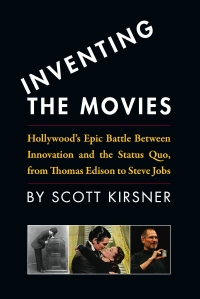
Book Review: Inventing the Movies

A while back I finished  (deep breath) Inventing the Movies: Hollywood's Epic Battle Between Innovation and the Status Quo, from Thomas Edison to Steve Jobs (exhale), by Scott Kirsner but never got around to posting about it in any detail.


The book is entertaining for anyone in an interest in business, in film, and in how technical innovation affected the business of film and vice versa.

For those with a vested interest in a similar space, such as gaming, the book is a must read. The parallels of history repeating itself are numerous and uncanny in their similarity.

A couple random examples: 
  • The reluctance of film editors to adopt digital editing systems and cinematographers to adopt digital cameras, have some parallels to the NIH reluctance we saw around the adoption of game engine middleware.
  • The concerns some have expressed about consolidation of distribution into the hands of console owners (see here and scroll down to Burning Mad) is similar to that expressed when studios locked up all the theaters and controlled distribuiton that way (pay attention MS/Sony/Nintendo - that one ended in a DOJ consent decree)
  • Many, many cases of elitism by the established players poo-pooing the new media and those quick to move to it. Pick your favorite EA, MS, Sony quote dissing casual games a few years back, or free-to-play biz models, or whatever.
  • Movie vendors said "no one will want to watch movies on a screen that small!" about TV, then about portable DVD players, then iPods. I hear the same thing about games on phones, iPhones, Netbooks, etc.
Anyone with time spent in the games business will see parallels upon reading Kirsner's book. The question, of course, is how to avoid falling into this trap of repeating history. First step, the easy one, is to know it, and this book is a good start. The harder step, is to be aware of which side of the fence you are on: Innovator or Luddite, and take a good introspective look on whether you've really assessed things objectively, or whether you sit too far to one side or the other.

Kirsner has a good blog where he continually covers this stuff, located here.

Thursday, October 23, 2008

I can hear the future calling...

... and it speaks silently.


More or less equivalent to where desktop voice recognition was ~15 years ago. 

Awesome.

Monday, February 25, 2008

Seer

My friend Dean forwarded me this:


I was jazzed when I got Lasik, but now I'm itching to upgrade!
Futurebunny! How I envy thee!

Thursday, November 15, 2007

Gaming and Worst Consumer Trends

So minutes after posting the Bronfman quote and saying we should take heed, this came across my desktop:

DRM, Fanboys, Region Encoding among PC World's "10 Worst Consumer Tech Trends".

Of the 10 sins cited, the games industry hits on the majority of them. Some of course, are an artifact of business and of other industries as well (e.g. licensing fees around GH tracks). However, a couple of them really resonated.

#7 Region coding: I know there are business reasons for it, and that there are sometimes technical reasons for it. That doesn't change the fact that it's a kick in the teeth to the consumer who just wants to play the game you didn't release in her region.

#1: DRM: Amen. I *really* don't know the solution here, but man, we need to figure it out. One look at the writeups for the PC version of Bioshock vs the Xbox360 version, and you know we have a problem.

Tuesday, February 6, 2007

Web 2.0 - The Machine is Us/ing Us

Everyone on the web will link to this, because it's the most concise explanation of Web 2.0 seen to date, and is entertaining and inspiring to boot.


Friday, January 19, 2007

Rip, Mix and Learn: Technology's impact on education

Last night the Bellevue school district had one of a series of 'roadshow' nights that they do, to talk to parents and the community about stuff going on in their schools. Last night's event was about the use of technology in schools, and since the twins will be in Kindergarten in the not so near future, I thought I'd attend.


I had extremely low expectations for two reasons. First, because generally speaking, we are priveledged enough to work in an industry of very smart people, the caliber of presentations 'out in the real world' is often lower than that which I'm used to (e.g. city council meetings, homeowners association meetings, etc, are normally like pulling teeth to me). Secondly, because my history of use of computers in schools has been that they are outdated, underused, and that the staff is usually so inept at using the technology, in comparison with the students, that it ends up being relegated to the simplest uses, or in dedicated 'computer class' type uses.


I couldn't have been more wrong. I was just *gobsmacked* at what I saw. A few examples (not all of these are in every school yet, but they are agressively rolling them out):


  • Their whole curriculum is online. The publicly viewable one (here) is just high level, but the one behind the firewall that the teachers use has every lesson, every exercise, and all that will be parent-accessible within the next year. Even just the high level helps parents better understand what their kids are working on, but long term, it means things like report cards are obsolete because you can get a snapshot of your kid's progress as often as you want, instantly.

  • Smartboards installed in every classroom. At first I thought "ok, it's a high tech blackboard", but these projector/touchscreen combinations are being embraced by teachers who are devising custom lesson exercises that use the technology. I saw one teacher demonstrating her dynamic editing of a sample book report, circling and dragging and dropping sentence fragments to let the class try different approaches, saving off two different versions and putting them side-by-side to compare, etc. At the very least, it's a massive timesaver (no more waiting 5 minutes for the teacher to write out the lesson on the board), but more importantly, it adds interactivity to the exercises.

    (crappy cell-cam pic of the smartboard - no, the class isn't in a darkroom -that's my phone)


  • All of these custom lessons and exercises that teachers come up with, they can save up on the web as custom materials for that class unit, and then any teacher teaching that unit can grab it, improve on it, and use it (think of a giant version of this). They gave me an example of how teachers are using this between units, where an art teacher one day decided they'd do art about their science topic, went over and looked at that day's science class exercise, which was about bugs, and said "ok, let's take those bugs you saw in your last class and see if we can do drawings of them in nature", borrowing the materials from the other class as a starting point.

  • Teachers can choose to record whole lessons, or just segments or excercises, and put the whole video on the site. Once parents have access (next year), they'll be able to better help kids with homework, catch up from sick days, etc.

  • 'Student Response System': Think of TV game shows "everyone in our studio audience, use your buttons to vote NOW!". Teachers can turn any question into an impromptu survey, displaying the results on the screen ("ok, only half of you got that right, maybe we should go over that again"). Kids can click their answers in from their desk.

  • Document cameras, so that if a teacher sees a student taking a novel approach at solving a problem during an exercise, she can grab the document, put it up on screen instantly and say "let's all look at how Susie did this...". Also useful to demonstrate details of an art or science project without the 20 kids crowded around the teachers desk.

  • I even saw a new music class they are adding to the curriculum in which they use SW to do composition, both of the traditional variety, as well as using Fruityloops to have kids do their own electronica type stuff.

Overall, I was really impressed. With my generation's teachers, I remember feeling that they were getting access to technology but had no idea how to use it (remember schools saying "we are getting computers this year." but there was no talk of implications?). In contrast, I felt that with these teachers and administrators, there was a palpable sense of passion and excitement about the opporunity before them; that they'd just started to grok the possibilities before them, and couldn't wait to put it to use and push the system to it's limits.

I'm fully aware that this level of tech in public schools is probably the exception, not the norm. It can't be just coincidence that it falls within the Microsoft campus 'blast radius of money'. Regardless, if this type of thing proves effective, other schools will adopt the same technologies and approaches. It improves the speed and effectiveness of teaching which at the end of the day is a good thing.

More importantly, it is, more than ever, empowering teachers to contribute to one another's teaching. It's putting teachers behind the wheel... and this schoolbus is supercharged.