Showing posts with label Consoles. Show all posts

Tuesday, September 18, 2012

Console Volumes over time

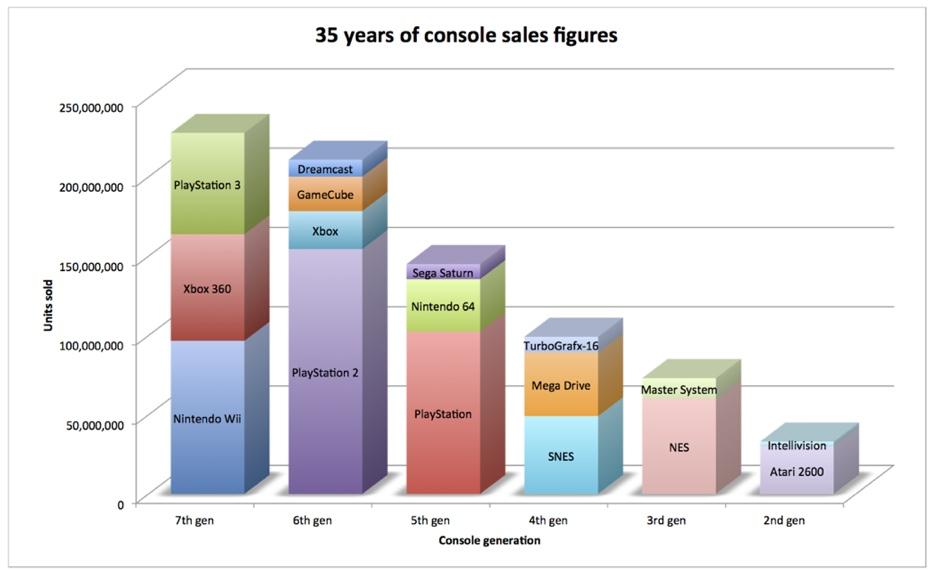
Martin Hollis tweeted a link to this very nice graph comparing the console "Generations" and their total unit volumes:


It's a nice graph, despite the chronological order being right to left.

It's a rough swag to group by generation as it is, since launch dates and end-of-life dates have only some alignment. Since some liberties were already taken, and I was curious, I did two things:

- Aligned the generations by date, picking a rough data for "mid life cycle"
- Normalized to 2010 numbers for population size. I used the sum of US, Japan, UK, France, Germany, as my proxy for "first world", as that's where most consoles are sold anyhow.

The resultant graph looks like this (going left to right with time)


Sort of more telling I think. Question is whether the current plateau is an anomaly, or whether we've saturated the market for consoles. A good second question is what this would look like if you removed the portion of Wii sales that were "fad customers", and whether that's fair to do in trying to preduct the next gen numbers.

Anyhow, food for thought.

Wednesday, May 25, 2011

Does LA Noire represent the next 3 years of AAA game innovation?

I started playing through LA Noire a few nights ago and am digging it thus far. As Red Dead Redemption taught me, the combination of Rockstar's immense game worlds and my limited gaming time, I won't likely finish it until sometime in 2012. Still there are a few initial thoughts I thought worth writing up.

The game doesn't have me *loving* it yet. Not in a Portal 2 (which I loved start to finish) kind of way, or even in a Red Dead Redemption (which I had 'moments of swooning' for) kind of way. That said, I think it offers some interesting hints on future direction.

LA Noire is very much a Rockstar game. Like both GTA and RDR, it offers a large 'open' world, many side-quests and missions, in-game mini-game type activities. The story is - so far anyway, I'm only five cases into it -more linear than GTA and RDR.

Still, there's no reason that this game needed to be anything other than 'Grand Detective Auto', just as many people labelled RDR 'Grand Theft Horsie'. It could have been the good-guy version of GTA, with lots of cops and robbers shootouts in a late 1940's setting. And they'd have sold tons of it.

Still Rockstar chose to take a couple risks in straying from the usual, in trying to make not a cops-n-robbers game, but a detective game.

The first is that the game has an element of point-and-click-adventure to it. Searching crime scenes, finding bits of evidence, writing these in your notebook, and then recalling them at the right time later to solve a puzzle - these are all reminiscent of the best of early 90's Lucasarts titles. More in keeping with the theme, and more unique in today's market vs the plethora of shooters.

The second, and bolder, risk they took was in making interrogation a core element of the game. The facial animation that's been much talked about, together with what must have been a massive spend on voice-and-mocap acting, were needed to add a more innovative - and thus risky element to the game. The game asks you to interview witnesses and suspects, and then lets you decide whether to believe, doubt, or accuse them of lying. Doing so requires that you look at the evidence you've got thus far, as well as reading the characters faces and body language. In doing so, it not only bumps into the uncanny valley - it throws the player headlong into it. Is it perfect? No.

I don't like the way this guy avoids eye contact!


The interesting thought to ponder here is where Rockstar chose to invest and/or innovate.

It certainly feels like we're near the asymptote on performance that can be extracted out of the current generation of consoles, and next generation isn't coming until (depending who you beleive) 2014.

That means another 3 years or more of making AAA titles, in which the publishers/developers need to garner interest in their titles, and they can't use screenshots alone to do it.

So, what do you do if you are trying to make money in this space. Well, for one, you focus on efficiency. Aside from that, you invest in content production (like all the voice acting in this case, and the more detailed facial models), and in innovations in gameplay (like the lie detection element; or the revisiting of point-n-click adventure).

I think this is a good indication of how others will be spending their money too. Production quality, art, and innovation in gameplay. I hope we'll see more big budget titles with experimentation along these lines over the next few years. Kudos to Rockstar for taking these risks.

Tuesday, November 23, 2010

Several good reads this week around the web

A few good finds this week to read over your morning coffee, or over turkey hangover:


  • Tim Berners-Lee (inventer of The Web) in Scientific American: Long Live the Web: A Call for Continued Open Standards and Neutrality. A lengthy dissertation on open standards vs walled gardens, Net Neutrality, and Electronic Human Rights. Much of it covers known problem, but it's good to see them called out so eloquently.
  • iReaderReview has a piece examining What Impact are Kindle Exclusives Having. There are some parallels with games here. In a crowded market like books (or, say, small downloadable games), does having an exclusive on even a significant number of titles make any difference for the platform's appeal.
  • Gamasutra has a good piece up on Console Hardware Trends in the Bundle Era. I find the title a bit misleading, and would rather label it "Hey Guys, how goes the mid-life booster rocket?". Title aside, though it's interesting. The table of 360 HW sales by month is interesting, showing 2010 to be a banner year thus far, and that was BEFORE the Kinect and its bundles launched.
  • Good CNET piece on Netflix's Secret Sauce for Acquiring Content. Good lessons here on being a good partner.
Go read! Discuss!

Thursday, September 4, 2008

The OTHER consoles.

Quick: How many consoles are there on the market?


Chances are, if you are a gamer, you either answered 3 (PS3, Xbox360, Wii), or maybe 5 (if you included PSP and DS handhelds), or maybe 7 or 8 if you dipped back into previous generation consoles that are still selling titles (PS2, GBA, etc). What if I suggested there were another few that you probably didn't think of? Hold that thought.

GameSetWatch had an interesting post up the other day about how the core game development community, and gamers themselves, are all too ready to dismiss games that appeal to a specific niche; especially when that niche doesn't include them. The post was in reference to Christian themed games, which I agree, are all too often dismissed by the general fan populace in the same way Christian rock is by mainstream rock fans.

The problem's not unique to this niche. We see it elsewhere too. Raph Koster, myself, and others have commented on how we as an industry are too quick to dismiss the kids MMOs when we in fact can be learning from them. And it really wasn't very long ago (2005-ish) that "casual games" was spoken with a sneer, and disregarded as not really games and not really a business. Opinion has shifted on both of those - to a point.

And when it comes to consoles, to most of the folks in game development, what springs to mind is a Wii or a PS3 or a 360. It is not this:


photo.jpg

That's my son Tom trying out a Fisher Price SmartCycle at the ToysRUs. It's a game console, it sells for $100, and it runs cartridge based SW (much of which is based on licensed IP) that retails for $20 or so a pop:


photo.jpg


Now the "fitness" angle is new and pretty interesting, but this certainly isn't the first or only game console for kids.

Leapfrog has a range of devices for different age groups, but the most popular is their flagship product, the leapster, which is still selling, and was introduced in 2003. It's had a number of features and sku's added, but is essentially the same platform as when it launched.

They just recently launched Leapster 2, which is smaller, more powerful, connects to the PC as well, and links via the PC to an online world where kids can share their content, get rewards for making progress in games (achievements-esque).

I'm not suggesting that everyone run out and write games for the Leapster. I don't think the market's there to sustain that many titles. I do think, however, that we could all benefit from having slightly wider peripheral vision. 

Looking at the features creeping into the HW and SW of these things, they are clearly learning from us. Are *we* learning from *them*?

Friday, February 15, 2008

The (repeatedly false) reports of the death of PC Games

Over the past five years, I've read what have to amount to hundreds of articles, blog posts, analyst reports, etc, on the future of PC games, declaring them either dead, or alive and well.

The reality, of course, lies somewhere in between, or that they are both true, depending how you look at it.

This article by Rob Fahey on GamesIndustry.Biz, is the best article I've read on the subject in a long time. Rather than go for the sensationalist tactic of taking one side or the other, he paints a more accurate, nuanced view of reality:

For once, this isn't the cyclical question of whether consoles will kill the PC market - a question asked so often, and answered with such an emphatic negative, that it finally seems to have fallen out of the industry's discourse, and good riddance. Rather, it is a genuine desire, both on the creative and financial sides of the business, to understand just what shape PC gaming is going to take in the coming years.

For a long time, it was simple to categorise PC games as "hardcore", with console titles seen as more casual. It wasn't a division that was entirely accurate, but it was close enough to the mark to be useful - for a while, at least.


That's simply no longer the case. While the PC still plays host to some of the most hardcore gaming genres, such as massively multiplayer games, realistic flight simulators and real-time strategy titles, a huge new market of ultra-casual games has also opened up on the platform.

It's a good read, especially for those that aren't close enough to the business to get a sense of both side of the story.

Saturday, January 5, 2008

Holy Hockey Sticks!

Casey just pointed me at this:


Holy balls.

For all the poo-poo'ing of the PS3 (I'm as guilty as anyone), you have to give them credit for chugging along and selling units as well as 360 did through launch, despite being last 'next gen' console to the party.

Nintendo's graph is, well, phenomenal. For them anyway. Whether it's good for *games* in general is debatable. They get credit for tapping the untapped segments of the market, but I still agree with Chris' rant on the console's shortcomings.

Sunday, December 23, 2007

Hacker Wiizardry

Apologies for the title. I am as prone to Wii-puns as the rest of the blogosphere.

A number of people pointed me to Johnny Chung Lee's youtube vids. Lee has done some interesting hacks with the Wiimote, and posted vids of them along with explanations. They include:

Interactive Whiteboard:


Minority Report-style finger-tracking:


VR headtracking:


These are all very cool, yes. But the real lesson to take away here is that this is what happens when you base your products on open standards (Wiimote uses bluetooth to communicate). This in turn is predicated on not selling your HW at a loss, which means you have to be damn sure people aren't using it for something other than its intended purpose, but that's the subject of another post...

One does wonder whether the folks at Nintendo are benefiting from these vids in some way. If I were them I'd be replicating the experience and doing some game jams around them to see if they have legs.