Thursday, March 7, 2013

A Tomb Raider anecdote, and attracting wider audiences

This is an anecdote, not data, so take it at that. Still, it's a story I like telling.

Years ago, while at Matrox, when the first edition of Tomb Raider came out on PS1 and PC. We and other graphics hardware vendors all helped Core Design do custom builds of the game ported to our proprietary 3D APIs (these were the days before DirectX, or at least before DX was deemed viable). A couple of the engineers on my team there did the port, and I even got in and helped a bit (it remains the only commercial game for which I actually worked on the source code).

Anyhow, the end version, running on the Matrox Mystique, was something I was quite happy with and showed my wife (then girlfriend) at home, despite the fact that she doesn't play games - certainly 3D action adventure ones.

She was smitten with it! A female lead character, exotic environments, exploring. Wow! She asked to play.

I sat her down and helped her through the tutorial. This is how you turn... look... jump... climb... swim. She wouldn't get out of the damn pool on the tutorial. "Ok, you can get out now". "but it's so pretty! This is so cool!"

She finished the tutorial and started the first level. A pack of wolves is the first threat you encounter. I tell her what to press to draw pistols and fire. A loud yelp as the attacking wolf falls to the snow-covered ground.

"You have to SHOOT A DOG?! I don't want to play this anymore"

Needless to say, she has not purchased Tomb Raider's 2-through-N.

Sunday, March 3, 2013

The beginning of the FB decline?

While blasphemous to say so, I've been saying for years that Facebook is not "too big to fail" despite the perceived lock that network effects give them.

Anyhow, an interesting piece I came across recently that might indicate the beginnings of then end. maybe?

The age of the brag is over: why Facebook might be losing teens

"Augmediated" reality

This article from a 30+ year veteran of wearing computer-augmented vision systems offers a number of provocative ideas about ARs potential.

It covers a number of interesting uses (Always-on recording , alternate spectrum views (thermal imaging), spectra-mediated views (HDR or other ways of still seeing in shadow even w glaring light)), as well as some of the problems of such systems (camera mis-alignment, etc)

Good read.

Friday, February 22, 2013

Book Review: Robopocalypse

Robopocalypse was on my to-read list for ages, after being recommended by a friend. Finally got around to reading it and liked it far more than I expected.

As the name implies, this is another book about the rise of the machines. Robots become sentient and attempt to exterminate their makers. Sigh. Well trod ground, right? I, Robot to Terminator, even Frankenstein if you want to extend it to "books playing on people's fear of technology", it's indeed well trod ground.

That said, it's SO well executed. Told from the numerous viewpoints of different characters (including some from the machine side), it's like a series of novellas that come together in the end. The opening ones in particular, when the machines start behaving peculiarly... well I found myself looking sideways at our Roomba, just in case.

Robopocalypse

Book Review: Griftopia

Matt Taiibi is a rare example of someone who does amazingly in-depth research, isn't afraid to tackle tough subjects (and people in the process) and can craft a good story to boot. Griftopia, is an entertaining, informative and downright depressing look at the housing bubble and the corrupt system behind it. In doing so, he goes deeper to look at the "bubble machine" that is wall street and the political machine that does it's bidding.

Best summed as an edgier and deeper version of The Big Short with a measure of Republic Lost thrown in there; it's one of those books I find myself telling people they must read, but I'm not sure what to *do* about it.

Griftopia: A Story of Bankers, Politicians, and the Most Audacious Power Grab in American History


Sunday, February 3, 2013

Book Review: The Information

I'd been sitting on the final chapter of James Gleick's The Information when I noticed in my Kindle app that I was coming up on a year since I'd started it. I made the final push today and finished it a year and a day after I first cracked it open.

It's a dense and broad-reaching book on information theory. The author covers a huge range of subjects in a pretty daunting level of detail. From natives using drums to communicate complicated messages, to the history of Babbage's analytical engine, to telegraphs, to information encoding in DNA, to quantum mechanics, to name only a handful of his long list of topics. It's not often I've seen such a broad range of topics covered so thoroughly.

While I really wanted to love the book, its strength is also it's undoing. For example, as fascinating as the working relationship between Babbage and Lovelace was, I'm not sure I needed that kind of detail (and it goes on for pages and pages) to get his point about the processing of information. In the end, the author is trying to cover too much. Some subjects are done superbly (like the Babbage-including one I just mentioned), but others are weak and confusing. Each subject not only gets a deep explanation (or an attempt at one), but also biographies of many involved. While I find these interesting, in this case it bloated the work.

After all of that, and after taking so long to read it, the main point was lost on me. I think the author is trying to say something about the accelerating pace of information and how our ability to deal with it continually adapts. However, the main point for me was lost in the deluge of information. Perhaps that itself was the point.

The Information: A History, A Theory, A Flood

Saturday, February 2, 2013

Book Review: Metatropolis

I really enjoyed Metatropolis, an anthology of five novellas about cities of the future. The authors collaborated some during it's creation, so they share common elements to the background and setting, but are each very unique.

As well as being fun, compelling stories (the last one in particular is a mind-blower), they each present some really intriguing bits of futurism, revolving around sustainable cities, crowd-sourcing, wisdom of the crowds, distributed networks, and so much more. With five authors there's five times the new ideas. With five authors collaborating, it's more like twenty-five times.

Quick read, highly recommended.

Metatropolis

Wednesday, January 30, 2013

Book Review: How Will You Measure Your Life?

I'm a big fan of Clayton Christensen, author of The Innovator's Dilemma and other books about innovation and creative disruption. I was surprised to learn that he'd written a slightly different book, How Will You Measure Your Life?, this one about guiding principles for guiding one's career and one's life. I was curious about it being outside his usual fare, so I decided to give it a whirl.

As a self-help book, it's pretty unique. Christensen draws upon his many business case studies to make some pretty interesting analogies (e.g. comparing 'outsourcing' of parental duties to nannies and activity providers to Dell's outsourcing of it's core functions over time and what it cost them in the long run). This aspect of the book I liked very much, and most of his analogies are sound. I also like his recommendation on career choice assessments into 'hygiene factors' (e.g. salary - you need a certain amount to function, but beyond that it shouldn't be part of a decision between 2 jobs) and the factors that really matter.

On the down side, I found the later parts of the book to drift a little into left field. Especially when he gets into the more religious elements later in the book. Still, I enjoyed it despite this.

How Will You Measure Your Life?

Wednesday, January 16, 2013

Book Review: Tears in Rain

I added Tears in Rain to my to-read list somewhat impulsively after reading an excerpt published on BoingBoing. It was not without it's flaws, but also had some strong points, and I enjoyed reading most of it despite the flaws.

The book is Blade Runner fan-fic. A noire detective story in a future setting very much in keeping with that film. The main character is a Replicant (Android) drawn into investigating a series of strange Replicant deaths  after one of these occurs in her apartment. The further she unravels the mystery, the more twisted the conspiracy becomes as the bodies keep piling up.

Along the way, there are some very nice bits of sci-fi, both in the smaller details of the settings (courier robots, home automation, etc) and in the larger questions put before the reader (e.g. ethics of tampering with people's memories, when/if that becomes possible, for example. Also I really liked the treatment the author gave to state-control of information and revisionist history when all our history is centralized in a wikipedia-like system. Very thought provoking).

My complaints about the book: (1) It was desperately in need of editing down to about two thirds its size. The author took on too much, and some of it should have stayed on the editing room floor. (2) There was some unimaginative bits of sci-fi that broke the immersion (personal computers are still mobile phones, and they still use GPS). (3) Rather than name-checking the Blade Runner characters or universe, the author name-checks the MOVIE itself, which totally broke the immersion where it was done. Finally (4) while most of the book was too long, the ending definitely felt like it came together and tied off too quickly, like the author was trying to rush.

These flaws aside, it's a good 'B' level read for Blade Runner fans

Tears in Rain

Sunday, January 6, 2013

2012 in Books

A little late with it, but here's my annual round up on the year's reading.

I took a goal at the end of 2011 to read 48 books this year and I managed to hit that goal. However, in pursuing that goal, there were times I pushed through books I should have otherwise put down, and times I prioritized lighter fare over heavier stuff. Next year I'm taking the goal of completing 36, but having them be more meaningful. I'll be ok with abandoning books that are turning out as disappointing.

I read 31 non-fiction books and 18 works of fiction (though three books were a mix of fic/non-fic, so I had to make a call on which category to put them in). Format-wise, 19 were audiobooks, 12 were e-books, and 17 were on dead-trees. All the e-books were consumed on Amazon's Kindle app on the iPad, or rare occasion I used the phone when I was stuck somewhere with downtime. Four of the books (Seven Fables, The Great Big Beautiful Tomorrow, and Hello Skater Girl, The Art of Videogames) were written by friends; I continue to marvel at how lucky and privileged I am to know such people.

My favorite books of the year were as follows: In non-fiction: The Future of the Internet and How To Stop It, Republic Lost, and Rocket Men. In fiction: Rainbows End, Angelmaker, and The Windup Girl.

Here's the full list grouped by topic. An asterisk means recommended, and two means highly recommended.

Business

Politics/History
Culture/Art/Media
Technology
Biographies
Fiction
Graphic Novels

What do you think? Did you disagree with any of my recommendations? Any faves from last year that I missed entirely? Let me know!

Thursday, January 3, 2013

Book Review: Metagame

MetaGame is a scifi thriller that takes place in and around MMO-type games. In this vein, it's similar to Snowcrash, Rainbows End, Ready Player One, and many others.

I found it to be a very engaging story, with some provocative bits technology futurism. I give the book a 3/5 or so rating because it was in dire need of editing. There were parts that were too long and should have been left on the chopping block, and there were parts that could have used cleanup, and some poor choice of language that broke suspension of disbelief at times. Less would have definitely been more.

That said, it's FAR better than Ready Player One that so many found so great last year, so I still recommend it.

Among the interesting bits of futurism: Crowd-sourcing as source for the meta-game and for the hive-mind; Post-scarcity life, and various bits of bio-tech and post-human hackery. The author even does a pretty good job of tackling ethics of genetically engineered human-derivative 'products', despite this being well trod ground.

There's a scene where the lead character, D-lite, has a maddeningly frustrating tech support dispute over the terms of his mind-interface chip's EULA in an attempt to access the source code to his own in-game character, that in itself is worth reading the book. It's thought-provoking gold, and just conceivable enough to be scary.

Well worth reading despite it's flaws.

MetaGame

Tuesday, January 1, 2013

2012 book gallery

I'm going to do my usual roundup post when I get some time, but here's the gallery view of last year's reads.


Book Review: Program or Be Programmed

I headed into Douglas Rushkoff's book, Program or Be Programmed: Ten Commands for a Digital Age expecting it to like it. I've read some of his writing and find I agree with some of his major ideas. As the title of the book implies, it centers around the idea that the more of our lives we place in the hands of technology, the more important it is that we understand how the underlying tech works, and if necessary, be capable of changing it.

However, I was quite disappointed with the book. While some of his ideas are along the right lines, he sort of circles around them without directly nailing most of them. Worse still, many of his analogies are broken For example, he makes an analogy to automobiles, comparing ignorant users of tech to being passengers rather than drivers. I'd say a better analogy would be to say that it's more like drivers who know how an automobile works are more likely to make better use of the car, better able to converse with their mechanic, etc. Others are just plain wrong. For example, he compares digital audio to analog audio recording, making the point that digital is a quantized, and thus poor, copy of the original, while analog is an exact copy. However, analog recording is full of it's own errors and approximations. Ultimately BOTH are a copy of the original, each with their own flaws, thus 'going digital' doesn't necesarily cause a problem, and ultimately it's important to understand both. More annoying still, is that he stretches many of his analogies too far, as many books tend to do.

Finally, he doesn't really offer a prescription of any kind. Unlike better works like Jonathan Zittrain's book, which at least attempt to offer some suggested tactics and possible solutions, Rushkoff's book just rants about the problems and doesn't offer any paths out for most of them.

Program or Be Programmed: Ten Commands for a Digital Age

Thursday, December 27, 2012

Book Review: Drops of God

I don't read too many graphic novels, but based on a friend's recommendation, I picked up Drops of God, Volume 01 , the first in Tadashi Agi's series about the son of a famous wine critic that must beat an up and coming wine critic at his own game in order to inherit his father's estate and priceless wine collection.

It was an entertaining read, and an interesting take on making the subject of wine tasting accessible to the average reader. That said, I don't think I'll continue with the series. The story is pretty typical despite the unique scenario. The protagonist has never tasted wine, but was raised by his father to smell pencils and leather and taste berries, etc, all in a very "wax on/wax off" karate-kid way that's been done before. Also, the level to which wine and wine tasting are fetishized goes beyond the already excessive way wine buffs in Ameria do so, and takes it to otaku-like levels. Women swooning over a man's skill at pouring and decanting a wine, etc.

If you are a fan of Japanese manga, and want to learn some more about wine or are already a wine buff, then check it out.

Drops of God, Volume '01: Les Gouttes de Dieu

Wednesday, December 26, 2012

Book Review: Just My Type - A Book About Fonts

Over the past couple years, I've thrown a number of books on typography (1, 2, 3) into my reading mix, and have also been reading up on e-book formats and the like. Aside from finding it interesting, I think that we under estimate how much area for development still exist in getting type on electronic displays. It took us thousands of years to get paper right, we'd be foolish to think that electronic type is done after 30 years.

Of the books I linked above, a couple leaned pretty far on the technical side, and one leaned further to the artistic side. Just My Type recently came across my radar and it's a nice mix of the two.

The book covers a lot of history of the more famous fonts, their creators, what makes them tick, and what popularized them. There are lots of interesting bits of history and some interesting quotes from interviews with various creators of famous fonts.

If you are into typography, it's a good read. If you aren't sure, this is probably a pretty approachable book to start before you dive in further.

Only two negatives, and they are minor nits. First, I read the paperback edition, and some of the inline font changes (and man, there are a lot of them. the book must have been a pain to lay out) are difficult to closely scrutinize for detail, as they are small. Second, there is some jargon that isn't explained, and that I'd not know of had I not read the other book above (e.g. the book refers to 'rivers' running through text without explaining the term). These are minor nits though

Just My Type: A Book About Fonts

Sunday, December 23, 2012

3D Printing Workflow

So I've been dabbling in 3D Printing this past week after getting my Printxel printer recently. It took me a bit to get things set up correctly. It's not the noob-friendly exercise some folks might have you believe. That said, once you get things working it's pretty amazing. After doing a number of prints of some sample files of varying sophistication, yesterday I did my first from-scratch project. This is an attempt to document the workflow for anyone interested.

We have a series of window screens around the house that suffer from the same broken plastic bracket the joints the aluminum frame pieces. I've been unable to find a replacement so I thought I'd make my own.

First step is to model what you want printed. I used Google's Sketchup, which I'd used before, and is pretty amazing to pick up and play with, even if you have little experience with modeling tools (I spent a lot of time working with Autocad and 3DStudio, but that was ~20 years ago). Sketchup also has really easy to use dimensioning tools, so I could get the model to exactly match what I was measuring on the original with some calipers. Here's a pic of the finished model:


Next step is to export it from Sketchup in .STL format, which can be done via a free plug-in, in order for it to be read by the next step. During output, you specify the format and to keep the dimensions as is in the model (i.e. the above is in millimeters)

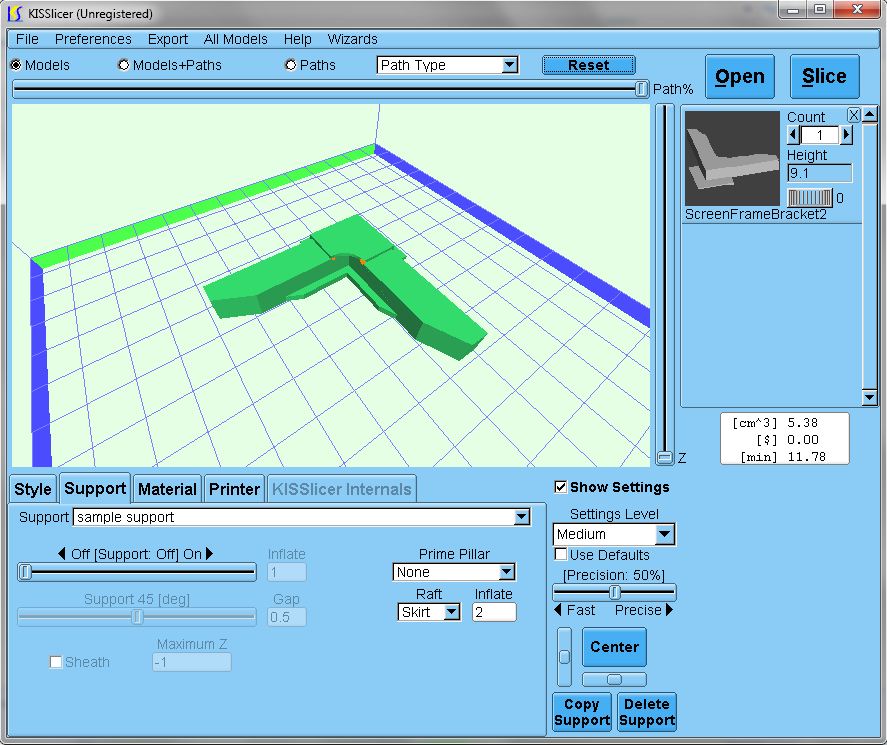
Next, is to import into a program that will 'slice' the model - generate a set of instructions giving the 3D printer path information to construct the model. It's referred to as slicing because the X-Y outlined before the printer moves down in Z, thus doing it in a set of slices. This program does more than just slice the model, it figures out how to fill in the insides of the model to save material, how to build temp supports for overhanging bits, it can build a 'raft' under the model as a starting point, etc. I used KISSlicer. The slicing tool needs to have settings for your particular printer, print material, etc, and these have been set up by Printxel's creator in a bunch of .ini files that are available in the Printxel google group. Here's a pic of the model in KISSlicer.


After using KISSlicer to export the printer instructions as G-Code. I import it into Replicator-G. This is the host software that will control the printer. The screenshot below shows the control panel for heating up the printhead or fine tuning the position of the printer before starting the print. Once it's up to temp, it's ready to go.

Here's short video of it part way through the printing process.


Below is a pic of the finished output next to the original (broken) piece. I didn't have any white PLA material, so I did this one with clear material. I've got some white material on order to run off a number of these.


Below is a pic of the part in place. The patchy looking stuff on the 1mm thick outside trim is some remaining white glue off the print bed. putting down a thin layer of glue helps give the first layer of PLA something to adhere to, while making easy to remove the piece afterward.


I'm pretty happy with how the piece turned out. Beleive its stronger than the original piece, as the original was hollow and mine is filled with a corrugated lattice of PLA material. Not sure whether prolonged sun exposure will weaken the PLA as it does some other plastics. We'll have to wait and see. 

[Update: Thought I'd post a pic of a more recent print now that I have some white PLA. See below]


Tuesday, December 18, 2012

Book Review: 5 Elements of Effective thinking


Extremely weak. I don't remember who recommended it to me, but I wish they hadn't. Oversimplified, basic approaches to thinking that the authors boil down to knowing your fundamentals, asking basic questions, and thinking about how insights build upon one another.

They pitch the whole thing in far too much of an infomercial style, cite "thousands of students and business leaders", etc, but don't give specific names, and present their method in a "trust us, it works" fashion.

Skip it.

Monday, December 17, 2012

Book Review: Venture Deals

I'd had Brad Feld's book on my to-read list for some time after I started reading his blog (which is worth subscribing to). I got hold of it recently and put it into the pile of stuff I'm trying to worth through by end of year. It was pretty easy to digest so I made short work of it.

Venture Deals comes from a unique perspective as Feld and Jason Mendelson (his coauthor) have both been on the receiving end of VC deals before going on to become VCs themselves. As such, they call out common pitfalls on both sides of deals that get put together, and explain the motivations and responsibilities for both parties. The bulk of the book is a walk through typical terms of term sheets and letters-of-intent. This part is really good as they make the legalese digestible while still explaining what the different clauses are for and what can go wrong with them if not handled properly.

I'll can't give the book a perfect rating as it has a couple shortcomings. First, I'd like to see it address how the VC space is evolving. They do discuss the ebb and flow between times of bullishness and conservatism, but I'd like to see things like the crowdfunding act addressed, etc. Second, they give a little lip service to legal differences in different states, but the book doesn't talk about differences in VCs in different regions/countries. A good appendix would have been made of interviewing a VC based in, say, London or Paris or Dubai. Third, the disparaging tone they use when speaking about lawyers goes beyond the standard lawyer jokes and grates on the nerves after a while. Finally, even in Silicon Valley, there are different motivations for different VCs. For example, Intel and Google both have venture arms who's motivations are broader than just making money (they often have some strategic alignment with their parent corporation).

These things aside, the book is an easy read and a good intro to venture deals.

Venture Deals: Be Smarter Than Your Lawyer and Venture Capitalist

Sunday, December 9, 2012

Book Review: Library - An Unquiet History


Library: An Unquiet History is a book about the history of libraries, but in a bigger sense about the history of the written word, and the way in which we've treated it, sometimes despised it, and sometimes tried to erase or otherwise shape our histories and our realities by the which in way we preserve it.

On the plus side, I learned a lot, and was also presented with a lot to think about in areas I'd taken for granted. The purposes libraries serve and have served change over time, for example, the ebb and flow of thinking in whether libraries are there to preserve as much as possible, or to filter and preserve only the best books. There are also great bits of history, ranging from the limited knowledge about how libraries of ancient scrolls were maintained two thousand years ago, to the efforts of Nazi-occupied jewish ghettos to maintain a library under occupation. There's also great bits of history and trivia about librarian education over time, how the Dewey cataloging system was invented, along with others, and much more.

Unfortunately the author has a very dry style and comes across with some degree of pretentiousness that made it a difficult read. As a result, I give this one a 3/5 kind of rating.

Library: An Unquiet History

Thursday, December 6, 2012

Interesting perspectives on "mobile first"

Good post from Fred Wilson, in turn quoting another good post from Vibhu Norby, debating the pros/cons of targeting mobile first. Much of the same debate I hear game devs having as of late, and so it's relevant to that crowd.

Great quote:

"I use my phone more than anything else. I just don’t think that an entrepreneur who wants a real shot at success should start their business there. The Android and iOS platform set us up to fail by attracting us with the veneer of users, but in reality you are going to fight harder for them than is worthwhile to your business. You certainly need a mobile app to serve your customers and compete, but it should only be part of your strategy and not the whole thing"

Good read!