Tuesday, November 27, 2012

My Game Developer Magazine Business Columns

I just realized that a few of my columns for GD Mag's business columns are available online, so I thought I'd put together a list of them here:

[update - added link for December]

December 2012: A retrospective on the year's business trends and on future directions

October 2012: On Crowdfunding and "Emotional Equity"

June 2012: On the Kickstarter Goldrush

April 2012: On the PC vs Console cycle of life, and whether that cycle is broken

March 2012 (requires subscription) - On Copyright

January 2012  (requires subscription) - Some pertinent business books from 2011

November 2011 (requires subscription) - On digital distribution, efficiency, and who should benefit from that efficiency.

June 2011 - (requires subscription) wherefore art thou wikileaks


Monday, November 26, 2012

Book Review: The Mongoliad - Book 2

A while back I reviewed the first book of The Mongoliad and quite enjoyed it. I'm a huge Neal Stephenson fan, and another friend of mine, Cooper Moo, was involved in this project, so I was really glad to read it.

The Mongoliad: Book Two is not nearly as good as the first. As others have noted, it jumps between a myriad of plot lines with little of the tight interweaving that Stephenson is known for. In a series like this, without an end in sight, this can feel like drudge work to get through as we don't know if things will come together in the next book, or in ten more. My personal pet peeve is that it's not as tightly edited, so different parts by different authors are clearly varied in their pacing and quality, several of them suffering from the excessive use of adverbs and adjectives that feels like high school composition trying to up the drama but coming off as hammy.

That said, it has it's moments, and like the first, there are some great bits of sword-clanging and battleground strategy. These redeem it some, but only partly. I'll hold off on the third book and see in a few months if I'm still itching to get back into the series.

The Mongoliad: Book Two (The Foreworld Saga)

Sunday, November 11, 2012

Book Review: The Naked Presenter

Recently, I was exchanging email with a colleague on the subject of presentations when he brought up Nancy Duarte's books, which I'd read some time ago, and given a positive review to at least one of them. One of the books that came up was Garr Reynolds Presentation Zen, which I'd also liked. It turned out he had a more recent book out, The Naked Presenter, and so I decided to give it a read.

It's okay, but I can't recommend it as highly as his previous book or Duarte's. The book focuses more on the "Zen" aspects of approaching presentation preparation and delivery, and less on the actual mechanics of those things themselves.

This would be well enough, but I found many of the techniques to be high level and vapid compared to other works, and the metaphors to all things Japanese felt forced.

Like many of the more recent "pretty books" (Duarte's and Reynolds' both fall in this camp), the content is so blown out in favor of whitespace, quotes, and pretty pictures, that it's pretty devoid of content. What's there is not beyond what's already covered in the original book. It does try to get into the whole zen-mental-state thing, on approaching prep, on delivery, on handling a hostile audience, etc, but only superficially. I'd have liked to see some approaches to drills or to methods of rehearsal and the like.

In summary, the book is alright, but I'd recommend Duarte's Resonate or Reynolds' Presentation Zen over this book. If you like Reynolds' other book a lot, then you may enjoy this one.

The Naked Presenter: Delivering Powerful Presentations With or Without Slides (Voices That Matter)

Wednesday, November 7, 2012

Book Review: Screw Business As Usual

I'm a big Richard Branson fan-boy, and really liked his first book, Losing My Virginity (which I highly recommend). Since then, I've given a few of his other books a try. I gave Screw Business as Usual a try this week. It was very quick to get through so I thought I'd post a short review.

The book is about the idea that capitalism can, in addition to pursuing the goal of making money, attempt to do good.

On the plus side, it covers a number of interesting cases, some of which are Virgin enterprises, others just ones Branson has come across. It's a wide enough variety to give some creative food for thought, but little is provided in the way of detail if someone wanted to do some analysis of real cost/benefit, or map to their business to see how it differs, etc. Still, they are inspirational stories.

Another negative is that a number of his examples consist of things akin to 'I saw a problem. I called up Nelson Mandela, Desmond Tutu and Bill Gates and we got together and decided to start a foundation'. Some have complained that this is name-dropping. I don't think that's the case, so much as it's just the circles he travels in. However, the few examples that are along these lines aren't really helpful for anyone looking to do good with their business.

In any case, it's a good read with some unique perspectives that some will get value from. Start with Losing My Virginity though, as I think it's a better read.

Screw Business as Usual

Friday, November 2, 2012

Book Review: The Future of the Internet, And How to Stop It

After having it on my to-read list for some time, I got around to reading The Future of the Internet--And How to Stop It and am kicking myself for not getting to it earlier. It's great. It's well thought out and it's an *important* book.

I plan on writing something lengthier on my thoughts after reading it - It has spawned dozens of ideas for me - but here are some quick points.

In short, the book is about the trade off between Open and Closed systems - something I've written a fair amount about. He makes the point that Open and Closed lie on opposite ends of a spectrum. Open provides Affordance (the ability for systems to be used for purposes beyond their design) and Generativity (that they encourage or breed the innovation of these new uses). Closed systems provide Security, Ease of Use, and sometimes affordability (e.g. think razors/blades).

In many places in current day, the closed systems are winning because vendors and users don't take the long term view as to the cost to innovation.

The author goes on to show how this view of systems holds true for the internet at large as well as the endpoint devices. It then broadens into a larger discussion of everything from reputation systems to legislative solutions vs 'honor code' types of systems.

Is the book perfect? No. Many of the solutions, or at least solution directions, proposed are flawed (e.g. allowing programmability with security through VMs is not a solution so long as the owner of the VM platform or the platform under it are still closed). It doesn't matter though. If the book gets people even thinking and talking about this subject matter, then it's a worthwhile contribution.

Go read it. It's an important book. (also, a free PDF version is available here)

The Future of the Internet--And How to Stop It

Monday, October 29, 2012

Some good - but insufficient - ebook publisher suggestions

As an industry with more history than most other forms of media, the pain book publishing is going through in trying to transition to digital is quite fascinating to follow and something we can all learn from.

As we've seen with music, film, and games, publishers are not only trying to assert rights that protect existing business models (e.g. trying to curb piracy) but also are pouncing on opportunities to gain rights that previously they didn't have, or had lost (e.g. rights for end users to resell books; rights for libraries to lend books, etc).

BoingBoing last week linked to an interesting piece by Joanna Cabot, calling for a return to common sense. It's a good piece, and a good starting point for discussion, but insufficient on it's own.

The TL;DR version is that she calls for three things:
- If granting rights that are really more akin to rental/lease than ownership, then say so explicitly and don't call it "buying"
- Understand that books are purchased by households, not neccesarily individuals, and sharing among household members shouldn't be a crime.
- Understand that individuals want and need to move books between devices, so don't make it difficult to do so.

In short, she's calling for e-books to allow for the same things that paper books do. If I rent a book I'm expected to return it, and if I buy it, I can do with it what I want. If I buy it or borrow it, I can share it with other members of my household, etc. She is saying that e-books should not allow us to do LESS than their paper counterparts. I agree.

However, it's not enough to stop there. e-books should allow for far more. They should allow for quoting, sharing, promoting. They should allow for commenting and conversing with authors, critics and other fans. They should allow for augmenting metadata about the book, its settings or its author. Some of this stuff has more to do with the e-book's usage in other services (e.g. imagine virtual book club social network groups), and some about opening the format to others (e.g. metadata).

Some of this is publishers not getting that these things can ultimately sell more books than their piracy-paranoid policies are saving in lost sales. Part of it is them rightly being scared that ultimately their role in the ecosystem may be less needed than before.

I think that if conversations in publisher board rooms are focused around "how do we ensure they pay?" instead of "how do we make the e-version of this book the most engaging and valuable, and how do we make it reach the most people?", those publishers are going to lose. The forward thinking ones asking the latter question, they are at least thinking in the right direction.


Friday, October 26, 2012

Book Review: Some Remarks: Essays and Other Writing

Some Remarks: Essays and Other Writing is a collection of Neal Stephenson work from various places over the past two decades. Most of it is available elsewhere and much of it for free, but the book gives you a one stop shop for it all.

Those looking for Stephenson's thoughts on real-world technologies and issues will find much of that here. There's less of his short fiction here thought that exists a bit too. I found I'd already read about a quarter of the material elsewhere, but got some value out of the remainder.

Most of it holds up pretty well, despite some being pretty dated. There's a fictional piece about virtual currencies generated around crypto algorithms which is particularly prescient. Basically nailing the whole e-spying thing and envisioning Bitcoin... in 1995!

There's a VERY lengthy piece, though a fascinating one, about how data cables are laid down on the ocean floor between countries and continents. Fascinating but wow is it long. It was written for Wired originally. Did they not have an editor somewhere?

In the end, expect some thought provoking work, but one bloated piece and a few that don't hold up as well.

Some Remarks: Essays and Other Writing

Monday, October 22, 2012

Book Review: Angelmaker

I loved this book. Angelmaker is steampunk adventure with a noire flavor to it, in which a simple clockmaker, Joe Spork - made very much in the mold of Hitchhiker's Arthur Dent - happens upon an impossibly complicated bit of junk that turns out to be much more than he'd imagined. Its something that many people want and some of those people are not good people, and some of them are very, very bad. He is forced to become more than he imagines he can be to survive it all, let alone figure out what the oddity does.

It would be an imaginative romp at that, but oh, the characters. This is where the book really shines. Ruthless rule-bending policemen, a megalomaniac ruler of an asiatic kingdom, a gruesome serial killer,  a society of undertakers, every color of mobster found in the british underworld, mad scientists, faceless veiled monks, a band of octogenarian grannies turned torturers, and the most libidinous spy ever to come from pen being put to paper... these all come together for a fantastic adventure of the kind that makes you want to grab strangers on the street and tell them they must read this book.

There are some some serious things under all of this that the author is trying to say - about the erosion of civil liberties and granting of unchecked power in the name of anti-terrorism, and about the meaning of truth in dimensions. You can ponder these if you wish, or let them sail by while enjoying the ride.

A bit of trivia: The author, Nick Harkaway, is the son of John Le Carre, and when I learned this, suddenly the book's flashbacks to WWII-era and cold-war spy stuff seemed all the better. In some cases being reminiscent of Le Carre, and in other cases deliberately more fantastical. I've added his other two books to my to-read list.

The book takes a while to get going but it's worth it. The author takes the time to dial up the color and character on all of these pieces, so that he can set them all together into a tightly wound bit of story machine that goes off like clockwork.

Angelmaker

Sunday, October 14, 2012

OK it's over, but was it really a "Revolution"?

Here is a Good article by Tadhg Kelly that many others have linked to this weekend. While it's good and nails a few of the key trends at play, there's a couple things in the article that don't sit well with me. I'm not sure I can do much better, but here are a few points to consider.

Tadhg points us to the recent goldrush(es) around Social and Mobile games, specifically naming 5 trends (social customer acquisition, a 'price crash', distribution at scale, game metrics focus, and lower development cost (for mobile and social), and then goes on to knock on why each of those is coming to an end.

While he's correct about all five, it's the way they are lumped together that makes me a bit uncomfortable. In some areas they are trends affecting different areas entirely, in some areas with overlap, but by casting them all as part of this single "revolution", it's somewhat misleading.

In saying Social Stopped Working, he's correct that easy, exploitive viral channels were closed, and that customer acquisition costs went up - but it's unfair to dismiss social-viral potentiality altogether. e.g. Its a bit unfair to say that Words With Friends winning over Lexulous is entirely due to customer acquisition spend. There are design elements involved that make WWF a game with higher potential of distribution (e.g. they were quicker to add push-notification of turns, and have an end-game mechanic that leads to active-games growth)

His points about cost-of-entry going up (in terms of cost of acquisition and the points he makes about production costs) are right on the money, and are typical of any maturing market. We saw this happen in PC Casual, XBLA, heck, I remember a time when people used to say "4 guys in a garage can do it relatively cheaply!" about PC first person shooters. There's nothing new here. However, when lumping together to social vs mobile categories - what I view as two separate gold rushes with overlapping but different timelines and trends - it confuses the discussion somewhat.

In any case. It's a good article. The trends are real and should be considered when thinking about how they'll effect your business. And in the end, any attempt we make to classify them as a single market, or single trend or a single 'revolution' are all just definitions we're artificially placing on these things anyway. I'm reminded of the Richard Feynman quote:

"...although we humans cut nature up in different ways, and we have different courses in different departments, such compartmentalization is really artificial, and we should take our intellectual pleasures where we find them."
So it is here that any distinction we make into different compartments is artificial - models for us to try and understand the changes afoot. We should take lessons where we can find them, be they pleasurable ones or otherwise.


Friday, October 5, 2012

Book Review: Where Good Ideas Come From

I've been whittling away for a while at Steven Johnson's Where Good Ideas Come From: The Natural History of Innovation and finished it today. I really liked it.

That isn't to say I agreed with everything in it. Like many books with broad theories like this one, I feel he tries too hard to extend it too far. Regardless, it's provocative and made me think a great deal.

The short version is that Johnson examines the different environments in which innovation takes place (think open/liquid networks like educational institutions vs closed networks like corporate labs - or networked collaborative efforts vs 'lone genius inventors', etc) and shows the strengths and weaknesses to each and where they each have a role under different environmental conditions.

He goes to great lengths to make a case that ideas thrive and multiply in the same way that organisms do, taking great pains to make comparisons to darwinian models and the like. At times he stretches it too far, in my opinion, but I'll forgive him as it's provocative.

The book will make you think, as it did for me, about your "idea networks" and how you might improve them, and about what the right approach for your company or organization might be given the current environment. In my opinion, a book that makes you think and gives you a few novel ideas is always worth it, even if there are elements you disagree with.

Where Good Ideas Come From: The Natural History of Innovation

Book Review: Digital Typography


This is an older book - over 20 years old. I knew going in that it would be dated, especially since it deals with tech details of getting type on screen. As such, some pieces no longer apply.

However, I wanted something that got to the fundamental principles of getting typo on screen, and in that sense the book offers some really interesting insights. There is some real gold in here that is timeless, both in terms of the history of type and why certain things are done the way they are as well as some good research cited that actually quantifies things like how reading speed or comprehension vary with, say, margin width or line leading (just to name two examples - there are many).

I also really liked the list of suggested areas for R&D - sort of an unsolved problems list from 20 years ago, many of which still apply.


Digital Typography: An Introduction to Type and Composition for Computer System Design

Book Review: Stories I Only Tell My Friends

My wife picked up Stories I Only Tell My Friends: An Autobiography by Rob Lowe as an audio book at the library. After recounting some pieces of it to me, I decided to give it a shot.

It was entertaining, and had some really interesting back-stories to the creation of some great (and some not-so-great) movies. The back story on The Outsiders, in particular was pretty interesting, as was that of The West Wing.

It's a little self-indulgent at times, but Lowe is more honest with himself than, say, Keith Richards in his autobio.

As a plus, I recommend the audiobook as Lowe narrates it, and his impersonations of other actors are quite amazing.

Stories I Only Tell My Friends: An Autobiography

Wednesday, October 3, 2012

Book Review: Bananas

United Fruit was the biggest and most ruthless multi-national corporation that most people have never heard of. Long before Coca Cola, McDonalds, GM, and Starbucks spread across the globe, United Fruit was ruling nations, toppling governments, and exploiting workers all in the name of bringing fresh bananas to first world breakfast tables.

There's an interesting, convoluted history here. It drags a bit at times, but in others is quite exciting. Not many business histories involve boatloads of mercenaries landing ashore and enacting regime change. Their long slow downfall to their current form (no longer a powerful monopoly) is interesting too. Interesting that a company nearly untouchable by presidents, would one day end up with the CEO throwing himself out his office window. Pick it up if you are curious.

Bananas: How the United Fruit Company Shaped the World

Tuesday, October 2, 2012

More Signs of the (3D Printed) future

These two pieces appeared on BoingBoing this week:

1. First this piece, about a synthesizer manufacturer who, finding it cost-ineffective to produce and ship replacement knobs/buttons/sliders, has opted to release the 3D models for free, to allow people to either 3D print them themselves, order them from places like Shapeways.

2. Secondly this piece, which needs the BoingBoing parargaph copied to make a point:

Defense Distributed is a collective that raised $20,000 in BitCoins to lease a 3D printer and develop and prototype a 3D printed pistol. Stratasys, the manufacturer of the printer, seized it from the home of Defense Distributed's Cody Wilson, after a heated email exchange

Re-read that. A real story involving crowdfunding, crowdsourcing, a digital alternative currency, 3D printing, and the war on general purpose computing, all in one tidy paragraph. Welcome to the future.


Wednesday, September 26, 2012

Book Review: The Technologists

The Technologists is a Fun little thriller/whodunit based in late 19th century Boston. Call it 'Historical fiction with a pinch of steampunk'. The first graduating class of the newly-founded MIT are forced to band together to get to the bottom of a series of technology-based disasters that befall the  city.

The book started out a bit weak, with the period-centric language feeling forced, and some of the character motivations feeling excessively contrived (e.g. in several places in the book, anti-technology folk stop their violence/rioting/etc to pontificate on the evils of science and technology). The science used to create the disasters is contrived and implausible, but this is as forgivable as that used in your average Bond flick.

The book really comes together in later chapters though. A good thriller like this, upon revealing who's behind the wrong-doing, should have you exclaiming "I should have known it was him! The signs were there all along!". The author accomplishes this several times over, only then to pull the reader back to realize that the given character wasn't the culprit after all. The author did a good job doing this, making the last few chapters worth the few groans induced during the earlier parts of the book.

The Technologists: A Novel

Sunday, September 23, 2012

Book Review: A.D.D: Adolescent Demo Division

I find Douglas Rushkoff a provocative thinker about media theory, so when I heard he'd co-authored a graphic novel related to the subject, I put it on the to-read list and recently picked it up at my public library.

A.D.D.: Adolescent Demo Division centers around a group of teenage professional gamers in a near-future where reality TV, pro gaming leagues and mega-corp marketing collide. The result is part X-men, part Enders Game, and part MTV's Real World.
While that might sounds like an interesting setup, the book has many flaws and so I can't strongly recommend it.

On the positive side, the artwork is clean and well done. I find many modern graphic novels leave me lost, artisitic ambition sacrificing a clear indicator of where the reader's eyes should go next. ADD doesn't suffer from this. Additionally, there are some interesting bits of near-term sci-fi in the setting.

What it does suffer from is a poor connection to the story, especially at the end when it's never fully revealed what the evil corporation is actually up to. Additionally, the excessive use of slang and offensive language (think lots of boner jokes, towel-snapping shower, and cyber-porn-tugging scenes) may have been used to make it clear that these are teenage boys lacking parenting (a pinch of Lord of the Flies in there), it comes off as flat and forced, hurting more than helping the story.

If I had to rate it, I'd give it 2/5. YMMV. A.D.D.: Adolescent Demo Division

Tuesday, September 18, 2012

Console Volumes over time

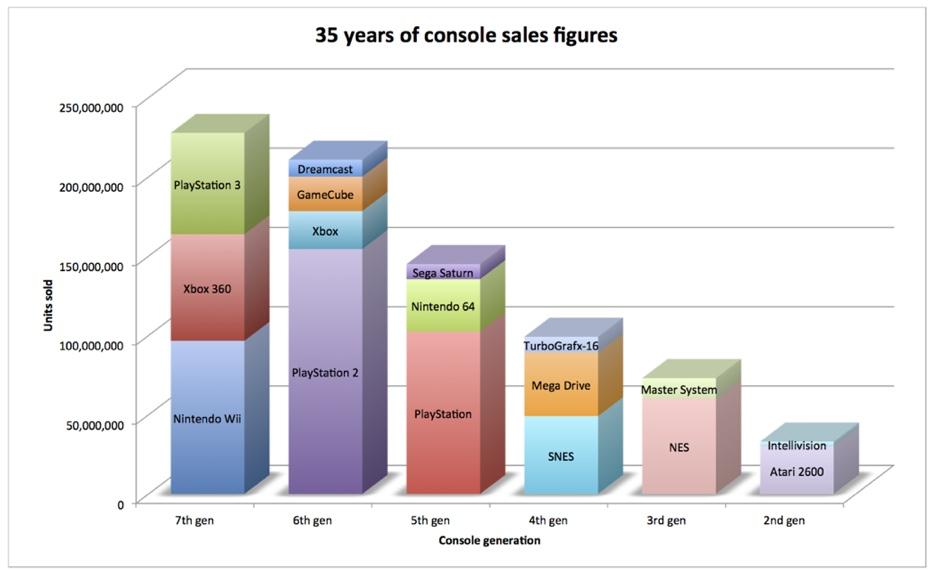
Martin Hollis tweeted a link to this very nice graph comparing the console "Generations" and their total unit volumes:


It's a nice graph, despite the chronological order being right to left.

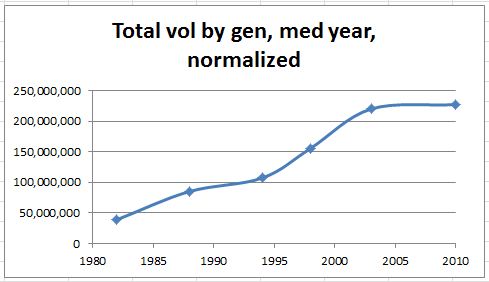
It's a rough swag to group by generation as it is, since launch dates and end-of-life dates have only some alignment. Since some liberties were already taken, and I was curious, I did two things:

- Aligned the generations by date, picking a rough data for "mid life cycle"
- Normalized to 2010 numbers for population size. I used the sum of US, Japan, UK, France, Germany, as my proxy for "first world", as that's where most consoles are sold anyhow.

The resultant graph looks like this (going left to right with time)


Sort of more telling I think. Question is whether the current plateau is an anomaly, or whether we've saturated the market for consoles. A good second question is what this would look like if you removed the portion of Wii sales that were "fad customers", and whether that's fair to do in trying to preduct the next gen numbers.

Anyhow, food for thought.

Friday, September 14, 2012

Book Review: Hello, Skater Girl

I backed my friend Julian Bleecker's book Hello, Skater Girl on Kickstarter and just received my copy.

Julian spent well over a year photographing skateboarding girls in Venice Beach and it shows in his photos. He not only captures some great action shots, but shots of the girls eating, laughing, etc, and as a result you get a nice little snapshot of a particular sub-culture community.

Here's a nice video he did that captures the spirit of making the book, and gives you a feel for the book itself.


It's a really pretty book that makes a nice addition to a collection of photo books, if you are into such things. I'm also looking forward to my daughter consuming it some day, not in hopes that she'll become a skater, but rather that she'll see that girls can do whatever they want - even things that some think are just for boys.

My only complaint is that I'd have loved for some of the back story (much of which is on Julian's blog) about the shoots to have made it into the book. Now, that would have changed the nature of the book itself, which is purely a photo book, so I'll forgive him for not including it, and now you've got an excuse to pour through his blog too. (As an example of what I mean, read this page, about climbing "Seal-Team-6" style into the back yard of a condemned 70's house, and it makes the photos of skating the pool that much sweeter.


Wednesday, September 5, 2012

Book Review: Neuromancer

I'd never read William Gibson's seminal cyberpunk thriller, Neuromancer but have had it on the to-read list for a long time. It holds up well, and is amazingly prescient given that it was written in 1984. Not only did he coin 'cyberspace', but think about where your concept of computers and networking in nineteen eighty frikkin four and then imagine, "The matrix has its roots in primitive arcade games. …Cyberspace. A consensual hallucination experienced daily by billions of legitimate operators, in every nation". Holy balls.

As visionary as Blade Runner, in some ways more so.

As an aside, I now look upon The Matrix in a whole different light. So much of it was clearly lifted from Neuromancer. I'm surprised there wasn't more talk of it at the time that movie came out.

Anyhow, if you've never read it, do yourself a favor and do so. Get a recent copy as it'll have updates from the author with some perspective on the time since it's writing.

Neuromancer

Monday, September 3, 2012

Book Review: The Windup Girl

I loved The Windup Girl. Biotech steampunk. Monsanto-styled shocktroops. Blade Runner's neon and steel city of the future, but powered by springs and compost. Takes a little while to get going but wow, when it does, it's great. It's sci-fi at it's best in the sense that the author uses a superbly envisioned future to frame social commentary about biotech, genetic modification of food and animals, and corporations holding patents over such things. Some of the characters are a little flat but I'll forgive him that given how well the rest of the book executed.

 The Windup Girl