Wednesday, November 12, 2008

Flying car? No. Flying pot roast? YES!


photo.jpg, originally uploaded by Kim Pallister.

W.T.F.?

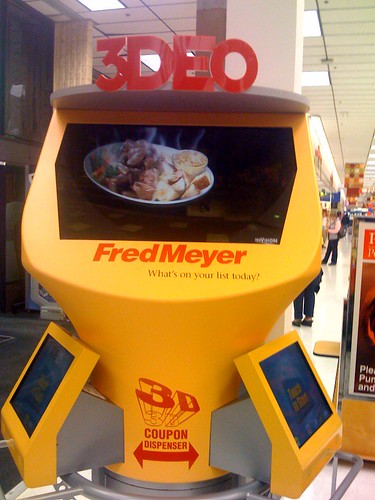
Fred Meyer (west coast grocery/department chain) has installed 3D displays from 3DEO with "3D Coupon Dispenser".

OK, while the tech is a bit nifty, the giant floating plate of roast turkey COMING OUT TO GET ME! (it really was floating way out in front of the device when viewed live) didn't do anything to make me want to buy it. Nor did the giant avocado COMIN TO GET ME! or the cantelope melon COMIN TO GET ME!!!!

Buy low, sell high


photo.jpg, originally uploaded by Kim Pallister.

Another exhibit at OMSI, it's a stock trading simulator.

We've all seen these before, but this one was cool in that it (a) was a better sim, with 4 different "trading desk" stations where people could sit and trade while also watching the market action and news on the big screen, and (b) at the same time was highly simplified, with only 4 stocks to buy or sell.

Probably doable for 9-10 year olds.

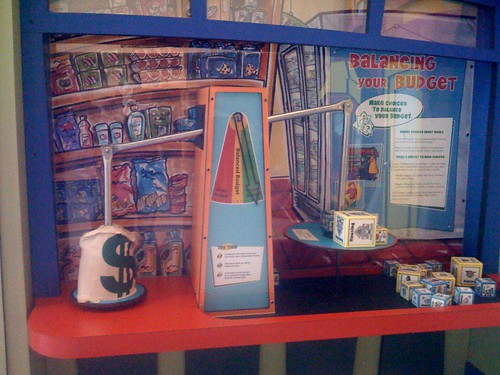
Balancing the budget


photo.jpg, originally uploaded by Kim Pallister.

literally.

The OMSI science museum now has a little section on economics (timely). One of my fave exhibits for the kids was this game of literally balancing the budget. The bag'o'money on the left is fixed income. The blocks on the right are different size/weight and are labelled things like "big house", "small house", "groceries", "eating out", etc.

The twins grokked it super quick. Though they chucked auto payments off in favor of 'buy toys'.

Can't say I haven't done the same!

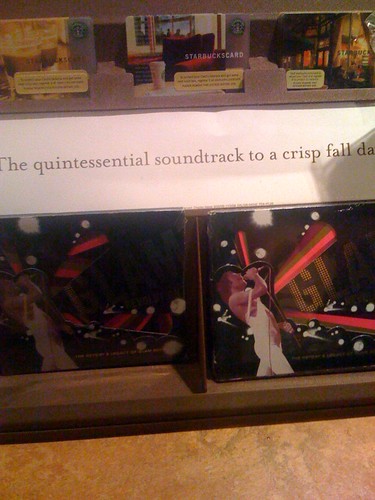
Quintessential Irony


photo.jpg, originally uploaded by Kim Pallister.

Starbucks point of sale CD rack labelled "The quintessential soundtrack to a crisp fall day".

On this particular fall day, that sound track included a glam rock collection. Because nothing says autumn foliage colors like Adam Ant, I guess.

Eee PC's R Us


photo.jpg, originally uploaded by Kim Pallister.

EeePC's on sale at Toys'R'Us of all places.

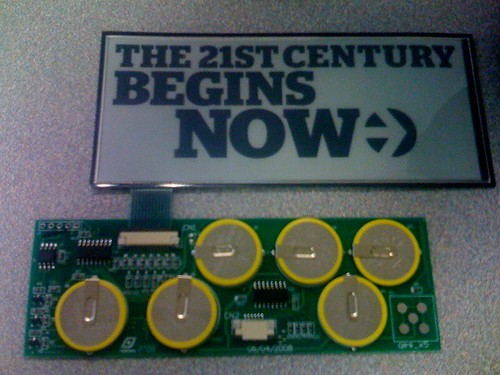
Epaper esquire deconstructed


photo.jpg, originally uploaded by Kim Pallister.

I tore apart the cover of my Esquire e-paper cover issue (blogged about a while back)

The second screen is missing because I peeled the layers apart until non-functional.

The display shown is still clocking along on my office wall. It appears to be 12 "pixels" or regions (e.g. "The 21st Century" is one region that must all be on or off), and has 4 states. White, light gray, dark gray, or black. The two larger ICs on the board are 8-bit shift registers, so it's just wired to cycle through a pattern of 'region 1; region 1, 3 and 8; region 2 and 8...." or such. Pretty simple. I'm guessing the 3rd is a timer, but I didn't look it up.

It makes it pretty useless to hack though. I was hoping it would be a regtangular grid of pixels, in which case you could do some fun stuff with it.

K

Tuesday, November 11, 2008

The taste of crow up in Redmond

"There's no chance that the iPhone is going to get any significant market share. No chance. It's a $500 subsidized item... They may make a lot of money. But if you actually take a look at the 1.3 billion phones that get sold, I'd prefer to have our software in 60% or 70% or 80% of them, than I would to have 2% or 3%, which is what Apple might get." - Steve Ballmer, April 2007


In related news, I heard an interview with Neil Young on NPR in the car on the commute home yesterday. Go NGMoco!

In other related news, NPD is starting to include the iPhone in their portable gaming devices market research.

Sunday, November 9, 2008

The Ambient Life

Cool bit of futurism here.

These things normally miss the mark some, but worth watching if it makes you think.


Book Review: Settlers of the New Virtual Worlds

So I've just finished Settlers of the New Virtual Worlds, by Erik Bethke & Erin Hoffman. It's actually both written and edited by them because the bulk of the book is a collection of essays by others.


The book's focus is on the evolving world of MMOs and virtual worlds, and how their progress and evolution is going to demand they transcend the current one-sided state of their EULA's, grant users (scratch that, residents) rights, and discusses many of the issues involved in doing so.

In short, it's a must read for anyone in the games industry - not just in the business of MMOs - and for anyone that is interested in the future of the medium. The book contains many provocative ideas. Not all are great, but that it will spur thought and discussion is reason enough to recommend it.

Among my favorite bits:
  • Raph Koster's piece on a declaration of player's rights (borrowing heavily from the 1789 French Declaration of Man and the Citizen and from the US bill of rights).
  • Ren Reynolds' piece on issues with claims with virtual property and IP in which he compares with precedents in both US and UK law and shows just how murky the water might be.
  • Erik Bethke's opening and closing pieces in which he seems to be putting his money where his mouth is, as he's taken some bold steps with his own EULA, for GoPets, which he runs.
There are some not so good bits as well (I won't name them) but you shouldn't let them stop you from picking up the book.

My only complaint was that there wasn't one of the essays that attempted to tackle the issue of virtual property as a sort of promisory note of service, as I've alluded to before*.

Anyhow, pick it up. Good read.

* One additional thought on the 'promise of service' idea. It's occurred to me in re-reading my earlier post in current economic times, that this is not unlike a sort of derivative. I have to think about that a little before expanding on it.

Friday, November 7, 2008

The first wave of bad news

Lots of axe-weilding around the games industry, and in the tech industry in general. A few recent examples:


Brash hit by layoffs, cancels titles (not surprised, given their initial titles' poor reviews, which seem to stem from an attitude of "hollywood license + low quality game = ok", as others pointed out when they originally announced. Guess you can burn through $400M pretty quickly these days. Fools and their money, etc.)


Google will give you plenty more examples. 

Unfortunately, i think this is just the battening down of the hatches. The real trouble comes if people tighten their belts a notch or two this Christmas, which I expect will absolutely happen. After that we'll likely see another wave of layoffs.

So much for 'recession proof', which was crazy to think anyway.

Shitty times. And I think it's going to get far worse. The layoffs in other industries have a ripple effect on people's spending; budget clamp downs in all industries are going to cut advertising budgets, which are a big part of the casual games business, etc.

Wednesday, November 5, 2008

The Unfinished Swan

Jane points us to this interesting concept, a 'first person painter'.


Clever!

Monday, November 3, 2008

The Virtual World Taxman Cometh

As aluded to previously, we all knew it was coming.


And notes:
[the ruling] seems to apply whether or not the value is cashed out.
(and goes on to note)
However, if the value is not cashed out and taxes are still paid, that could mean (maybe should mean) that the companies are liable if they manage to accidentally delete some of it. In other words, they’re banks.
I commented on his post that non-Chinese MMOs like Wow are probably glad they licensed the right to run servers in that country to other parties. Boggles the mind to think how something like this would apply, be determined, be policed, etc, if numerous countries were to institute similar laws. Thousands of individuals all paying taxes on income incurred in other countries (where the servers reside), and businesses in some cases being run from elsewhere than where the servers reside. Blech. What a mess!

It's already moderately messy to do taxes for, say, stock purchases & sales, if you do anything moderately frequent in the way of trading. Now imagine that on a micro-scale at an accelerated pace. 

As I understand it, in the USA, Internet commerce has been relatively hands-off in the area of taxation; as an incentive to promote growth. However that can't last forever, can it? At some point, growth has happened. Plus, no one is doing VW business in the US only going forward. 

This whole idea of 'countries' is obsolete :-)

Wednesday, October 29, 2008

Prince of Persia original reference footage

OK, definitely among the top 5 coolest things happening on the internet:


Prince of Persia Animation Reference 1985 from jordan mechner on Vimeo.

"Jordan Mechner, creator of the original Prince of Persia, has been posting his original development diary entries to his official blog to coincide with the exact date they were written 23 years ago. Each post is a treasure for fans of the games, but the October 20th entry is particularly special: it contains the animation reference video for the Prince Mechner shot in the Reader's Digest parking lot in 1985, using his kid brother as a model."

I viewed it before reading the above blurb, and thought it was someone imitating PoP and doing a good job. Now I get why. So awesome.

Another big game, another set of reviews questioned

Games journos are calling attention to themselves again and questioning the value of game reviews that are rushed to print in order to scoop the competition.


We saw a rash of this conversation around the GTA4 release. As part of that, it was implied that the game's publisher further egged it on by incenting higher review scores by restricting allocation of pre-release copies of the game, etc.

This time around, it's reviews of Little Big Planet. The games servers were down for a while, so arguably the reviewers were reviewing the game without looking at some of it's most important features.

Kotaku discusses the topic here, once again showing that the Brians are capable of seeing the big picture & implications.

[Kotaku's serious side aside, am I the only one that thinks that their renaming Epic's Cliffy B to "Dude Huge" is one of the funniest things on the intertubes?]

Heavy Rain (of Incentives)

dIn an interview up on GamesIndustry.biz, Heavy Rain developer Quantic Dream's CEO Guillaume De Fondaumiere makes some comments on the effects that Quebec's game development incentives had on the French games industry:


[referring to the French games industry downturn from 2000 through 2005]
"...we've been hit by the distortion of competition - primarily from Canada, from Montreal, which as you know is a French-speaking province. The fact that they created a tax credit worth almost 50 per cent, this has had a big impact in France, and a lot of our creators, developers and programmers went to Canada, so I think we lost more than half of the community to Montreal in those days."

He later goes on to say that France's institution of a similar - but smaller - system helped stem the bleeding.

Tuesday, October 28, 2008

$38M Bust in Korean MMO laundering case

"...Korean police arrested a group responsible for laundering money generated by CHinese gold farming from Korea back to the mainland. Over 18 months, the group wired $38M from Korea to a Hong Kong paper company [ed. Mildly ironic] as payments for purchases." (link)


As Raph concisely puts it "...and where it happens on large scales, regulation cannot be far behind."


Friday, October 24, 2008

Precendents...

More legal precendents being set in MMO's/Virtual worlds:


1. Tokyo woman jailed for logging into husband's Maple Story account and killing his avatar (link). I wonder: If she was a noob and did this accidentally, would his have been VW manslaughter?

2. Dutch teens convicted of VW theft after logging into Runescape and roughing him up and taking his virtual items (link). 

The latter of these is particularly interesting. If the game allows "roughing up", then hasn't the victim here subscribed to a PvP portion of the game/world? If not, how did it happen. If so, then hasn't he opted to allow this kind of thing to happen? Seems like if a hockey player were suing for getting checked.

Thursday, October 23, 2008

Please stop pouring viagra in the fanboys' mountain dew!

I'm torn.


While I find the provocative pix over on this Kotaku post as, err, interesting as the next fellow, I'm also frustrated by the fuel this throws on the embers of the Jade Raymond fire.

The games industry & culture is still rife with a lot of sexism. It's a factor in attracting more of the fairer gender to the business, which is a factor in making games that appeal to them, etc.

[Of course, there's a difference with the Jade Raymond thing in that Jade did nothing to fan the flames so to speak, and Grace Kim arguably is inviting some of the commentary, or at least playing to the stereotype. Another difference of course is that Ms Kim was in PR, and we all know PR people are hired for their looks anyway. Ha! I kid! I kid!]

Gabe & Tycho make a good point...

Areae now Metaplace, gets more money

Congrats to Raph and company for closing their series B round for 6.7M.


Among the investors is Marc Andreesen, which I view as - at least in this case - a 'smarter than the average bear' investor. His take on 'levels of internet platforms' which I previously blogged, would class Metaplace as a 'level 3 platform'. I view this as a very strong endorsement of Metaplace. 

Go Raph!

I can hear the future calling...

... and it speaks silently.


More or less equivalent to where desktop voice recognition was ~15 years ago. 

Awesome.

Wednesday, October 22, 2008

In the "truth is stranger than fiction" department...

[alternative title: Great Simultaneous High and Low Moments in Gaming: Part 7]


PS3 downloadable fun-with-ragdoll-physics title Pain is adding a celebrity appearance in the form of... The Hoff. Trailer complete with Hasselhoff doing a cover of Culture Club's Do You Really Want To Hurt Me can be found here.

Yes Hoff. Yes we do.

Thursday, October 16, 2008

Count the monitors

French-canadian news clip on day traders playing the current market volatility. The guy in the red sweatshirt is my buddy Dave.


For those of us in tech, it's fun to watch just to see the crazy multi-mon goodness. I think the biggest setup I spotted was 14 monitors plus a TV. 

iPhone Games Market: Promised Land or Cesspit?

While at TGS, I had a lot of hallway & dinner conversations about iPhone games, with people weighing in on whether the iPhone Appstore was the promised land (a la XBLA circa 2005) or whether it was going to rapidly turn into something less than that.


Some thougts on the subject:
  • The fact that the Appstore was not part of the initial design of iTunes is apparent. There are some fundamental features you would want to enable here that are lacking. Most significant of these is a "Try'n'Buy" mode which right now developers are implementing by shipping two versions of their games, which is a broken experience. Other examples include couponing, gifting, friend invites, discounting, retail point-of-sale cards, on-deck pre-installs, etc. (some of these, like gifting and friend invites, are going to become especially important when you look at the marketing challenges which I discuss below)
  • Two different people involved in the business of iPhone games told me that "Try'n'Buy models actually often result in people NOT buying the games". This may be true, but the opposite means that the customer has made a purchase he/she will regret, and will be more reluctant next time. If it's good product, let them see it and try it. Fooling them into buying it is a loser strategy.
  • The "open" policy of letting developers put anything up on the store (vs, say, XBLA's approval process) is good for a number of reasons, but it has implications:
  • The store is CROWDED. Even more than XBLA, the responsibility of getting your app noticed falls on the developer. Crossing your fingers and hoping to make the "featured" page or the "top 25"page is not a strategy.
  • The quality level is highly variable, and the long-term effects this is going to have on the customer impression of the store is TBD. My guess is that over time, there's going to be negative perception for this reason, and Apple's going to start reeling it in (either by pushing low-quality titles to the 'back shelf', or pulling them off altogether).
  • We are going to start hearing questions about transparency. For example, if the Featured page is a big driver, then how does something get featured? Can people buy their way onto that page? Maybe not today, but the pressure will be there to do so going forward.
  • An additional driver for transparency will be that some developers will choose to 'spend their way out of the clouds' in terms of development budgets, quality, etc. If they do so, they are going to want to know BEFORE they develop their titles, if they are going to be allowed to ship. This is especially true for apps that might be viewed as conflicting with Apple's business model or on-deck apps, but also true for games.
All in all, I think some of the shine is going to come off the apple, but that it's definitely a compelling platform and has reached critical mass as a platform that it's here to stay for developers. 

I don't think developers should delude themselves though. This is rapidly going to become an even more crowded space in which quality titles are going to be expected, and in which the challenge will be in overcoming obscurity - which you can read as "developers need to do their own marketing and they need to be good at it". Alternatively, they an rely on a publisher to do that marketing for them, which is one of the reasons that a publisher business makes sense in this space (Ngmoco, for example, was an early entrant into this space).

[Speaking of Ngmoco, they've announced their first couple titles, and while I'll reserve judgement on Maze Finger and Topple, I will say that Rolando, an innovative platformer using both accelerometer and touchscreen, looks awesome. Trailer here]

Last thought: On the subject of marketing, several folks I spoke with were in agreement that devs/pubs need to do their own marketing outside of the Appstore e-tail placement. However, there was some varied opinion on what that marketing should entail. Several folks I spoke to were of the "viral" mindset. (i.e. you do it on facebook and myspace and via mechanisms incouraging friends to join mail lists and such). There wasn't much excitement around traditional mechanisms like, say, print ads. On the other hand, if you think about it, this is a very interesting marketing problem. The iPhone customer, I'd guess, has a widely varied demographic, is affluent (they aren't cheap), and there may not be one answer to he question of how to reach them. Maybe print ads make sense, but if so, where? Wired? Forbes? Tiger Beat?. Maybe do something at retail, but where? Target? AT&T stores? Starbucks? Maybe coupons/invites in your cell phone bill? Will be interesting to see what turns out to be successful here.

Monday, October 13, 2008

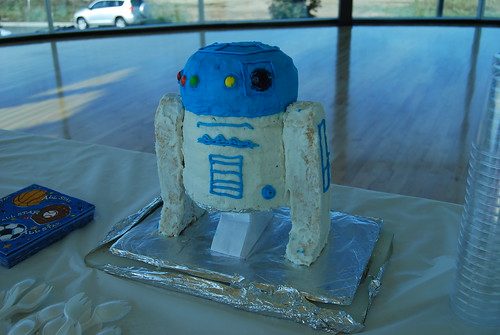
Artoo!


DSC_0058, originally uploaded by Kim Pallister.

B-day cake engineered by ambitious spouse!

Sunday, October 12, 2008

TGS '08 tidbits

Just flew back from TGS yesterday morning and it was straight off to the twins b-day party, so I was a little messed up and still have a ton to catch up on. Will post pix of Tom's awesome R2 cake later.

Overall the show is down attendance-wise (at least the industry piece of it, public day numbers look like they were even bigger).


PC Gaming presence was worse than ever, with most PC games being found in the anemic PC-online section of the show, which showed a number of fat-client MMOs and VW's, and many more flash-based versions of the same. 

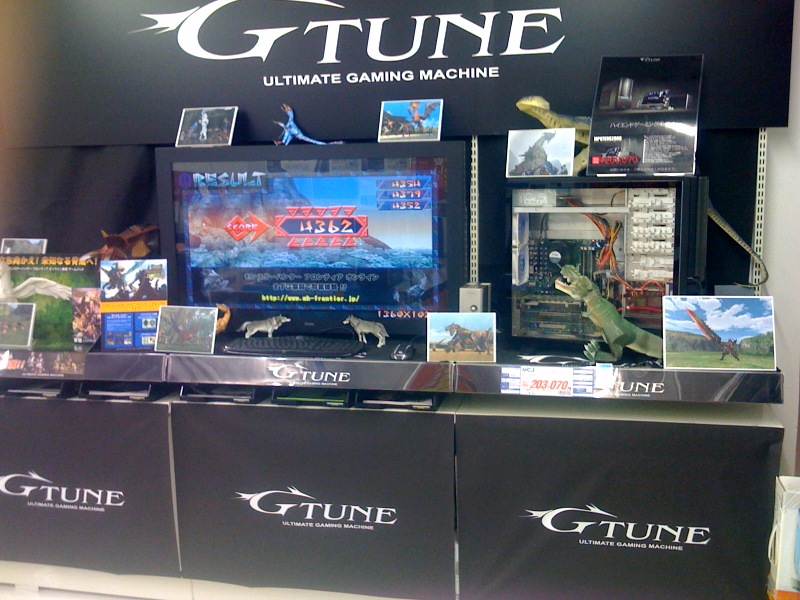
However, if you dug below the surface, you realized that many of the big titles/franchises have PC SKU's, and there's still some PC action going on. Which jived much better with what I saw in Akihabara on Saturday, with many high-end gaming rigs, graphics cards, and point-of-sale displays featuring games like Monster Hunter, which is huge in Japan.


Thursday after the show I went to a big developer get-together for Tokyo-based expat gamedev community which normally swells when TGS is going on. Got to hang and talk shop with many friends including Simon, Jane, Casey and others. Lots of interesting conversation which I might have some future posts about if given the time.

Friday was dinner with Alice, Cory, Aleks, and Ben (oh! Just realized it was an all-blogger dinner!). Food was yummy and conversation also good, though after the 2nd day of the show and a few bottles of saki, bedtime came early.

Best looking game of the show, IMHO was still Little Big Planet (like last year), it's definitely a platform game-changer. 

Best game of the show was We Ski and Snowboard for the Wii. This'll finally get me to buy a Wii and a Wii fit to boot. I didn't try skiing, but they *nailed* snowboarding. If you think about it, it maps very well to a balance board, as all you are doing is leaning heel-to-toe when snowboarding at a good clip. Here I am giving it a go and refusing to get off and give Aleks a turn. (The person before me refused to get off too. a good sign!)


More notes when I get some time, but in the meantime, what I hope to make a recurring feature: 

The 5 worst (and therefore best) named games of TGS!

5. Anything Gundam. Because there are too many and they all bleed together after a while.

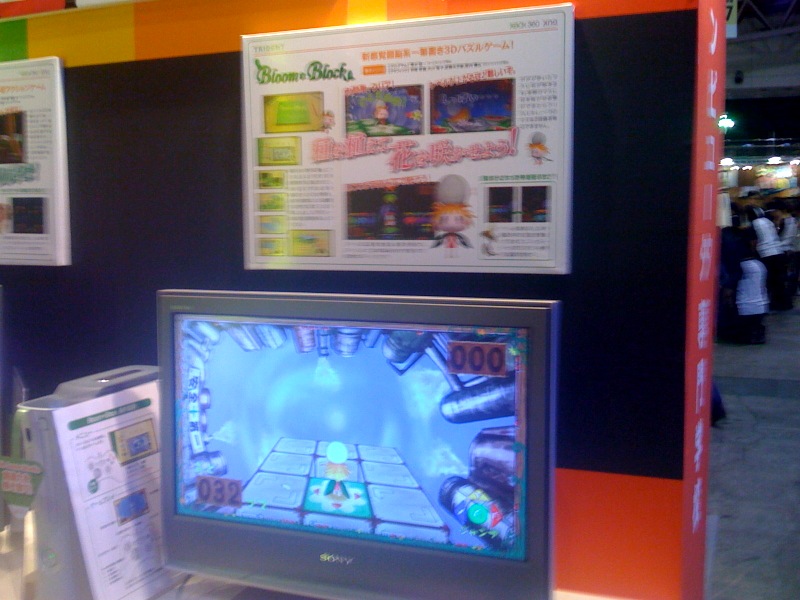
4. Bloom blocks. Because it sounds a little too similar to a certain popular Wii title from a certain Hollywood director. Too be fair, it was a student project, did involve blocks that bloomed, and was one of the better games of TGS, at least in terms of a really snappy satisfying core game mechanic. The casual industry will surely rip it off in short order :-)


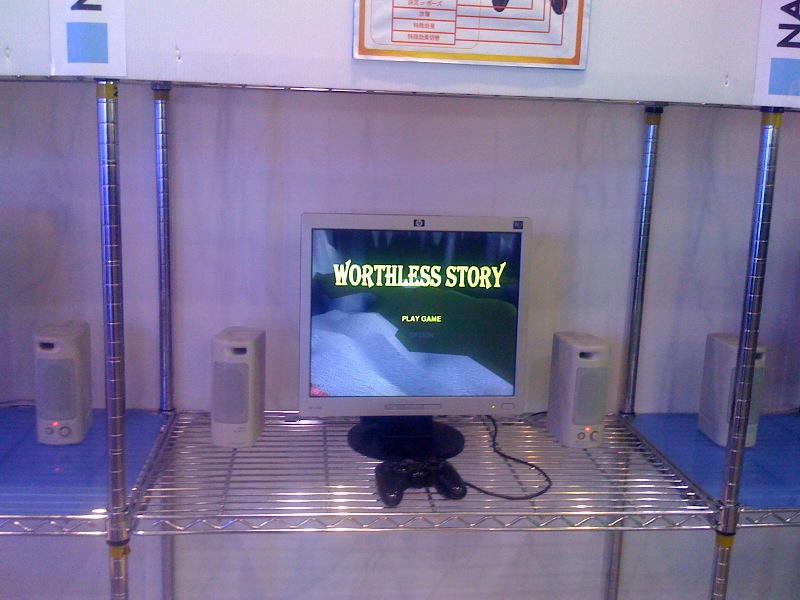
3. Worthless Story. At least they are honest about it.


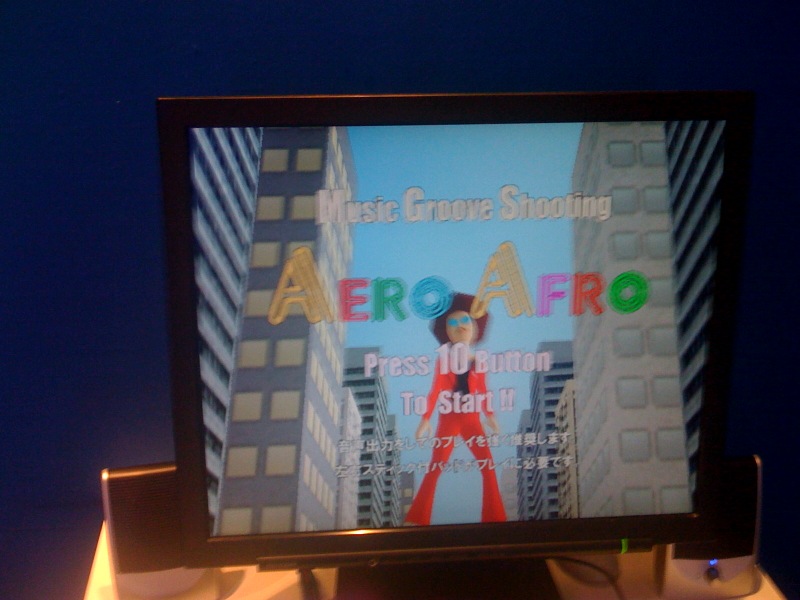
2. Aero Afro. A beat-match ghetto fighting game where disco dudes fly over an urban landscape, duking it out with bad-ass beats!


1. A lot of Broccoli. Because it's not just broccoli. It's a LOT of broccoli! And that's something my mom told me was good for me. And because their graphic is awesome.



Tuesday, October 7, 2008

The FUTURE is here!


photo.jpg, originally uploaded by Kim Pallister.

At the airport today, I picked up the October Esquire because it's the one with the E-Ink cover!

I was disappointed to learn it wasn't the whole cover, but rather a ~4x3" rectangle (and another inside with a Ford ad), but still, it's awesome.

Financial Crisis Explained

This is not just a great explanation of the current financial crisis. It's also a great example of how expertise in a subject and a well suited metaphor can make for a powerful presentation.


Thursday, October 2, 2008

Best MAME setup *ever*

Years ago, (*brag*... way before it was trendy), in like 1999 or so,  I built my own MAME arcade cabinet conversion. Pic here.


Since then, I've seen a bunch of people do home arcade machine setups, either as arcade cabinets or as coffee tables and the like.

However, this one, built into a bar, is full of The Win. The contest is now over. I can't imagine how anyone will top it, short of perhaps building it into Angelina Jolie's backside or something. :-)

(Seriously though, it could be improved. Trackball, spinner, for starters. Rotatable monitor is another idea)


(Thanks Alice!)

Wednesday, October 1, 2008

Another entrant in the UGC games race

Mashable has an interview up with the folks from Gendai Games who are the developers of Game Salad, another entrant to the drag'n'drop user created games space (e.g. like gamebrix and others).


The main thing that makes this unique compared to other offerings is that it's primarily targeted at Mac and iphone, (including multi-touch & accelerometer support). Mac-only for now, which sounds niche, but is a nice niche to go after, vs the crowded PC space.

On the negative side, from what little text is on the page, it sounds like it's mainly dragging your pix and such onto game templates, vs editing game rules and the like. I could be wrong though.

As an aside, someone needs to define a bunch of terminology for this space. There's a very wide spectrum from GameSalad to GameBrix to Metaplace to XNA. There are a bunch of differences including how much the seatbelts come off for the developer, the business model(s), open-vs-closedness, etc.

Sunday, September 28, 2008

Technological advances in genital simulatation continue...

Hot on the heels of the Spore penis creatures, comes a penis machine in little big planet.


If only all that creative talent could be used for good.

Thursday, September 25, 2008

Putting my theory to the test

Well, it's as if someone read my last post about IP infringement in User Generated Content centered games.


Wednesday, September 24, 2008

The coming tsunami of IP infringement

The "User Generated Content" or specifically "User Generated GAME" space seems to be red-hot these days.


Lots of web-based examples (Metaplace, GameBrix, Silverlight, Atmosphir, etc), and now console games are going to be a hotbed as well, with Little Big Planet being the case example getting the most mindshare.

David Edery had a post up doing his own post-mortem on Scrabulous, in which I commented on it's successor, Wordscraper. In it, I said:

Wordscraper... supports user-definable boards and tile weightings. Which means you can do, as I have done, a board and tile set that exactly match those of Scrabble, and VOILA! IP circumvention via User Generated Content!!!

If they were to publish something like a board-sharing service, the developer (or FB?) would be subject to DMCA takedown notices, but now Hasbro/Mattel has a harder job: Vigilantly watch the forums, send repeated DMCA takedown notices, etc. Also, I don’t know if other countries have similar laws.

There are some holders of game IP that have tried to enforce their hold over game rules, mechanics, etc. Obvious examples are Tetris Corp, who recently were in the news for getting a clone pulled from iTunes, as well as the Hasbro/Mattel Scrabble example. Other cases exist where it seems to have flown under radar (e.g. Webkinz's games are almost ALL rip-offs of classics, but with name changes and theme changes. Sometimes game design changes too)

Quite frankly, I just don't see how the IP holders are going to keep up with it all in this new world.

I suppose you could serve takedown notices to - like Scrabulous - only the most successful examples. But then what does that say for all those would-be infringers out there: Go ahead and clone games and be successful with them... but not TOO successful.

Monday, September 22, 2008

More on marketing of indie console titles

Gamasutra has a postmortem up of the XBLA beat-match-3 title Go Go Break Steady.

Of note is the last point they make on their 'what went wrong' list.

5. Marketing XBLA games as an indie.

What is hype? We completely underestimated the marketing effort required for a successful XBLA title. One of the most attractive reasons for us to develop for XBLA was that we wouldn't need a publisher or major marketing, as the game would always be available online and would be able to garner enough sales for us to make up our investment.

This might have been true when we first started developing for XBLA, as there were then fewer than 10 titles available. We, on the other hand, were the 150th title on XBLA, and we were released alongside a very popular remake of a classic arcade game. Going into our release, we had next to no hype and much to our chagrin very little post-release hype.

Researching this more, we realized that this seems to be the bane of all indie developers. Although we found someone to help us with the PR work close to the release date, in retrospect it would have been prudent to show more of the game earlier so consumers would at least recognize the name when they see it on XBLA.

As I've been saying for some time, this is the real challenge for downloadable titles. Both Braid and Castle Crashers are great examples of devs creating their own buzz.

Indie devs can't count on XBLA, PSN, Steam, or any other digital distribution service to do the full marketing effort for their titles. Doing so would be the equivalent of EA counting on EB Games doing the marketing for Madden. The storefront plays a role, but there has to be anticipation built for the title over time, etc. Viewed differently, if you do well, the storefront will bolster your effort. If you don't do well, they'll forget about you quick.


Thursday, September 18, 2008

Portal Prequel coming soon...


...and it's made with PEOPLE!
via Rock, Paper, Shotgun, news of an 'official prequel' for Portal.

And there's people in it, which is a little strange, till you get the back story:

Its story revolves around the pre-GlaDOS epoch, even before she was plugged in. At this time, test subjects were monitored by real Aperture Science employees, whose work was tedious, lengthy and repetitive. This is why they decided to build a great artificial intelligence that could both replace them in these difficult tasks, and also take responsibility for many other tasks within the complex and compete with Black Mesa’s superiority. All employees of the Aperture Science complex are now eagerly awaiting GlaDOS. Maybe even a little too eagerly, as the upcoming events will tell… This game is totally free and set to be released somewhere around the end of the month. It offers a bit more gameplay hours than the original Portal, with 8 chapters, 48 challenges, 6 advanced maps, a brand new storyline and more than 400 lines of speech with english and french subtitles.

Tuesday, September 16, 2008

Spore DRM-haters create anti-DRM Spore creatures within Spore


There's a been a bunch of people griping about the SecureROM DRM in Spore. Some of those people have now created creatures within Spore to voice their opinions. Crafty, given that the game is built around the sharing of player-generated content.


At right, the VeROFLaptor, "hails from the planet EADisappointsMe and is known to spray excessive DRM and overhype on it's attackers".

Sunday, September 14, 2008

Google and Games: Yes. Publishing? No.

A few people have pointed to an article that appeared this week on Forbes web site, speculating that Google might get into game publishing.


I think that while Google's definitely making inroads into games, which is the main thrust of the article, the article is a both a little off base on it's predictions, and also mixing up terminology some.

First, the article mentions that it could make inroads into the in-game ads market (citing casual games sites like Pogo & Real's) market using something "similar to Adsense". And also mentions that the company could use it's warchest to acquire development studios to develop titles to display those ads. This line of thinking has a number of flaws:
  • Google's already publicly stated that they intend to do 'adsense for games'. 
  • Casual games sites like those mentioned, or MSN's which I worked on, while this do some "in-game ads", usually advergames or 'skinned' games, do the bulk of their advertising via interstitial ads as well as ads elsewhere around the games. For those not familiar: think TV commercials vs in-show product placements.
  • Doing either of those, or even in-game ads, doesn't require acquiring a studio. Lots of examples out there today of people using technology solutions to connect ads with other parties' content.
Which brings me to the second and main issue I take with the article: That I don't think believe the content publishing business - where specifically I mean publishing to mean "the business of funding and otherwise aiding the production and bringing to market of content" - is something that fits within Google's DNA. 

Google's a technology company. Technology that aids the connection of people and content, sure. So adsense, yes. Platforms for games (which Lively or Google Earth, etc), sure, I'll buy that too. Game portal? Quite possibly. 

I could see them trying to the shoes of either flash-based game portals (newgrounds, kongregate) or traditional multiformat casual game portals like Real's or MSN's (and maybe supplanting the manual merchadising with an algorithm-driven one - not unlike what happened with Search). I could even see them doing a algo-driven/technology-driven version of what Oberon does - a whitelabel games portal service.

But none of these requires that they retain control over IP, fund content development, etc. So I don't think Publisher is in their future list of roles. 

It's also worth considering that there are parallels in their other businesses: Acquired Blogger and aggregate advertising realestate there, but haven't felt the need to acquire BoingBoing or Kotaku, etc. Acquired YouTube, but aren't producing video programming nor acquiring the Coke'n'Mentos guys. 

What do you think?

Thursday, September 11, 2008

Re-treading the re-tread games argument

GamesIndustry.biz has a post up about Frontier's David Braben making some comments about the second hand games industry. I've commented on this issue before (e.g. here), but thought it worth adding a couple things.


First off, this idea that a rental games market could replace a second hand games market is a bit of a fantasy. The second hand games market IS a rental market, at least it can be looked at as such.

That aside, however, there's a basic math problem here that doesn't add up. Either you are going to charge consumers more for the same thing (which then won't replace the second hand market), or you are taking a portion of the retailer's money (which he isn't willing to give up). 

Put differently, the problem is that users are getting the same product, and they and the retailer are getting better value by cutting the developer/publisher out of the equation, and neither gives a damn.

So, what do you do? It seems there are two pieces to address. Here's the same sentence with a couple pieces highlighted:

the problem is that users are getting the same product, and they and the retailer are getting better value by cutting the developer/publisher out of the equation, and neither gives a damn.

Let's spend a bit of time thinking about each:

On the First front, the "new" has to be demonstrably better than the "used". People have done this by linking it to services (MMOs, Steam). There's also the personalize games idea. There's also the idea of shipping the game with something that doesn't transfer as well. Guitar Hero discs are worth less without the guitar, and people often want to keep the peripheral for sequels, etc. 

On the second item, getting people to give a damn, there's two pieces to that:

1) Getting retailers to give a damn. This is a tough one. They make a great amount more money on a second hand title, especially a hot one. In a case like that, a $60 game (from which they make maybe $15 or less) sells for $55 (of which they might make $25 - paying $30 to the consumer for the title). Nevertheless, I have to beleive there are some things that could be done to help incent them to curb the behavior:
  • Cut them off. Don't do business with them. Granted, this is cutting off your nose to spite your face, but if you are Rockstar, people will go find your title. 
  • Give exclusive release periods to retailers that don't sell second hand.
  • Give rebates/discounts/etc to retailers that don't sell second hand.
2) For consumers buying second hand titles, getting them to care, I beleive, doesn't come through their wallets but through their hearts.
  • They need to be educated where the money's going.
  • That needs to be PEOPLE, not COMPANIES. i.e. No one cares that some of Spore's proceeds are going to EA. They *might* care that it's going to Will Wright. 
  • They need to know that the people getting the money appreciate their support.
  • They need to know that its part of a relationship they have with those creators.
I know I find myself having to explain to EB employees, trying to get me to buy a second hand copy of a game for 
The music business has an element of this happening. Why can't we get the same thing in games? It seems like in a funny way this related to the whole game credits thing that the IGDA has been going on about for some time. But that's a discussion for another day.

I guess the point is that whining about not liking a business model isn't going to change it. You've got to go build something better.

Wednesday, September 10, 2008

More power Scott... and fans. and fans for the fans.

Jeff at Rad posted some video of one of the multi-core specialty dev machines Intel has them working with.


This is awesome in too many ways to speak to. just go view the vid, put headphones on, and turn the volume DOWN!

Thursday, September 4, 2008

The OTHER consoles.

Quick: How many consoles are there on the market?


Chances are, if you are a gamer, you either answered 3 (PS3, Xbox360, Wii), or maybe 5 (if you included PSP and DS handhelds), or maybe 7 or 8 if you dipped back into previous generation consoles that are still selling titles (PS2, GBA, etc). What if I suggested there were another few that you probably didn't think of? Hold that thought.

GameSetWatch had an interesting post up the other day about how the core game development community, and gamers themselves, are all too ready to dismiss games that appeal to a specific niche; especially when that niche doesn't include them. The post was in reference to Christian themed games, which I agree, are all too often dismissed by the general fan populace in the same way Christian rock is by mainstream rock fans.

The problem's not unique to this niche. We see it elsewhere too. Raph Koster, myself, and others have commented on how we as an industry are too quick to dismiss the kids MMOs when we in fact can be learning from them. And it really wasn't very long ago (2005-ish) that "casual games" was spoken with a sneer, and disregarded as not really games and not really a business. Opinion has shifted on both of those - to a point.

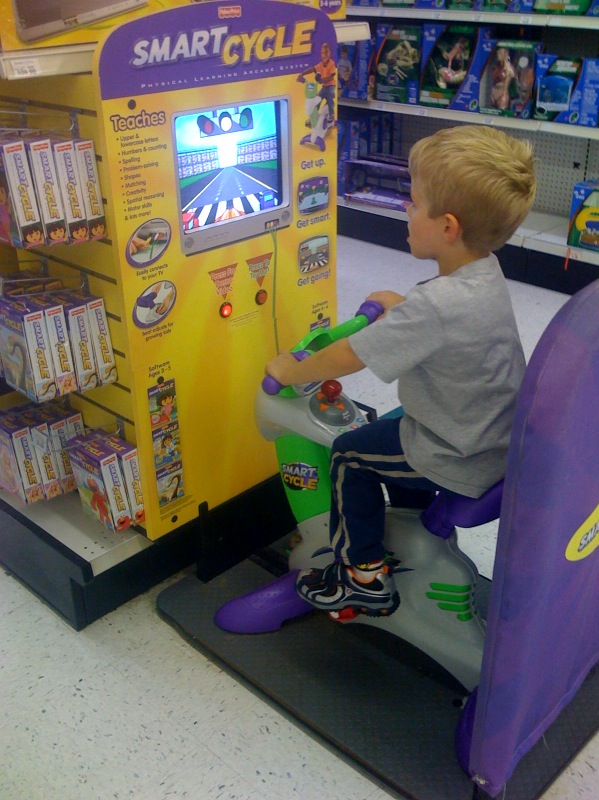
And when it comes to consoles, to most of the folks in game development, what springs to mind is a Wii or a PS3 or a 360. It is not this:


photo.jpg

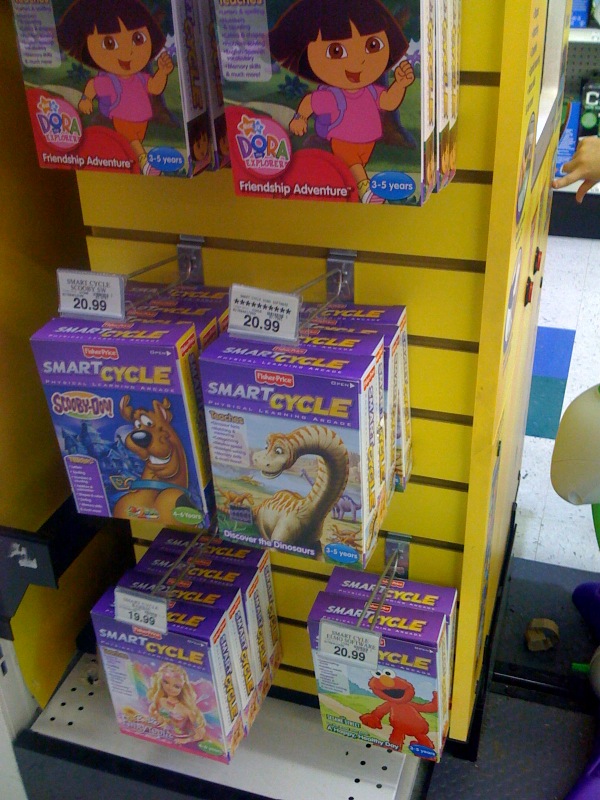
That's my son Tom trying out a Fisher Price SmartCycle at the ToysRUs. It's a game console, it sells for $100, and it runs cartridge based SW (much of which is based on licensed IP) that retails for $20 or so a pop:


photo.jpg


Now the "fitness" angle is new and pretty interesting, but this certainly isn't the first or only game console for kids.

Leapfrog has a range of devices for different age groups, but the most popular is their flagship product, the leapster, which is still selling, and was introduced in 2003. It's had a number of features and sku's added, but is essentially the same platform as when it launched.

They just recently launched Leapster 2, which is smaller, more powerful, connects to the PC as well, and links via the PC to an online world where kids can share their content, get rewards for making progress in games (achievements-esque).

I'm not suggesting that everyone run out and write games for the Leapster. I don't think the market's there to sustain that many titles. I do think, however, that we could all benefit from having slightly wider peripheral vision. 

Looking at the features creeping into the HW and SW of these things, they are clearly learning from us. Are *we* learning from *them*?

Rhetoric

I turned on the republican convention coverage for a bit this evening but really couldn't stomach it after a while. I get that McCain's military service arguably speaks to his character, but jeez. We're electing a president. Listening to the speeches, you'd think we were electing Rambo!


*I take  a little liberty with the use of "We" here. I'm not a citizen yet, so *I* won't be electing anybody!

Wednesday, September 3, 2008

More on retail's evolution

Not one, but two trips to Target in close succession. Ugh. Anyhow, another interesting observation.


Last time, I'd posted something about retail's evolution, upon which Raph added some thoughts.

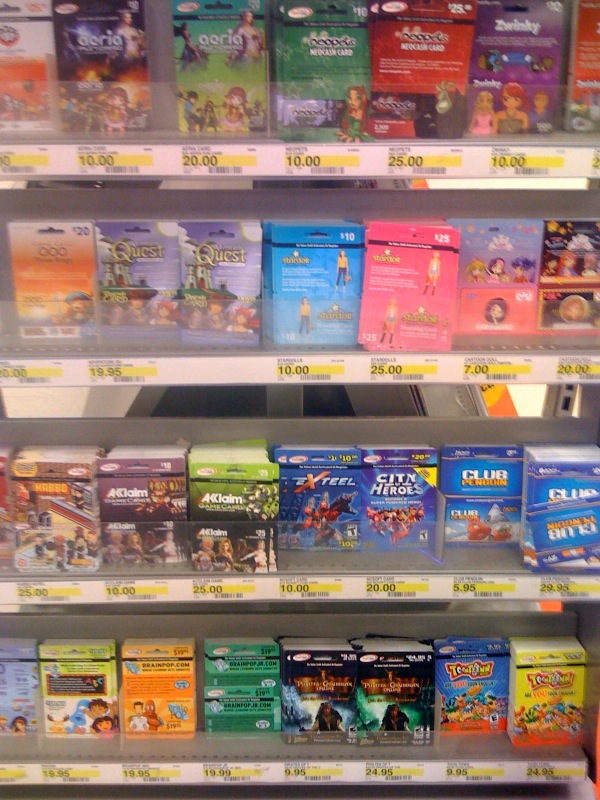
This week, I noted the huge end-cap of point-of-sale point & subscription cards for virtual worlds:


Some thoughts:
  • Look at how many there are! Twenty or so varieties and that's just what I got in frame! It wasn't so long ago that only WoW was doing this and even then it surprised people.
  • Look at the variety! Acclaim, Toontown, WoW, Dora, City of Heroes, Club Penguin, Pirates of the Caribbean, Habbo...
  • Look at how many I've never heard of! BrainPop.com?
And this doesn't even count those who's retail transaction is obfuscated by masking it in a plush (or other) toy, like Webkinz, BuildaBear, BarbieGirlz... (of which I've written here, and here).

Evolution indeed!

Thoughts on Google Chrome

Google launched their browser, which made some (surprisingly little) noise around the blogosphere yesterday. I installed it (this is my first post made from within Chrome) and thought I'd post some thoughts.


First off, kudos for the Comic that kicked off the launch (fans of Scott McCloud will recognize his work here):


Brilliant! What a brilliant way to convey at consumer-level the ideas behind some of the advantages that Chrome offers over competitive offerings. things like Multi-threading, memory management, JVMs, priviledge levels, etc

Secondly, I'm just surprised how little talk there's been about it. First off, it's got to be a HUGE threat to Microsoft. Firefox has made inroads just based on technical advantages and word of mouth, but now here comes Google, with a track record of gaining MSS via a proven business model (look at their toolbar business), and the advantage that comes with being a primary starting point for so many people's web experience. Which brings to mind... why is Chrome not being pitched on the google homepage; nor even in the options at the top; nor on the 'other' pull down menu? Strange. Anyhow, secondly, holy cow this has have Firefox worried. Google's been a major partner for them, and it will be interesting to see just how fickle their users can be, and how many were with them because they just weren't IE.

Finally, the browser itself is pretty slick. I love the 'most visited' and 'most recent bookmarks' in the startup page, The tabs are nice with duplicate features, the drag'n'drop of them feels nice. The treatment of popups is very slick (much better than IE's 'yellow bar'). 

My only complaints so far:
- it'd be nice if History was nested by site. I'm occasionally.searching for a page I found earlier in the day, and this feature makes it easier.
- I'd really like the RSS integration that IE7 has. I know Google has Reader, but I want it baked into my desktop app and I want that app to be the same as my browser.

Anyhow, fantastic product from what I've seen thus far. Nice first effort Google!

Sunday, August 31, 2008

No Pax for me :-(

The forces of the universe continue to conspire against me, and I'm not making it to Pax again.

Sounds like it's really exploding in size, and it looks that way too. Jason's posted some pix showing just that, plus goat spotting!

Friends Mark, Jane, Andre and Rob were all speaking on a cool panel I'd like to have chimed in on, about whether casual is 'killing' core games. Sorry I missed it.

Meanwhile, I've got to get back Mother of All Spreadsheets... [grumble]

Wednesday, August 27, 2008

Monday, August 25, 2008

Evolution of retail


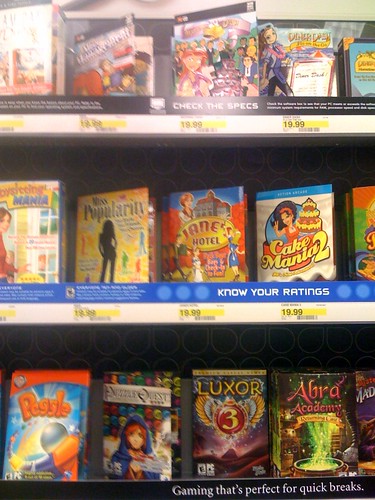
photo.jpg, originally uploaded by Kim Pallister.

Having not set foot in a retail game store for some time, I found myself at Target recently.

Holy balls! Look at the PC game shelf! Approx 1/3 traditional PC hardcore fare (not shown), 1/3 kids & adventure (e.g. Dora, Nancy Drew, etc - also not shown) and 1/3 $20 casual download titles.

Once the domain of Mumbo Jumbo and a couple others, now every downloadable title to have proven itself beyond a given threshold (not sure what that might be - 100k units? half that maybe?) graduates to physical retail.

I wonder whether this is a nice secondary market or whether it's "the big leagues". I'm guessing the former, but who knows!?

As an aside, it's interesting to see their box designs. Most of these games had to sell themselves on a name and a 60x60 thumbnail. The luxury of a big cardboard box lets them mix it up a bit.

Thursday, August 21, 2008

It's Bizarro Internetz time!

The Internet is a conundrum of opposites!

  • Competing Loanwords! GD Mag's Brandon Sheffield argues we've reached a Graphics Plateau. On the other hand, Crytek's Cevat Yerli argues we're at the beginning of a Graphics Renaissance! While both make some valid points, I'll side with Yerli. I've heard the 'mips fatigue' argument for 15 years, and it's graphics variant for at least the last 5. We still have *very* far to go in graphics, and in computing for that matter.
  • I posted yesterday about Cliff Harris' concluding that DRM was bad for business. Id's Todd Hollenshead apparently thinks the evil lies with platform vendors, who won't bake DRM into their platforms. Do we really have to learn the painful lessons that the music biz did, for ourselves?
  • Apparently we do. Hey, we can NOT learn from those lessons even better by hiring on RIAA legal beagles. Ugh. No opposites there, just bone-headed behavior on both sides of the pond.
It's all too much to ponder. Probably best pondered while sweating in a sauna, cause that's where all tech talk happens, right. Warning. Footage of pudgy nerds talkin' mobile gaming. You have bene warned. (seriously though. I like that it's pretty out of the box approach to pitching. Then I like nothing else about it. shudder. Those guys should seriously check their image)

Wednesday, August 20, 2008

One way to get to the root of a problem...

Awesome post up by Positech Games' Cliff Harris, in which he, when trying to figure out why people pirate his games, decided to ASK THEM, via his blog.

The comments back were detailed, thoughtful and enlightening. Cliff also outlines a plan to take action based on the feedback received. Put another check in the 'DRM does more harm than good' column:

1) No more DRM

I only used DRM for one game (Democracy 2) and it's trivial. It's a one-time only internet code lookup for the full version. I've read enough otherwise honest people complain about DRM to see that its probably hurting more than it help's. I had planned on using the same system for Kudos 2, but I've changed my mind on that. I have also removed it from Democracy 2 today. I now use no DRM at all."

It's a cool read for a bunch of reasons. Check it out.

Monday, August 18, 2008

Hey EA! Your innards are showing.

I was pointed to this article in adweek about how EA Sports is launching a new "Freestyle" brand aimed at delivering more casual sports fare, for the Wii as well as other platforms.

While it makes sense to target that as a market, does it make sense for a new brand? Couldn't EA Sports Freestyle titles compete equally well under the EA Casual heading?

Perhaps it does, but I'd wager that there was also some internal politicking at work, and that what we're seeing is the creation of a casual brand that doesn't have to reside in Kathy Vrabeck's EA Casual shop. If they are going to create answers to Wii Sports, etc, then will the expertise really come from the Madden team or the Casual team or from Blueprint?

Anyhow, I could be off base, but the announcement smelled a little of office politics to me.

Look at the unit(s) on that guy!


photo.jpg, originally uploaded by Kim Pallister.

Funny button seen at Siggraph. Auteur will remain anonymouse :-)

If you get it, you get it. If you don't, well, keep surfin'. Nothing to see here.

Armored Core Floor


photo.jpg, originally uploaded by Kim Pallister.

Long-time readers of my blog may remember our trials and tribulations with moles destroying our lawn when I last lived in Portland.

We had sod put into the back yard of the new place and decided not to mess around. This is a pic of the 1/2-inch metal cloth mesh I laid down before having the sod put in.

Lets see the little buggers chew through that!

Friday, August 8, 2008

Braid & Indie 'Escape Velocity'

[OK. Last Braid post for a while, I promise.]

I checked out the Metacritic score as of this morning, and it's weighing in at 92, which makes it the top rated XBLA title, and the #10 ranked title of all time, just nudging ahead of Mass Effect, a multi-million dollar title from a large team. Braid cost under a quarter million.

[Update: A few people picked up on this post, and the WSJ one saying Jon invested $180k of his own money into Braid, as concrete evidence of the development cost of the game. I should clarify: Although I had some involvement with Jon, I have no idea what it cost to make the title. That's his business, and up to him whether to disclose. Secondly, my *estimate*, having given it some thought, are that its much higher in total. Likely more like $300k-$400k. Jon's $180, plus an unspecified amount borrowed, but let's assume it's a significant amount, plus the costs that MS covered as advances on royalties for localizations, ratings, etc. Jon talks about some of these here. Anyhow, if you look at it as a $400k dev cost, that's still about 40k unit break-even. More if you consider the tax issue that Jon mentions. And let's not forget that 'break even' isn't the goal, or at least it shouldn't be.]

Now Metacritic is useless in many ways (e.g. there are interweb thoughts on MC scores of Wii not being indicators of sales; or MC scores being too harsh on XBLA titles, etc), but it's still followed closely by console manufacturers and publishers as an indication of what does well and what to aim for.

Which means that people are going to be looking at Braid and trying to emulate it/follow it. This is not unlike how Geowars inspired a publisher/platform vendor thirst for small two-stick shooters (e.g. I courted Everyday Shooter for some time as a more 'arty'/indie title, but Sony wanted the title far more than I did. There are a ton of other examples, both good and bad).

I think there'll be a few misguided publisher/developer/console companies that look at Braid's success and say "we need painterly-rendered platformers with time mechanics!", but I think they'll be small in number. They'll also be wrong in pursuing those as root causes of Braid's success.

What I think is shining through, and what I think the majority of the industry *will* get, is that Braid's success comes from the delivery of a game containing an undiluted form of its creator's passion and vision. Which is, IMHO, what the overused "Indie" moniker is really all about. It's not about small teams, small budgets, or "wackiness". It's about artists taking the vision in their minds eye, and wringing it out in blood, sweat and code.

And if you think about what might happen if the companies in the industry actually take that to heart, well, that's interesting.

If it were to mean a willingness to fund, pubisher or otherwise support titles, while acknowledging that their success will come from completely relinquishing control to those with the original vision, well, that'd be good for 'indie' games now wouldn't it? It would mean 'escape velocity' for indie games, where the metaphor refers to the gravitational pull of the mainstream and the dollars that fund it.

Of course, at some point, those converations within those companies will start to include words like "risk aversion", "focus group", "market trends", etc, and then it'll be hard to stay hands-off, but one can always dream.

Braid mention in Wall Street Journal

In addition to the glowing reviews of the game, WSJ has a nice write-up here with some background on the game's development.

Wednesday, August 6, 2008

Braid is out!

Braid has *finally* released on XBLA.


I only had a few minutes to play at 5am this morning before heading out, but was so happy to see the final product.

I believe it's one of the most beautiful things on xbox360, and I also believe it's THE most beautiful thing to happen TO xbox360. (Metacritic scores up so far seem to agree)

Congrats to Jon for seeing his vision through, and for keeping nose to the grindstone for SO long (I first talked to Jon about it at IGF 2006, so he started 2005?2004?). I stand in awe of his passion for the art.

Monday, August 4, 2008

Peek inside Larrabee

A Siggraph paper on the Larrabee architecture went live today, so there's press aplenty about the details we've given.

Still lots is hush hush, but those curious can read the paper here.

Tuesday, July 29, 2008

Scrabble/Scrabulous Scrap Specifics

GamePolitics has a scan of the court docs up.

For those curious about the details, here's a summary:

Case is over trademark and copyright infrigement (not patent infringement as some have stated)

Trademark in that the Scrabulous name rides the coattails of the Scrabble name brand (trademarked several times since 1954, and in 2002 wrt video game versions).

Copyright in that, the rules were copyrighted in 1948, the board design was copyrighted in 1948, the OSPDictionary was copyrighted in 1978, and included things like. These copyrights include things like:

- The board is similar in size, color, multipliers (indeed, the doubles and triples in Scrabulous are color coded and the player assumes what they are worth)
- The tilecount (total and per-letter) is identical
- letter point values are similar.

There's an interesting element to this in that the docs seem to outline a strategy to take what I guess were tactics RJ Software used to obfuscate the copyright infringement, and then uses them as the lynch rope. For example, the fact that there are no rules published for Scrabulous, that the multipliers on the board don't reference the x2 or x3 values, etc. How do people know how to play? Well, it must be assumed they know how to play Scrabble.

"Lawyers" for 63 points!

Well, they finally did it, Scrabulous is down. The following message gives a hint:

"Scrabulous is disabled for US and Canadian users until further notice. If you would like to stay informed about developments in this matter, please click here."

US & Canada is of course the territory covered by Hasbro's copyright on the Scrabble game. EA licensed that property and launched Scrabble for Facebook earlier this month. My guess is that someone had a "pull it down by end of July, please" notice and well, it's the end of the month.

LATimes has more detail here.

Mattel, who has Scrabble rights for rest of world, is suing the Scrabulous developers in India (where they hail from) and has launched their own game for folks in their territories.

They will of course win, and we'll be stuck with two versions of scrabble for different regions, and an inability to play with friends overseas.

Hasbro, Mattel and EA win. RJ Software loses. However, there are other casualties. The end user loses, and Facebook loses. However small a stain on their service this might be, it's still a loss: A social network app that bifurcates the members of the network. It's unfortunate there couldn't be a more win-for-all solution that came out of this.

A wave of original XBLA content

Looks like the XBLA team has been queuing up a wave of original titles for a burst of July/August goodness. Given some of the flak XBLA has taken over the past year (over everything from changes in royalty structure to mediocre content), it's nice to see all this original content coming out, and I hope and expect some of it will fare really well both in terms of sales and critical review.

A few of the recent and upcoming titles:

Go Go Break Steady


OK, it's not faring so well sales-wise, and suffers from meta-critic averaging of what seems like polarization of it's reception. Still, I bought it and am rather enjoying it. I'm generally not a fan of beat-match games on a controller, but this one's ok. Plus, the mix of genre with match-3 is unique, and the theming and music are sweet.

Geowars: Retro Evolved 2

XBLA's monster hit, second in sales only to Uno (an aptly named game), it'll be interesting if the game (debuting at $10) can be the must-have that it's predecesor was.


When I worked at MS, there was a photoshop job someone had done (or downloaded?) that was hanging up in the hallway, entitled "missing GeoWars features" and it showed the player ship in a mucho-crowded scene, with a speech bubble captioned "Where the F*** is Co-op?!?" or something along those lines. See above screenshot. That is all.

Braid


Finally! Braid's slated to release the week after Geowars 2, and it's been a long time coming. I first played it at the IGF (when? 3 years ago?) where it *hurt my brain*. So when I joined MS's XBLA bizdev team, Jon was the first person I approached about getting his title on XBLA. I'm glad to have played a part, and I really hope the Xbox customers have a thirst for such an original brain-bending platformer.
Also coming:
Castle Crashers (go go The Behemoth!), and Galaga Legions (which promises to be a complete remake of the original in the same way Pac Man CE was; a game I play almost every day). Also looks like N+'s add-on pack of 200 levels boosted sales of the game. Go Indies!

Tuesday, July 22, 2008

Player Created Content: Industry Created Glut

Man, things sure seem to be shaping up for a mighty crowded playfield on the user-generated-content (or the better 'player created content' name) landscape.

The basic premise of '99% of everything is crap, but in a long-tail world, there's enough content for some cream to float to the top' seems sound. However, creating content takes time, and one has to wonder what the intersection of sets looks like between gamers and would-be-creators, and then how big that pool is, vis a vis it's dilution across so many venues for content creation & sharing.

An incomplete inventory off the top of my head:

Games centered around UGC
- Spore
- Little Big Planet*
- others

Games with UGC as non-core feature
- Many many first person shooters (e.g. Unreal)
- Race games allowing for custom cars/tracks (e.g. Forza)
- etc

Virtual worlds with UGC-element
- Second Life
- Google's Lively
- Habbo and a thousand would-be Habbo's
- Sony Home

Game creation middleware/systems
- MS's XNA
- Torque

Hosted game creation services
- Playcrafter
- Raph's Metaplace (my personal fave)

The good news is that there's plenty of variety, and they run the gammut from writing cod to drag-n-drop.

I do worry, however, that many will fall by the wayside for lack of sufficient user-base to generate the content.

And yes, I realize I *totally* sound like one of those "there'll never be more than a million MMO players!" cronies of 7-8 year ago. I was one of them! :-)

* BTW, this may point to it being a smart idea Sony's hinted at, allowing users to sell their content, to provide additional incentive beyond the rest of the fray. I beleive Raph's system is going to allow such things as well.

Wednesday, July 9, 2008

Here comes Google...

Google pulls the covers back on Lively!


Looks like cartoony 3D space social network, with limited user creation tools (I'm going off other's posts - will give it a go when I get some time).

no content creation tools at the level that Metaplace is doing (i.e. not sure you can actually MAKE GAMES with it), but I might worry if I was someone like Habbo, etc.

As one of the commenters on Alice's blog points out, it's a vehicle for advertising, so that may turn off some users and limit how much people can do with it (because most people don't want their banner ads popping up on the sides of flying penii.

As Casey once put it, 'now the dancing turns German'.

(via Wonderland)

Tuesday, July 8, 2008

Rein Myopic on Stereoscopic?

Epic's Mark Rein is interviewed on GamesIndustry.biz this morning, and among the juicier quotes they latched onto is this one:

Q: Ubisoft has said that their going to be using 3D - or stereoscopic - technology in games...

Rein: That's dumb.

Q: So there's not going to be an Unreal Engine that supports it then?

Rein: It does already. I have a 3D Monitor sitting in my office and stereoscopic has worked on Unreal for a long time. [snip] So unreal works fine on stereoscopic, it's just that you've got to change out your screens to use it - that's a big accessory.

I really like Mark, but I think he's missed the point on this one. I don't believe that 3D monitors are going to be what the console manufacturers latch onto, if in fact they decide to differentiate via stereoscopic 3D. It'll be via LCD shutter glasses with the TV you've already got.

LCD shutter glasses have the downside that (a) they are glasses, so you have to wear them and look dorky, with which I am well acquainted, and (b) you need a pair for each person in the room.

The upside, however, is that they are cheap (e.g. sub-$100 products exist with 2 pairs of glasses, so within range of a pack-in peripheral with a high-end title if MS or Sony were to do in real volume), you can ship them as a peripheral along with a USB dongle to drive the shutter (or maybe can be done via the existing IR on the 360 or PS3?).

You can drive existing HDTVs at 30hz per left/right field, which works, but will make your retinas bleed. The more interesting way to drive it is at 60hz per field, on 120Hz LCDs. Anyone who's shopped recently for an HDTV knows that 120Hz refresh is one of those differentiator features that is rapidly becoming a checklist item that will exist across all products in the near future.

Another cool think you can do is two-player games where each player has a full-screen view.

As an aside: You could probably do some other cool social/family games where you flash stuff intermittently on the screen in a way that everyone can see it except the person with the glasses on. Kind of like the 'isolation booth' in old game shows.

Anyhow, it means that adding stereo to a console is probably more of a $25-ish peripheral, not a 'buy a new TV' option as Mark interpreted it.

That being said, I'm not bullish on a feature like this being anything other than a science project mid-console-lifecycle (note that some science projects actually do ship). It's more like something they might go big with in the next cycle.