When travelling with the family recently, my wife took the kids to the "
Build A Bear Workshop"

For those unfamiliar with this great little enterprise, here's how it works: You bring the kids in, they pick a type of bear, various accoutrements, and go through a ritual where the bear is 'brought to life' by filling him with stuffing and inserting a heart. Before inserting the heart, your kids rub it on their head to make it smart, on their muscles to make it strong, etc.
Kind of a sugar-coated version of Frankenstein. :-)
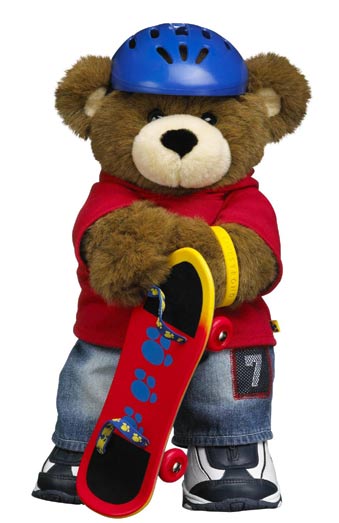
Anyhow, the result is that they get a bear that is 'unique', and are given a birth certificate for the bear with the name they give him.
It occurred to me that this kind of visceral experience - which develops quite an bond between child and bear - would be ideal to partner with a kids virtual-world company to go compete with Webkinz and other kids VWs, which I
blogged about a while back.
Of course the thing with good ideas is that other people have the same ones, and they've already beaten me to the punch, with
BuildABearVille.
Now the key point is this: With Webkinz, you enter your product code, and the online animal matches the physical product you bought at the store - which for kids, is COOL. With BuildABear, you enter a unique ID number off the birth certificate, and you get an online version that is identical to your one-of-a-kind, custom bear that you built. Of course the "one of a kind" bear is only one of given number of permutations of options, but still, to a kid, this is MAGIC!
So anyhow, it's cool, and I suggest you check it out. Take your kid, or a friends kid, or a kid-at-heart, to your local BuildaBear Workshop and give it a whirl.
So what does this have to do with software piracy? Bear with me (and my puns)...
This month's Wired has a great
piece in which David Byrne interviews Radiohead's Thom Yorke and the two of them discuss the shift in the music business of recent times, where music went from being about performance and artist relationship to being about manufactured product and now it's being shifted back the other way, where the manufactured product is no longer monetizable as it once was, and so the value will come from performance and from the relationship that artists can have with fans.
Others have been talking about this too, how the value is in the artist/fan relationship, not in the product per se; and how if the relationship is there, people will gladly pay for it (and the product in turn).
Traditionally in games, the discussion around 'relationship' has been around that of service provision. e.g. You provide a service and the pays for that service on an ongoing basis, whether it's on a per-month basis, per-game basis, per-item basis or whatever. MMO's, Xbox Live, Kart Rider, Gametap, are all examples of this.
But perhaps another path exists, other than "service provision as proof of relationship". What if we think about "Personalized product as expression of relationship"?
So what do I mean by this? Consider things like architecture plans. These are copyrighted, architects that do plans for 'cookie cutter' houses and the like have to worry about their designs being used without their permission. However, an architect hired to do a custom design for a client very likely has to worry less. Why? Because the plans were done for THAT client, and that client very likely doesn't want his design copied and takes pride in it's uniqueness and that it was done for him. "Look at my kitchen. Personally designed for me by Hans Arkitekt."
To take this to games, if we could find a way to build a game for a specific customer, tailored to them, then this should mean that they could share it with someone else, but that person wouldn't want it, they'd want their own. In the same way that I may covet my friend's tailored suit, but that doesn't mean I want his suit, but rather that I want one of my own.
So what would it mean to build a game *for a specific customer*? I'm not sure. But I'm not talking about nonsense like binding it to the user's machine with DRM and the like. No, that's silly and people will find a way to strip it out anyway. No, the personalization has to add value in some way.
It could be an object of social status ("Look, Cliffy B personally autographed my copy of Gears and thanked me for my business"), an element of personal integration ("It came pre-built with my character stats already set up!"), or custom fitting ("all the graphics assets and settings came perfectly tuned for set up for my personal machine").... who knows.
Actually, it's very likely none of the above. Minds more creative than mine will come up with far better ideas. The best example I can think of is that of The Behemoth and the
custom trophies they built for leaderboard winners. Still, I do think there's something to this, and the first requirement would be a change in mindset. To change from viewing the game as mass-produced product to viewing the finished game as an asset; 95% completed, and now ready for customization and personal delivery to each and every one of your fans. The extent you *value* each one of those relationships, is the extent to which they'll provide value in return.
I guess like any relationship, you have to decide if you are ready to put some work into it and hold up your end of the bargain...
 Labels:
BusinessModels,
Piracy,
Pirates
Labels:
BusinessModels,
Piracy,
Pirates

