Wednesday, September 26, 2012

Book Review: The Technologists

The Technologists is a Fun little thriller/whodunit based in late 19th century Boston. Call it 'Historical fiction with a pinch of steampunk'. The first graduating class of the newly-founded MIT are forced to band together to get to the bottom of a series of technology-based disasters that befall the  city.

The book started out a bit weak, with the period-centric language feeling forced, and some of the character motivations feeling excessively contrived (e.g. in several places in the book, anti-technology folk stop their violence/rioting/etc to pontificate on the evils of science and technology). The science used to create the disasters is contrived and implausible, but this is as forgivable as that used in your average Bond flick.

The book really comes together in later chapters though. A good thriller like this, upon revealing who's behind the wrong-doing, should have you exclaiming "I should have known it was him! The signs were there all along!". The author accomplishes this several times over, only then to pull the reader back to realize that the given character wasn't the culprit after all. The author did a good job doing this, making the last few chapters worth the few groans induced during the earlier parts of the book.

The Technologists: A Novel

Sunday, September 23, 2012

Book Review: A.D.D: Adolescent Demo Division

I find Douglas Rushkoff a provocative thinker about media theory, so when I heard he'd co-authored a graphic novel related to the subject, I put it on the to-read list and recently picked it up at my public library.

A.D.D.: Adolescent Demo Division centers around a group of teenage professional gamers in a near-future where reality TV, pro gaming leagues and mega-corp marketing collide. The result is part X-men, part Enders Game, and part MTV's Real World.
While that might sounds like an interesting setup, the book has many flaws and so I can't strongly recommend it.

On the positive side, the artwork is clean and well done. I find many modern graphic novels leave me lost, artisitic ambition sacrificing a clear indicator of where the reader's eyes should go next. ADD doesn't suffer from this. Additionally, there are some interesting bits of near-term sci-fi in the setting.

What it does suffer from is a poor connection to the story, especially at the end when it's never fully revealed what the evil corporation is actually up to. Additionally, the excessive use of slang and offensive language (think lots of boner jokes, towel-snapping shower, and cyber-porn-tugging scenes) may have been used to make it clear that these are teenage boys lacking parenting (a pinch of Lord of the Flies in there), it comes off as flat and forced, hurting more than helping the story.

If I had to rate it, I'd give it 2/5. YMMV. A.D.D.: Adolescent Demo Division

Tuesday, September 18, 2012

Console Volumes over time

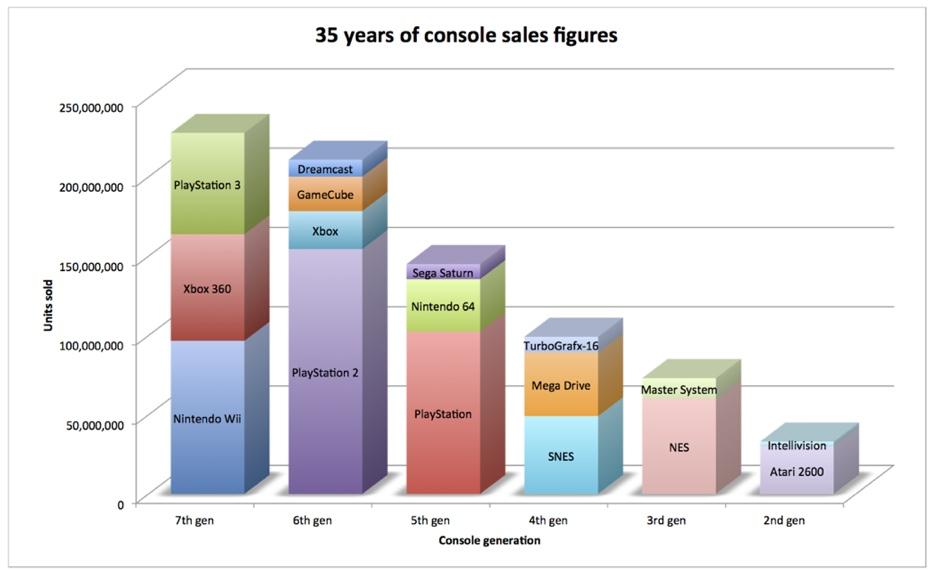
Martin Hollis tweeted a link to this very nice graph comparing the console "Generations" and their total unit volumes:


It's a nice graph, despite the chronological order being right to left.

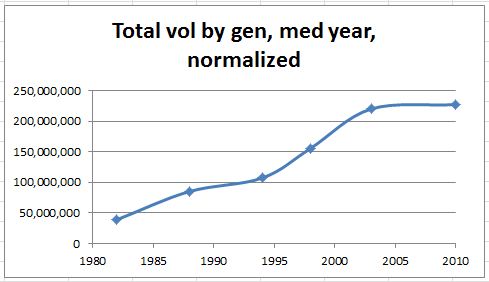
It's a rough swag to group by generation as it is, since launch dates and end-of-life dates have only some alignment. Since some liberties were already taken, and I was curious, I did two things:

- Aligned the generations by date, picking a rough data for "mid life cycle"
- Normalized to 2010 numbers for population size. I used the sum of US, Japan, UK, France, Germany, as my proxy for "first world", as that's where most consoles are sold anyhow.

The resultant graph looks like this (going left to right with time)


Sort of more telling I think. Question is whether the current plateau is an anomaly, or whether we've saturated the market for consoles. A good second question is what this would look like if you removed the portion of Wii sales that were "fad customers", and whether that's fair to do in trying to preduct the next gen numbers.

Anyhow, food for thought.

Friday, September 14, 2012

Book Review: Hello, Skater Girl

I backed my friend Julian Bleecker's book Hello, Skater Girl on Kickstarter and just received my copy.

Julian spent well over a year photographing skateboarding girls in Venice Beach and it shows in his photos. He not only captures some great action shots, but shots of the girls eating, laughing, etc, and as a result you get a nice little snapshot of a particular sub-culture community.

Here's a nice video he did that captures the spirit of making the book, and gives you a feel for the book itself.


It's a really pretty book that makes a nice addition to a collection of photo books, if you are into such things. I'm also looking forward to my daughter consuming it some day, not in hopes that she'll become a skater, but rather that she'll see that girls can do whatever they want - even things that some think are just for boys.

My only complaint is that I'd have loved for some of the back story (much of which is on Julian's blog) about the shoots to have made it into the book. Now, that would have changed the nature of the book itself, which is purely a photo book, so I'll forgive him for not including it, and now you've got an excuse to pour through his blog too. (As an example of what I mean, read this page, about climbing "Seal-Team-6" style into the back yard of a condemned 70's house, and it makes the photos of skating the pool that much sweeter.


Wednesday, September 5, 2012

Book Review: Neuromancer

I'd never read William Gibson's seminal cyberpunk thriller, Neuromancer but have had it on the to-read list for a long time. It holds up well, and is amazingly prescient given that it was written in 1984. Not only did he coin 'cyberspace', but think about where your concept of computers and networking in nineteen eighty frikkin four and then imagine, "The matrix has its roots in primitive arcade games. …Cyberspace. A consensual hallucination experienced daily by billions of legitimate operators, in every nation". Holy balls.

As visionary as Blade Runner, in some ways more so.

As an aside, I now look upon The Matrix in a whole different light. So much of it was clearly lifted from Neuromancer. I'm surprised there wasn't more talk of it at the time that movie came out.

Anyhow, if you've never read it, do yourself a favor and do so. Get a recent copy as it'll have updates from the author with some perspective on the time since it's writing.

Neuromancer

Monday, September 3, 2012

Book Review: The Windup Girl

I loved The Windup Girl. Biotech steampunk. Monsanto-styled shocktroops. Blade Runner's neon and steel city of the future, but powered by springs and compost. Takes a little while to get going but wow, when it does, it's great. It's sci-fi at it's best in the sense that the author uses a superbly envisioned future to frame social commentary about biotech, genetic modification of food and animals, and corporations holding patents over such things. Some of the characters are a little flat but I'll forgive him that given how well the rest of the book executed.

 The Windup Girl

Friday, August 17, 2012

Signs the Future is Already Here (biotech edition)

Couple things that came across my radar this week, despite being a few years old.

1) Doggie DNA testing service.

Unsure of the pedigree of that mutt you got at the point? Test their DNA and get a family tree of breeds.


2) Genetically-modded fish, trademarked, owned, and available for purchase as pets!

I was at the petstore with the kids and saw some day-glow (tropical looking) freshwater fish for sale. I noticed a (r) beside the name, Glofish, and thought, hmm, maybe they are GMO fish? Sure enough, yes.


(photo from Glofish.com)

Anyhow, this would have been the stuff of sci-fi only a couple years ago. Hmm....

Monday, July 30, 2012

Book Review: Distrust That Particular Flavor


Usually, I'm not a fan of these types of books, where a publisher has persuaded an author to throw together a bunch of previously published articles, talks, and the like, into a collection for sake of putting it on a shelf.

That said, I found this book pretty good for a couple reasons: (1) It was interesting to learn some background on Gibson's writing process and his, well, I'll call it 'observational research'. (2) There were some interesting bits of background on books of his that I read that gave me new appreciation for them (e.g. I feel much better about Pattern Recognition now), and (3) it was interesting to read these different pieces from over a decade or two, that were each mini-time capsules of futurism, upon which Gibson gives some additional commentary.

If you like speculative fiction and near-term futurism, this is a good read.

Distrust That Particular Flavor

Tuesday, July 24, 2012

Book Review: Logicomix

For a while now I've been whittling away at Logicomix, a graphic novel about the life of philosopher and mathematician Bertrand Russell. I've never had any particular urge to learn about him, but I saw several positive reviews of the book popping up from time to time so I decided to give it a whirl.

While the book is loosely a biography, it really uses this for it's real purpose, providing the reader with a history of the development of logic at the turn of the last century. In doing so, it uses Russell as a central figure but also talks of the work of Frege, Pointecare, even up to Turing (the latter mentioned only later in the book as a 'look where this lead' type of example).

One complaint is that I would have liked some of the subjects treated in Scott-McCloud-style graphic illustration, while they instead are treated only with text, with the illustration just being of Russell or someone else discussing the idea.

In covering these subjects so sweepingly and in graphic novel form, it doesn't go into the detail some might want, but it does give a palpable sense of the different schools of thought prevalent at different times and how they evolved. This it does in a pretty compelling way, in a book that's interesting and beautifully illustrated.

Logicomix: An Epic Search for Truth

Wednesday, July 11, 2012

Book Review: A Short History Of Nearly Everything

A Short History of Nearly Everything is a brief history of the physical sciences.

Bryson takes the reader through an introduction to geology, paleontology, nuclear physics, chemistry and a host of other topics. The book is both a crash course in how they work and fit together, as well as the history of each field.

The coverage is pretty lightweight (it would have to be, for this wide a set of topics) and humorous as Bryson pulls numerous memorable trivia and stories on the persons involved. Anyone who's a fan of James Burke (of Connections fame) will find this book to their liking.

 The only down side I can think of is that he goes on a tangent of doom-and-gloom for a while, which I found was laid on a little thick, but I still quite enjoyed the book.

 A Short History of Nearly Everything

Monday, July 9, 2012

Book Review: The Mongoliad: Book One

Fast paced, medieval sword-n-shield, knights vs mongols, action. The fast action swashbuckling of System of the World, without the lengthy political in-betweeny bits. I tore through this one really quickly. My only complaint is that the next book isn't due out for a while and the cliff hanger at the end has me wanting more.

Wednesday, June 27, 2012

Book Review: Rocket Men

Fantastic book. Most know the story of the Apollo 11 mission to moon, at least in short form. In Rocket Men however, it's covered in a great level of detail, with interviews from crew members, ground crew, researchers, etc, and in doing so really carries across just how amazing a feat it was.


There's also a lot to learn about the way large organizations work. Examples of them both accomplishing amazing things and also being blindly bureaucratic.

Rocket Men: The Epic Story of the First Men on the Moon

Monday, June 25, 2012

Book Review: Pattern Recognition


Pattern Recognition was... ok. Liked the premise, typical cyber-thriller plot that's more speculative-present than future, with a cool-hunter as protagonist. The first 2/3 of the book are pretty good, giving a real palpable taste for the various scenes (in multiple senses of 'scene').

However, three main flaws were that made me give the low rating. First, Gibson didn't really convey the cool-hunting thing other than giving the protagonist a kind of an ingrained ability/allergy that let her sense what would work. Secondly, and a far more egregious sin, is that the ending is a real failure. These are the types of stories you want to come together in the end, where the threads of stories and different characters wind and twist closer together until everything is brought to a tight finish. Stephenson is a master at this, for example. However, in Pattern Recognition, Gibson just has it kind of suddenly happen and that's that. Kind of hard to explain without spoilers, but suffice it to say that it's an unsatisfying end. Third, and related to the last point, is that several of the characters, including the main antagonist, just kind of dead-end.

Fail. skip it.

Sunday, June 10, 2012

Book Review: Benjamin Franklin - An American Life

When I read the Steve Jobs book a while back, a friend of mine remarked that he'd preferred the book on Benjamin Franklin by the same author, Walter Isaacson. I added it to my list and then ended up doing it as an audio book, covering the bulk of it this past week while at E3, as I was staying far out and had a lot of rental car time.

Benjamin Franklin: An American Life, like the Steve Jobs book, is a good introductory book to Franklin. A pretty thorough work in the account of his history and accomplishments, it doesn't excessively focus on any one area.

If there's any fault to it, it's that it doesn't do too much to get into Franklin's head and discuss emotional state, relationships with those in his family (e.g. it talks about his relationship with his wife but not the emotional state of that relationship). Now granted, in order to do so, I'd imagine some poetic license would need to be taken.

Franklin was an amazing person. Like many, he was not without flaws. Still, if you've read no other work accounting his history, this is a good place to start.

Benjamin Franklin: An American Life


Monday, June 4, 2012

Book Review: Beware Dangerism

This was a great little Kindle Single by Gever Tully (of Tinkering School and 50 Dangerous Things (You Should Let Your Children Do) fame).

It is a nice short outline of his argument (one I share and have debated with several parents, including the one I'm married to) about the trend toward 'dangerism'. Dangerism is a term he defines as the circular ratcheting up of fear around certain activities, the hardening of safety measures around those, and the subsequent further ratcheting up of the fear induced by the hardened safety measures. For example, people fear merry-go-rounds are unsafe, so they remove them from a playground or two, which then incites other people to assume they are unsafe because they've been removed from a few playgrounds, etc.

In the book, he breaks down the numerous factors contributing to this, among which are media fear-mongering, fear of litigation, tendency of individuals to focus on risks they can have effect upon, and more. It's a nicely structured argument in a short format.

I fear that it's not robust enough an argument to withstand someone who's decided to believe in one of these dangers - maybe that's not even possible - but it can at least provide helpful fodder to the debate.

Beware Dangerism!

Sunday, June 3, 2012

Book Review: The Great Big Beautiful Tomorrow

Browsing at Powells (aka The REAL Happiest Place On Earth), I happened on Cory Doctorow's The Great Big Beautiful Tomorrow, a sci-fi novella coupled with a transcript of a lecture on copyright and the arts, and a trascription of an interview with Cory from a couple years back. It was a cheap buy so I picked it up and threw it in my travel bag.

The lecture on copyright is good, but offers little over other talks I've seen him give, so while good, it did little for me. Same goes with the interview. Feels like the publisher added them to pad it up and justify the book price.

That said, the novella was quite clever. It's about a transhuman boy who is sort of an alpha-version of an immortal, who is separated from his inventor/father and forced to make sense of what he is while finding a way to fit in with a very strange and evolving future world. There are a few surprises and twists along the way. Like many of Cory's books, Disney artifacts play a role in the story as well.

It was clever and I quite liked it.

The Great Big Beautiful Tomorrow

Saturday, June 2, 2012

Book Review: The Next 100 Years

A while back I reviewed George Friedman's The Next Decade. Before he wrote that book, he wrote a coarser-grained, longer term look at the future, The Next 100 Years. I mentioned that while I disagreed with much of the 'decade' book, I enjoyed the gaming out of the possibilities, and that it gave food for thought.

I found less of interest in The Next 100 Years. It's expected that the error bars would grow wider looking further out in time, but it's not that I disagree with, it's the author's methods. He picks selectively from influencing forces, picks and chooses from coarse or fine grained elements and in the level of specificity.

By the time he had a coalition of the Turks and the Japanese attacking the US by flinging rocks from the far side of the moon, well, I had a hard time continuing on. I forced myself through the book, but can't recommend it.

The Next 100 Years: A Forecast for the 21st Century

Thursday, May 17, 2012

Book Review: Screw It, Lets Do It

I picked up Richard Branson's Screw It, Let's Do It at the library in audio book form as something to easily get through on a recent business trip where I was going to have a bunch of driving.

I was a fan of his earlier book, Losing My Virginity, and had mixed reviews for Business Stripped Bare. This latest one rates somewhere between the two. More generalized advice, less detail on the early days of Virgin Music and Virgin Atlantic (Losing My Virginity covers both well), but does cover some hairy tales of his sailing and ballooning exploits. Some of these stories overlap with the earlier book, but its interesting enough storytelling that I didn't mind.

Screw It, Let's Do It

Wednesday, May 16, 2012

3D Printing and wonders of the Internet


Top of the list of things I will NOT be using my 3D Printer for? Buttplugs!

That said, the fact that someone is using Republican candidate approval rating data visualization to cast molds for 3D printed buttplugs, well... if this doesn't demonstrate the wonders of maker culture in the Internet age, I don't know what does.


Tuesday, May 8, 2012

Book Review: How to Fix Copyright

In late 2009 I reviewed William Patry's great book, Moral Panics And The Copyright Wars. I had high praise for many elements of the book, but dinged Patry a bit for not having a prescriptive solution for any of the issues he raised. I don't think I was alone in this complaint as he responded with a follow-up book late last year entitled How to Fix Copyright.

Like the Moral Panics book, How to Fix Copyright is an even-handed, and extremely thorough treatment of the topic. If it comes off as "copyfight"-leaning to some, it's only because he is critical of the current state of copyright, which leans heavily in favor of rights holding organizations and companies.

Those interested in the topic needn't read the first book, as this one covers the arguments, history, and current state of the law adequately enough with numerous case examples. Perhaps not as deep as the first book in background, but deep enough.

In terms of prescribing solutions, he does this time around. Among his suggestions: Basing the debate on empirical evidence rather than moral panics and biased metaphor, enacting reasonable (shorter) terms of limited monopoly, conditions that take into account the difference between media types, and modernization and unification of rights-holding organizations to allow for international licensing. He also examines several of the issues around international licensing costs and piracy that are really failures to address different  market needs - i.e. Failed business models masquerading as copyright issues.

Some will be frustrated by Patry's refusal to offer a bullet-point list of solutions. He opts instead to weave them through the book as he notes that the issues are complex and nuanced. I admire his sticking to his guns on this. Not all in life fits on a powerpoint slide.

My only fault for the book is this: The first book didn't propose solutions, the second proposes the 'what' but not the 'how'. It's difficult to see the steps toward making these things happen giving the existing regimes and laws, the entrenched interests and their lobbyists. A debate based on fact is a great idea, but how to make one happen, let alone unwind elements of the DMCA? Granted, these aren't easy questions (Some are ones that caused Lessig to go chop at roots).

The above 'fault' is really more a wish. I hope he continues to do great work on this important topic. In the meantime I recommend this book. He's an engaging writer that makes this subject matter highly engaging.


How to Fix Copyright