Wednesday, November 30, 2011

Book Review: Churchill

Churchill by historian Paul Johnson is a biography of Winston Churchill that is a short, easy introduction to those wanting an overview of his life and accomplishments. It is far from an objective look, being high on praise and low on critique of the man. If you can look past the bias, it's an easy entertaining read.

I was familiar with the highlights of Churchill's time leading Britain during the second World War, but not of the rest of his career. Nor did I know much about his many accomplishments.

A few interesting bits:

  • Early in his career, Churchill seemed equal parts opportunist and bad-ass. Having only mediocre educational achievement, he sought to make a name for himself in the military. He sought out (through influence of his family) opportunities to throw himself into any fight in which the military was involved. As a result, he earned 8 medals while fighting in Cuba, India, Sudan, South Africa and then leading a battalion on the western front during WWI. By opportunist, I refer to the fact that he doubled as a correspondent through most of this time, earning money by writing columns and giving speeches about his military exploits.
  • He was a prolific writer, publishing over 15 million words in numerous books and articles. His work on the second world war won him the Nobel Prize in literature.
  • He showed some savvy as to the publishing business as well. e.g. Post WWII, he struck a deal with his successor as Prime Minister to give him exclusive access to all military documents and exclusive use of them under some set of conditions. This put him at a huge advantage over other historians, and given that  Roosevelt, Mussolini, and Hitler were all dead, he was the only western leader left to publish his account.
A good short read, but best taken with a grain of salt, given the author's bias.

Wednesday, November 9, 2011

Book Review: The Art of Living According to Joe Beef

Attending Montreal Game Summit recently, I had dinner with a number of developer friends, including Trapdoor's Ken Schachter who - among other skills - may be the best restaurant-connected industry figure.

Ken hooked us up with dinner at Joe Beef, which was a not-to-be-missed experience not for the faint-of-heart or faint-of-wallet. I won't go into the details here, but suffice it to say that I couldn't encounter the Foie Gras Double-Down and *not* order it. Oof. My arteries!

Anyhow, perhaps as a gesture of how we gushed over the food, or more likely how much we paid for it, we left with copies of the restaurant's book, The Art of Living According to Joe Beef: A Cookbook of Sorts.

I went through the book over the weekend, and rather enjoyed it. I haven't cooked anything out of it, and I should note that most of the dishes aren't easy fare to tackle though I'll likely try my hand at a few. However, the recipe portions only make up a fraction of the book. There are also a really interesting series of pieces on the history of food in Montreal, backgrounders on different wines and liquors, a guide to interesting train journeys around Canada, and even guides on building your own smoker and building an urban garden.

Makes a fun coffee table if you are looking for something different, and if you like to cook and aren't worried about heart failure, then by all means pick it up.

The Art of Living According to Joe Beef: A Cookbook of Sorts

Sunday, October 30, 2011

Book Review: Resonate

A few years back, I read (and reviewed) Nancy Duarte's slide:ology , a book about making presentations. I gave it a mixed review, saying that it was very pretty and perhaps useful in conveying some basics about how to use or not use Powerpoint, but that it focused too much on the slides, and not enough on the story, where clearly the latter is more important.

I guess I wasn't the only one to give her the same criticism, because Resonate is largely an answer to this concern. Duarte touts it as a prequel, and I'd argue it's the more important of the two for most people to read.


Duarte centers the book largely around the Hero's Journey (a sound concept for presentation structure), and then backs it up by analyzing a number of case examples from wide variety of speeches, breaking them down into components and showing how they align to this model. She then goes on to give a number of rules to follow when building presentation narratives. I like her "sparkline" model for visually breaking down presentations.

Overall I liked this book much more than Slideology, though I found it to have two downsides. The first is the same I complained about with the previous book: It's a very pretty, but very lightweight book. Almost as though someone built it out of a PowerPoint presentation to begin with, and filled in pieces of the text. As a result, it's very quick to get through (this may be a plus for some) but lightweight in numerous areas.

The second complaint I have about it is that Duarte doesn't delve into the differences in presenting to different kinds of audiences. She does say to tailor the talk to your audience, but doesn't talk about the dynamics of, say, presenting to superiors rather than subordinates; to a large group vs one-on-one, etc. (For example, when presenting to superiors at a large company, one has to be prepared for being sidelined with questions that you don't have the option of ignoring. If one of of these ends in a 10-minute time sink, then I find it useful to have "ripcord" slides that I can jettison to make time, and will have rehearsed ahead of time how to do a transition from slide 8 to slide 11 gracefully)

Still, even with these complaints, I think anybody but the most accomplished speakers will find something of use in this book.

Resonate

Thursday, October 27, 2011

Coffee Joulies review

I supported a kickstarter campaign a while back for an innovative idea: Coffee Joulies, stainless steel 'beans' filled with a special 'phase change material' that liquefies at 140 degrees, absorbing energy in the process (cooling your coffee) and later solidifies releasing energy (warming your coffee). Idea is that the coffee cools off to be drinkable sooner, but stays warm longer. Good for long drives, etc.

I finally received them in the mail recently, they look like this:


I did some testing on them and the results were not dramatic. I used matching ceramic travel mugs, with lids, and tested both with 2 thermometers, a coffee thermometer and an over thermometer:


I used exactly 1.5 cups of near boiling water and then charted temp over time. I used 3 of the joulies in one mug, and zero in the other.

There was a mild, noticeable effect. However, it wasn't dramatic. Initial temp was 180 in the non-joulie mug, and about 173 in the joulie mug. At the tail end of the experiment, there was about a 5 degree delta the other way, with the joulie mug being warmer.

So they work, right? Not necessarily.

Having those 3 objects in the mug is going to do two things:
(1) It will cool the liquid off at the outset because there's more heat exchange going on.
(2) It will change the overall volume of the resultant 'coffee + joulies' entity. Since the cooling has to do with heat exchange with the outside air (ok coffee <-> mug <-> air). The mug with the joulies is more full, and since the volume rises exponentially compared to surface area, a larger volume will cool more slowly. For an example of this, see THE MOLTEN CORE OF THE EARTH!

So, to know whether the phase change material actually makes a difference, versus say, throwing a handful of well polished rocks in there (see how medieval people kept their tootsies warm in bed), I'd have to do another experiment. Maybe if I have time in the coming days.

 So, I'd say the jury is still out. but I certainly didn't notice a huge dramatic effect. It may have been more pronounced with all five joulies in the cup, but now I'm sacrificing significant coffee volume, and I needs me the java.

[Update: Another thing that occurred to me is that the PCM liquification could probably be verified with the boiled-egg-spinning trick. Heat the joulie up, sit it next to a cool one, try and spin both of them like a top. The one with the liquid center shouldn't spin well]

[Update: Doh! Looks like BoingBoing beat me to posting a review AS I WAS WRITING THIS!. Looks like they concluded roughly the same thing]

Saturday, October 15, 2011

Book Review: Reamde

I just got done with Neal Stephenson's latest, Reamde: . I think I held my breath for the last 40 pages or so. Whew, what a ride.

Readers expecting something in the way of speculative sci-fi along the lines of Snowcrash or Diamond Age may find it comes up a bit short. The book certainly does a little exploration of "where might MMO's end up, but not to the degree that Stross' Halting State did. That said, it's not like the book won't reward the reader in other ways.

The book takes the reader on a wild ride that starts when some MMO gold farmers try their hand at virus writing to increase revenues, unwittingly tick off some Russian mobsters, who in turn tick off some middle easter terrorists, and then we're off... The rest is classic Stephenson white-knuckle adventure with the reader rooting for the heroes, and not always sure who's on which side.

Reamde: A Novel

Book Review: Alexander the Great and His Time

I was never much of a history buff in school, and so only had some passing knowledge of the history of Alexander the Great and the empire he created.

The author, Agnes Savill, does a decent job of covering Alexander's history both thoroughly and in an engaging style. If you are looking for an engaging summary of such, this could serve as the book to do it.

However, it should probably be taken with a large grain of salt. As I understand it, there are many points in Alexander's history that are debated. Savill claims to want to address these but so plainly gushes over any positive praise and so quickly dismisses any critical points of view, that she comes off as someone who is not only an Alexandrophile, but is so to the point of being incapable of listening to reason.

Alexander the Great and His Time

Tuesday, October 11, 2011

Book Review: Business Model Generation

Business Model Generation is described as a tool to help imagine and craft new business models through use of  something called the "business model canvas", a framework for analyzing business models and considering "what if..." type questions around potential different models.

The book is very pretty. It seems cut from the same cloth as Slideology and others like it. Lots of pictures, pages with sparse text and varied typographical styles. This makes the book easy, even a pleasure, to proceed through, and the concepts easy to internalize.

Two complaints I have don't necessarily mean you should shy away from it, but take them into account. First, the book is too lightweight on, well, details around business models. It would be nice to see a few case studies where it at least went to business plan level. Its easy to imagine thousands of business models, but whether they'll fly or not, well, you need to put some numbers behind them. Secondly, where there are case studies, they are all after the fact. It would be nice if they picked examples of businesses they'd worked with so they had the before-after case, including how the process was used to dream up the new model, what worked, what didn't, etc.

These complaints aside, it's still an interesting book. I think it would be of most use as a framework for a group exercise. Say if you and a few collaborators are trying to do a brainstorm on new business models.

So, if with that in mind the book still sounds interesting, by all means pick it up. Just keep in mind that the detail work is left as an exercise to the reader.

 Business Model Generation: A Handbook for Visionaries, Game Changers, and Challengers

Monday, October 10, 2011

On publishers 'clearing out the attic'

James Bridle has an other excellent piece up about the evolution of text - or I should say the evolving value of text while text itself needn't evolve into other media. It's a good read if you are interested in text as a medium and/or a business.

Toward the tail end, he discusses the challenges to publishers bringing online their back catalogs of text - and how they must do things to add context to the work in today's connected world:

 As publishers spin up their digital and print-on-demand backlists, more and more is published with less and less context. These efforts amount to land-grabs and rights-squatting, without adding value. Works without TOCs, indexes, author bios, footnotes. Placing work in context is one of publishers’ primary tasks, stretching out to commissioning introductions, assembling background material, supporting biographies and critical studies. Design belongs here too: good book design, appropriate book design, as important now as it has ever been.

It struck me that this can easily apply to all those game publishers looking to sift through their back catalogs and re-publisher works onto new platforms and business models. Something to think about.

Sunday, October 9, 2011

Book Review: The Age of Persuasion

Came across The Age of Persuasion at the library and picked it up. It was OK in some ways, poor in others.

The book is a history of modern day marketing, as seen through the eyes of an advertising copywriter turned broadcaster. It covers a lot of interesting history, rife with colorful examples, of advertising over the past century.

On the plus side, there are a ton of interesting factoids, and the authors seemed to have done their research. They cover the advertising side of the business and the factors motivating players in each strata of the business.

On the down side, there are three flaws I find with the book.

The first, which is minor and forgivable, and which can be seen by the cover art, is that the book is very much trying to ride the coattails of Madmen, focusing, and perhaps over-glorifying advertising's 'golden age'.

The second is that "marketing" is not the same thing as "advertising". If the book's tagline were "how advertising ate our culture", that'd be fine, but otherwise the authors perpetuate the myth that marketing is about ramming stuff down people's throats. It largely ignores the other half, which is figuring out what they want or need to begin with.

The third issue is that by seeing the world through an ad man's eyes, the book is too quick to ascribe too much value and too little blame to advertising in the influence that it has. Where they do cite negatives, it's always the other guys, the inept and evil ad men, not the creative good ones (which they likely include themselves in). I feel like it's really not so black and white.

If you can see past the negatives, there are some interesting data points and interesting bits of trivia here. Just make sure you take much of the book with a grain of salt.

The Age of Persuasion: How Marketing Ate Our Culture

More connected toy sightings

Early in the year I was saying we'd see more connected toys (see #5). I've noted a few on my radar and thought I'd call them out:

In addition, Sifteos have started shipping and several people are doing iPhone connected robot/vehicle toys like what AR Drone did last year. Tankbot is one example, or here's a comparable kickstarter project which I'm supporting.

All of these are continuing what started a number of years back with Webkinz, UBFunkeys and others, as I discussed here and here.

Will be interesting to watch this space.

Omegathon Junior!

The twins turned 8 recently and each wanted their own sleepover birthday party. Tom wanted his videogame themed, so I was put in charge. Since he had his circle of friends had all professed being SO awesome at videogames, I decided to put this to the test. I hope the penny arcade crew will forgive me for totally ripping off the Omegathon, their awesome contest held at Pax.

I wanted to have games that were easy to pick up and play, had play sessions under 5 minutes (because 5 minutes * 6 games * 6 kids, plus time for practice sessions, was going to be all time would allow for), and most importantly, covered a range of periods of gaming history.

We played 6 games, and the 6 boys were awarded between 1 and 6 points depending on their rank on each game. Final round was worth double points, and then the points were totalled.

Here's an account of what we put together. It was a TON of fun, the boys had a blast, and it was easy and inexpensive to put together.

Round 1: Pong

Well, to be accurate, it was "single player handball" on an APF TV Fun machine, my first game system that dad bought back in ~1978. It has several game modes, including a single player "handball". Since the rheostate on my player2 side was giving me trouble, we went with singple player, and then the kids competed to see who could score lowest in one minute of gameplay.

Round 2: Ladybug (on Colecovision)

The kids *loved* this game despite none of them having seen it, and especially loved discovering the secrets to the game (bonuses/extras/specials with the color changes over time, etc).


Round 3: Time Pilot (on Xbox360)

Moving forward, I picked this one because it's easy to pickup and fast to play. Also comparable in ways to Geowars, which we'd play later on.

Round 4: Peggle (on iPad)

Most of the boys had played this in one form or another. Another hit.


Round 5: Geometry Wars: Retro Evolved

They liked this game too, but only one of the boys had played it before and had somewhat of an advantage as a result. Maybe could have picked something obscure.

Round 6: Fruit Ninja Kinect

I left this one for last as I knew it'd be a double-point round, and the big push for the finish, and thus a chance to work off all the birthday cake sugar. It was hysterical to see them all pouring every last ounce of energy into the game's final seconds. (I'd post pics, but by this point kids were in their PJs and some parents might be paranoid about half-naked pics of their kids being posted).

Results:

In the end, Tom and one of his friends tied for the lead position.


All the kids were given trophies, which Alisa ordered a couple weeks ahead of time and which were dirt cheap. Here's a pic of one of them.

Anyhow, I hope this gives some other parents an idea to do the same sort of thing. The kids were already talking rematch at next year's Omegathon Junior when they went home the next day.


Thursday, September 22, 2011

Book Review: The Tomorrow Project

Recently, I blogged about science fiction as a tool for forecasting future usages and the like. In that post, I mentioned The Tomorrow Project, a science fiction anthology curated by an Intel co-worker. The project enlisted several science fiction authors to look at what we are researching at Intel and draw from these for their stories.

The book is available for free in PDF form, or can be bought in carbon form here:The Tomorrow Project.

It's a short read and definitely worth getting. I didn't care much for the first story, which is more of a far-reaching sci-fi story. The other three however, are near-future sci-fi vignettes that are each *okay* as stories, but are great imaginative pictures of uses of near-future technology. Among those name-checked and addressed: Home automation, ubiquitous sensors, computer-driven automobiles, media/content creation and more.

I recommend checking it out.


The Tomorrow Project: Bestselling Authors Describe Daily Life in the Future

Sunday, September 18, 2011

Book Review: Liar's Poker

A few months back I reviewed Michael Lewis' The Big Short. Shortly thereafter, a few friends recommended his earlier work, Liar's Poker. I got around to reading it last week.

Liar's Poker was Lewis' literary debut, and tells the account of his time as a Wall street trader at Salomon Brothers, where he spent several years.

The book talks in detail about the hiring process, culture, and career path at the firm, and in the process paints an accurate picture of the dog-eat-dog harsh culture in these firms. It would strain credibility for me if I didn't have a good friend who worked at such a firm and who has shared countless stories that mirror Lewis' account. It then goes on to talk about the rise and fall of the firm during rushes around gold-rushes in the mortgage security and junk bond markets.

While not as detailed an account of the systemic flaws of modern day markets & market regulation as The Big Short was, it does go into enough detail in the style that Lewis has become famous for. Namely, taking complex and dry topics and making them engaging and digestible.

Where the book shines though, is in the portrayal of the personalities and the culture of trading firms. Characters given pseudonyms such as "The Opportunist" and "The Human Piranha" should give you an idea of why so many who work in this business don't last more than a few years.

Liar's Poker

Tuesday, September 13, 2011

Book Review: Ready Player One

After having a number of friends recommend Ready Player One,  I bought the Kindle version and read it on my iPad & iPhone.

Through the first half of the book, I came *very* close to putting it down, and was ready to dismiss it as the worst book I'd read in several years. I persevered only because so many had recommended it, and the book did improve and redeem itself *somewhat* in the second half.

The basic premise of the story could be described as "a mix of Cory Doctorow's For The Win with Charlie and the Chocolate Factory, in which Charlie is replaced by Richard Garriot". The story is set in a future in which the bulk of civilization spends its time immersed in the ultimate virtual world. The simulation's creator leaves his entire fortune to the gamer who can decipher the ultimate easter egg. Doing so pits nerdy gamers against evil corporations, in a race through countless 1980's entertainment based puzzles.

On the down side, the writing is at best cliche and predictable. At worst, it's like something a high school student would write. Excessive hyperbolic use of adverbs, shallow and predictable characters, and loose plot points abound. Painful to read, but again, the author gets a handle on it in the back half of the book. Also, the 1980's pop culture references are far too frequent and wedged in every corner of the story in ham-handed fashion. Worst of all, as a science fiction piece it is unimaginitive, and most of what's envisioned here is retread from Snowcrash or other classics. Futurists beware.

The latter half of the book improves a great deal, and the final race to the prize actually gets it to page-turner status.

I don't recommend it as strongly as I'd recommend Snow Crash, Halting State, or For the Win. Go pick those up if you haven't read them. They're a far better use of your time, IMHO.

Ready Player One

Saturday, September 10, 2011

Book Review: Havana Nocturne


I came across the audio book of Havana Nocturne while searching the local library for something else. I was intrigued by the synopsis on the back and ended up very happy I picked it up.

The book covers the rise and fall of the Havana mob; the group of American organized crime bosses that conceived of, established and grew a mecca of vice in Havana Cuba; then amassing a fortune from it only to watch it all collapse overnight during the Cuban revolution. The book is filled with a lot of interesting stories and some great characters, ranging from a variety of stereotypical mafioso, to Castro, to Batista whom he overthrew, to stripper Bubbles Darlene, who made a name for herself walking the havana streets in only a transparent raincoat.

Its hard to wrap one's head around the sheer chutzpah of the mob at it's peak. Feeling increasing heat under the eye of the US government, they took it upon themselves to take over a country and create an offshort mecha of vice - and succeeded in doing so.

The book is an entertaining read. A few interesting observations:
- Myer Lansky, "Financier of the Mob" and basically the book's main character, shows some excellent leadership qualities. (1) He's unflappable in front of of his partners and underlings. Even in the middle of the Cubans rioting post-revolution, he remains cool as a cucumber. (2) Despite being in the mob, he knew that peaceful reconciliation, even if more costly, was preferred to violence. (For a lesson applicable to today's business world, replaces 'violence' with 'litigation')
- The whole book is a example of what can happen if you underestimate the possibility of serious disruption to your business. Nothing is 'too big to fail'.
- Fidel Castro was a bad-ass. Say what you will about him once he got into power, but prior to that, doing things like throwing himself off of a boat in police custody and doing a 7 mile ocean swim to shore, well, pretty bad-ass.

Havana Nocturne: How the Mob Owned Cuba and Then Lost It to the Revolution

Monday, September 5, 2011

Futurism, Forecasting & Fiction

Just after posting my review of Charles Stross' Rule 34, BoingBoing linked to this NYT piece on Sci-fi authors predicting the future, perhaps better than analysts or others. Among books name-checked in the article are Super Sad True Love Story (which I loved), and Ready Player One (currently reading, my review won't be good).

Not alone in recognizing the potential of these authors to predict our possible futures,Brian David Johnson, an Intel co-worker, has an interesting anthology out. The Tomorrow Project is an anthology of Sci-fi short fiction by leading authors (Ray Hammond, Douglas Rushkoff, Markus Heitz, and Scarlett Thomas), commissioned by Intel to speculate on the implications of certain technologies.

I haven't read it yet (on the to-read list after I'm done Ready Player One, and perhaps Stephenson's new book coming out in a couple weeks), but though it a good time to mention the project and link to it.

The Tomorrow Project is available as a free download here. There's a follow-on with a different set of authors in the works as well.


Book Review: The Republican Noise Machine

A well researched, though left-biased, detailed history of the right's efforts to subvert the media industry/engine. I found it depressing to read, in that I came away not feeling like there was a solution, other than perhaps to take an extremist left-leaning set of tactics that are equally dishonest. It feels like either way, the inevitable victim here is nuanced, intellectually-honest debate.

Though depressing, it's an interesting read and a good look at how the media can be used as a tool by a well organized force. This of course is nothing new:

“The most brilliant propagandist technique will yield no success unless one fundamental principle is borne in mind constantly - it must confine itself to a few points and repeat them over and over” - Joseph Goebbels

The Republican Noise Machine : Right-Wing Media and How It Corrupts Democracy

Sunday, September 4, 2011

Book Review: Rule 34

After I reviewed Charles Stross' Halting State, I gave it a mediocre review for the story, but strong praise for the picture it painted of the possible futures of virtual worlds, augmented reality, and many other facets of gaming.

With Rule 34, Stross has improved his storytelling, while still having a keep eye for possibilities of technology in the not-so-distant future.

Like Halting State, Rule 34 follows an ill-equipped detective investigating a series of crimes and getting in over their head. Instead of a bank heist, this time it's a series of bizarre murders involving bizarre fetishes (thus the title, Rule 34, as explained in number 3 here). As detective stories go, it's not bad, and I think better than Halting State was. Be warned, for those that mind, that there are some racy bits, so not for the kiddies.

Again though, where Stross shines is on his take of the future of 3D printing, custom fabbing/making, DRM, Internet memes, with a good measure of the Big Brother police state (something pretty common amongst UK-based sci-fi writers these days it seems).

This is my favorite piece of fiction so far this year, after Super Sad True Love Story. New Neal Stephenson coming out in a couple weeks though, so we'll see if Stross gets bumped from the podium...

Book Review (x2): Richards' Life vs Clinton's My Life

A while back, I listened to Bill Clinton's My Life as an audio book while I also read Keith Richard's Life. I thought it might be funny to review them together, stating something like "what a difference an possessive pronoun makes". They turned out to be more similar than I'd thought. Both had their moments, but I wouldn't recommend either as strongly as they were recommended to me. As such I'll keep the reviews short.


The first thing you'll hear about Clinton's My Life is that it's huge, at over a thousand pages. My local library had two versions of the audio book, abridged vs unabridged. I highly recommend the abridged version, not just because of the length, but because it's read by Clinton himself, while the unabridged version is ready by someone else.

On the plus side, the main things that come across in Clinton's book are his genuine passion for public service and politics, as well as a portrait of a really hard-working and entrepreneurial Clinton during his youth and early career. There are some great stories about how he capitalized on opportunities thinking outside the box. There are also a few good anecdotes about hardball negotiations during his time in office. If you enjoy stories of this kind, or like hearing about the backroom mechanics of Washington, you may like this book, modulo the caveat I'll get to in a minute.

Richards' Life is, as you'd expect, a bit different. The positives are twofold. First, that Richards comes across as some who, even today but especially in his youth, has a passion for the blues. You really get the feeling that given the choice between the music and the success it brought, he'd rather be a pauper with a guitar than the alternative. Secondly, he comes across as someone who lives his life without a shred of compromise, doing exactly what he wants, when he wants. The result is, as you'd imagine, some pretty crazy stories. A bonus is that, perhaps as a result of the times in which the Rolling Stones enjoyed their success, the number of celebrity circles they intersected result in stories involving many household names of the era, from the Trudeaus to Andy Warhol.

There are a couple things both books have in common. The most positive being that both of them have deep passion for what they do. Unsurprising, as I'd argue this is a pre-requisite for success for anyone.

On the negative side though, there's another thing they have in common: Both authors are liars, telling their audiences, and themselves, a lie.

In Clinton's case, when he gets to the subject of the Lewinski affair, he feigns guilt, talks about it being a low point in his life, etc. Then he repeatedly jumps back to his defense used in his testimonial, and nit-picking fine points about how certain questions were asked, and how his answers here therefore truthful. It's like practiced his statements so much that he's started to believe them.

In Richards' case, his lies are two-fold. First, he's an addict, and though he's quit taking heroin, he still speaks to it like an addict does. 'I was always able to manage it', 'I always took it in moderation', 'It actually made me more productive' are examples of what he says in defense of a habit that he elsewhere admits would have killed him had he not stopped. Secondly, what he on one hand positions as being a free spirit and having an understanding about his dealings in his relationships with others, really comes off as his being a coward. In numerous places he talks about long-term relationships he had with women where rather than breaking up with a girl, he just stops coming home until she figure it out for herself. Sad really.

Both books have many interesting stories and points, but show that the authors have flaws they themselves don't see. Interesting, but not the top of my recommended reading list.

Sunday, August 7, 2011

Book Review: The Next Decade

The Next Decade: Where We've Been . . . and Where We're Going is George Friedman's follow up to his well received "The next 100 years", and attempts to make some more precise predictions about the way the next decade will play out on the world stage.

Overall I liked it, but not because I agreed with everything Friedman has to say. I agreed with perhaps half, with the remainder falling between disagreeing and not knowing enough to say either way.

The bulk of the book centers around Friedman's assertion that America is an "accidental empire", making comparisons to the Roman and British empires, but asserting that while those were created through might, America's was a mix of that, economic might, culture, and a melange of historical accidents. There's some validity to his claims about America's place on the world stage (e.g. 5% of the world's population counting for 25% of the world's GDP), but the analogy is strained at best.

In addition to this analogy being strained, a couple other things I disliked:
  • The author assumes (at least by the weight given in the book) that 99% of what shapes the world stage is politics. Perhaps I'm naive but I believe that the old institutions don't carry the weight they used to and will carry less going forward.
  • Technology in particular, is given only passing mention. When looking at the growth of high tech in places like India and China; or at the recent twitter-fueled uprising in the middle east, it seems there should be more consideration given on this front.

On the other hand, some things I did like:
  • I learned much about the political dynamics in some parts of the world about which I had little history.
  • He asserts that leaders, and the US President in particular, need to lie. That they need to do things that won't be popular and that sometimes this means saying one thing and doing another. I believe this is true, and to believe otherwise is naive.

In short, I recommend it, but to be taken with a considerably sized grain of salt.

Thursday, July 28, 2011

Book Review: SVK

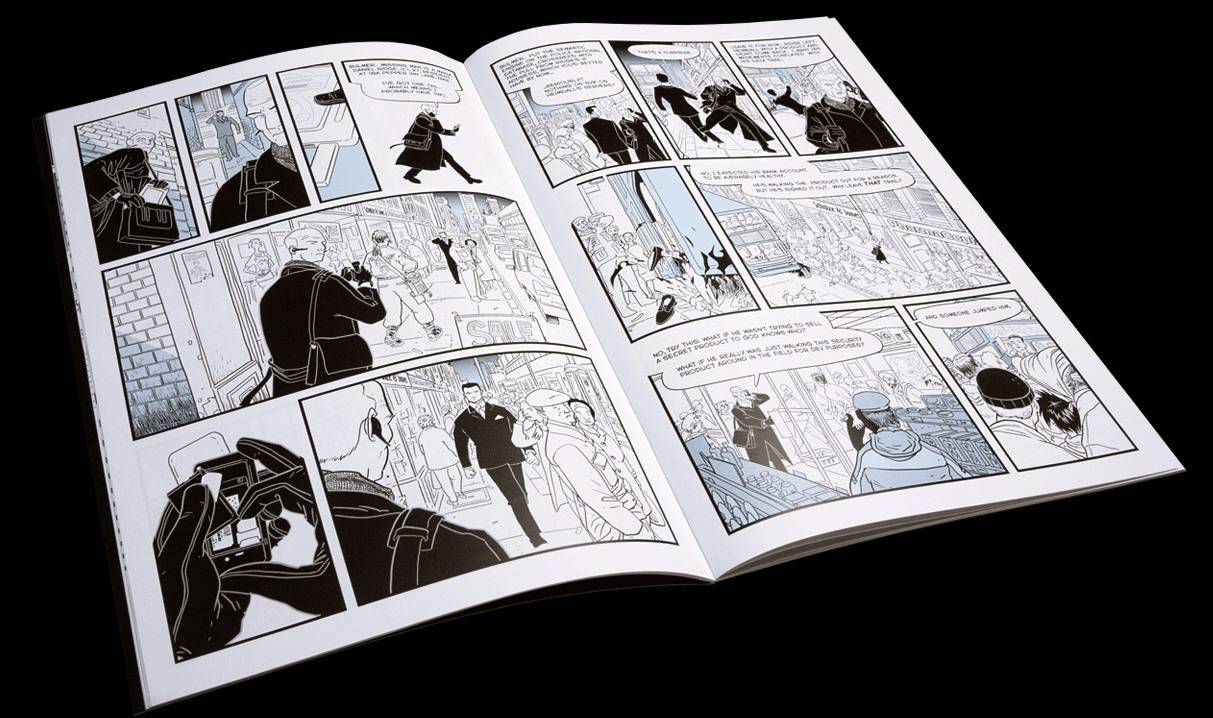
I've been real busy lately, so posts have been lacking and book reviews are backlogged a bit as well. I did, however, want to post about SVK, a really cool comic book release I got my hands on recently.


SVK is an attractively and minimalistically-styled, dark sci-fi comic by Warren Ellis & D'Israeli, about unchecked government control, with an augmented reality theme.

The story centers on a gun-for-hire, hired to clean up a problem for a government security agency. While doing so, he uncovers the roots of what the real problem is and what they are trying to hide. The story is good but by no means unique.

The thing that really sets SVK apart, however, is that it comes with a credit-card sized UV-flashlight, which you shine on the comic to reveal the augmented reality world that the protagonist is seeing. See the pics below.

To add icing to an already delicious cake, the directives at the start of the book, the fictional ads directed at the reader, and the fact that the UV light is make to look like a secret SVK device, all conspire to poke at the 4th wall a bit, making the reader a secret agent of the future, if only for a for an hour.


Monday, July 11, 2011

Book Review: Edward R Murrow and the Birth of Broadcast Journalism

Many people are familiar with Edward R Murrow, mainly in the context of his role in challenging McCarthyism, as portrayed in the film Good Night and Goodluck. Even prior to this film, many are familiar with his role in shaping journalism and in particular with his barn-burner speech that I referenced here.


I, for one, wasn't familiar with his life up to that point, and so when I came across the audiobook version of Edward R. Murrow and the Birth of Broadcast Journalism, I decided to pick it up.

Highly recommended, especially in audiobook form.

First off, the book is a good study of how Murrow's principles guided his actions. He was able to steer a course in complex scenarios because he had a clear view of what he believed was right. Still, there were times where he decided to pick his battles, but this was more about astute politics than it was any wavering in his principles.

Secondly, it's also a lesson about people passionate about a new medium (two actually, radio and then television) experimented to find it's potential. There are lessons here for games as a medium, especially for serious fare.

Finally, the audiobook uses some original recordings which are well worth hearing. Murrow's recount of riding shotgun on a British bomber on a bombing run over Berlin is electrifying, white-knuckle listening, even sixty-plus years later.

My only complaint about the book is that the author, in his conclusion, claims we'll never have another Murrow because the mediums have already been invented - there'll never be another 'birth' period to live through. This is of course untrue. We are still in the midst of the reforming of journalism for the Internet, for one. And games as a medium for news journalism and editorial are even earlier in their development, with folks like Ian Bogost, Molleindustria, and others helping the form to take it's first steps.

I still recommend it as it's easy enough to ignore the author's assertion here and think about what a "Murrow of Games" would challenge us to do with our "Lights in a Box".

Edward R. Murrow and the Birth of Broadcast Journalism (Turning Points in History)

Tuesday, July 5, 2011

Book Review: Do The Work

Lately, I've been doing 4-5 books in parallel. A book in the gear bag, a book on the night table, one floating around the house, one on the iPad, and something lightweight on the phone.

The latter of these, my pick for the iphone, needn't be lightweight in sense of subject matter, but rather for phone use I tend favor books digestible in short chunks. Books by Seth Godin, Hugh McLeod or Guy Kawasaki come to mind. It was in this vein that I came across Do the Work by Steven Pressfield and thought I'd add it to my reading list.

I was really rather disappointed by the book.

It's a sort of motivational book about execution, and pushing through resistance (outside and self-inflicted) to complete creative works.

While this is a topic that can help many, the problem is that the book doesn't have a lot of substance to it. Unlike Godin, who draws many on-point analogies from experience, or McCleod's ability to cut through to tell-it-like-it-is fact, Pressfield's book is filled with labored rhetoric, repetitive truisms and the like.

I didn't find it of much use. YMMV.

Do the Work

Friday, July 1, 2011

3 Problems Hiding in Zynga's IPO filing

[I'm not a lawyer nor an accountant. My opinions are mine and not my employers, etc, etc]

Zynga's S-1 filing is really interesting reading. Tech Crunch has a (rather short) post on it here, and VentureBeat has a better post looking at some of the details here. Hit the bullet points on the VB post if you want the TL;DR version, but most of this will leap out at you from the S1 filing anyway. Short version:
  • 600M revenue in 2010, almost 4X 2009. $235M revenue Q1 this year alone.
  • Profits growing, with revenue (Q1-Q1: 135%), but...
  • R&D up sharply (160%)
  • marketing costs up (130%)
  • but on the plus side, Cost of Revenue (mostly operating costs) up 110%, suggesting they are getting efficient, or benefits of scale, or both
So, all in all they are doing very well, and it certainly looks like a better investment than GroupOn or any of these other crazy IPOs that have people crying bubble.

But hang on a second. It still smells funny. Look at it from 10,000 feet. The company is HIGHLY dependent on one platform/vendor (Facebook), they don't have nearly the revenue or war chest that the incumbent publishers have, etc.

So, I thought I'd read through some of the fine print. I think the S1 doesn't address three important areas:

  1. Allocation of R&D costs: Details on R&D are sparse, and the statement just cites increases in headcount, etc. What it doesn't say is whether that's because of a broadening portfolio of games (that would spread risk) or whether individual game title budgets are growing, which would suggest an increase in risk, as each title becomes a bigger gamble.
  2. Risks posed by entry of EA and other incumbents: As the major publishers awaken to social games, this could have a three-sided effect on Zynga: (i) R&D costs go up to compete on product quality, (ii) possible loss of MSS as the publishers bring major titles to market, and (iii) user acquisition costs go up as the competition drives CPMs on FB's ad network up.
  3. Terms of Facebook credits agreement. To Zynga's credit, they DO call out the move to the Facebook credits system that took place last year, where they went from giving up 2-10% of revenue for payment processing to giving up 30%. However, they didn't just move to Facebook's credit system. They did so after a bit of a fight, and they signed a five year agreement. What are the terms? I'd like to know, for example...
  • Do they get preferential ad pricing and/or placement as a result?
  • Although signed in July 2010, the S1 states the migration was only completed April 2011, so how much of the revenue from 2010 and 1Q11 was earned at 95 points on the dollar vs 70 points?
With any company, it'd be possible to ask infinite numbers of questions to learn or infer more. In this case though, I think there are at least a couple key things that investors should consider.

Food for thought over your long weekend...

Friday, June 24, 2011

The Seven Skills

There was one part of Seth Godin's Linchpin that resonated very strongly with me, and that I wanted to riff on a bit.


Seth has a section on factors that make one indispensable within one's network or organization. I struck me that while these do apply anywhere, in large company environments in particular, Seth really nailed the blueprint.

Here's his list (in bold) with my commentary about how I've seen this apply at large companies like Microsoft and Intel.

I'm certainly not claiming I rate super high on any or all of these. But, where I've had successes, it was from delivering along one or more of these vectors. Similarly, where I've failed it was because I required one of these and fell short.

  1. Provide a unique interface between other members of the organization: Complex organizations inevitably get divided into groups to work on different functions. Sometimes that split is vertical (by product or market segment), sometimes horizontal (by functional area), often both. This necessitates meetings or processes by which decisions get made and priorities managed. Being the person that manages that process, runs the meeting, etc, even if not the person that makes the decision, is a valuable function. That person ends up being the person who knows who is doing what, has all the history of what was assigned to whom, etc.
  2. Deliver Unique Creativity: This is that person in your organization that can synthesize a problem, and provide unique creativity to one element of it. "Sara is the best at coming up with compelling business plan pitches", or "No one comes up with out-of-box ad concepts like Fred".
  3. Manage a Situation, Project, Product or Organization of Great Complexity: The larger the project, be it hardware, software, game, or whatever, the more likely that there will be very complex tradeoffs and priorities to manage. It is VERY common for people to spin themselves into a circular holding pattern because they can't get past some tradeoff. Being the person that understands how to trade off features, schedule, cost and priorities, keeps their eye on fundamental product goals, understands what decisions can be made at a low level and which have to go to the top, and who does/doesn't need to be involved in making it -all of these are valuable skills, especially in aggregate. It also involves recognizing that you can't be the domain expert on every area, so when someone asserts "we must do A", you bring in the expert on the contrarian view and manage the debate.
  4. Lead Customers: There are two angles to this, in my point of view, one is salesmanship, in the most positive sense of the word - understanding customers needs, and helping lead them to a solution. The other one is internal, acting as an effective customer advocate, which means not just "they are asking for feature X", but understanding why, helping internal product teams understand the benefits or consequences of not doing so.
  5. Inspire Staff: People need leadership. At large companies in particular, there are a lot of people that never leave the building. Inspiring them with a mission and a view of how they can have impact, well, I think we can all think of how rare the examples of this are in each of our work histories.
  6. Provide Deep Domain Knowledge: "The smartest guy in the room on topic X". Pretty self evident. Hint: There's no amount of reading that substitutes for actually doing it. e.g. There are sports commentators that are huge fact repositories. There are those that were players or coaches themselves. Those that have both are the ones that have life-long careers.
  7. Possess a Unique Talent: Easier said than done. "She's the only person that can...". The weak form of this is "He's the only person that can access our database because he's never trained anyone on it's structure". That's not a unique talent, that's protectionism. I remember a friend introduced me to a senior guy at EA a few years back and told me "He's the best closer in the business". I asked what they meant, and they said "when a product is over budget and/or behind schedule, or not meeting goals, they send him in. And then it gets fixed".
Anyhow, it struck me as a good list. Chances are you have abilities and challenges along all seven of these points. Good to think about how you can improve and which ones you can make your best ones.

Thursday, June 23, 2011

Riffing on the Popcap acquisition rumor

Yesterday Techcrunch broke this story:


Popcap to be acquired for $1+B, which started a rumor mill going. Who could it be? Story points to potential buyers as: Zynga (discounts them as not having stomach for the price & multiple, EA, DeNA, Tencent.

I tweeted about it saying I thought EA just as a gut call. Later though, I started wondering why no one had asked if it could be Google, or even more credibly, Microsoft.

Techcrunch added a story about rumors that it was likely EA.

And then today, VentureBeat had this story pointing to EA (nothing new, just citing the techcrunch article), but being skeptical about it and pointing at other potential buyers: Zynga, DeNA, Media companies like Fox, Activision/Blizzard, and throwing water on any "stingy" chinese companies.

(WTF, why is VentureBeat also not mentioning Microsoft? Does everyone assume they are broke after buying Skype?)

The interesting thing about these pieces is that they are looking at the market rather naively. Techcrunch refers to Popcap as a startup while at the same time mentioning that they've been in business since 2000. VentureBeat mentions their social games but barely mentions mobile let alone all the other platforms they are on.

Anyhow, I believe the EA rumor is most likely accurate (though I still have a side bet on a surprise that it's Microsoft, but I'm crazy like that).

Just for grins and giggles though, here's some alternate takes on the headlines made possible by this acquisition, which I think make it more apparent that this isn't such a bad buy. Allow me my editorial liberties:

If it's EA:
  • #1 iPhone games publisher buys #2(3?) iPhone games publisher to further cement leadership
  • #2 Facebook games publisher buys #3 facebook game publisher in bid to take lead position away from #1 FB games publisher
  • Leading western games publisher buys another entry ticket in race for China gaming market (Popcap has social games/portal play in China, a shanghai studio doing original IP, etc)
  • EA buys leading casual games dev, "Popcap is the Valve of casual games" says Someone.
If it were to be Microsoft
  • MS buys publisher of popular iPhone, iPad games in bid to secure exclusive content/features for MS phones/tablets
  • MS buys publisher of social games in bid to catch up in that race
  • See same two above points about traction in Asia and Popcap's production abilities, quality
In any case, my point is that there's a lot more value to Popcap than just "Plants vs Zombies on Facebook or iPad". They are a force in the mainstream games market with recognizable IP, real revenue, good distribution, top notch development talent, international portfolio of games and distribution, etc. You can play their games on almost every platform under the sun - even play bejewelled on airplane headrests!)

$1B is a lot of money, but Popcap is an awesome crew, and likely worth it. I sure hope whoever it is doesn't screw the magic formula.

Book Review: Linchpin

I've reviewed a bunch of Seth Godin books here, and while I'm a great admirer of his, my reviews have varied; with some medium-to-highly rated (Meatball Sundae, Poke the Box, Small is the New Big), and some less so (The Dip).

Linchpin is flawed, but valuable. I give it a recommendation, but only for those that understand that there'll be some repetitiveness, and some random jumping from topic to topic. Nevertheless, there are some good points made.

At a high level, it's Seth's take on what it takes to be essential - a linchpin - in your organization, network or community. His high level assertion is that the Internet, the attention economy, and other factors have fundamentally changed the nature of work. Being a quiet cog in a machine is a decreasingly viable path, and so people need to think about what factors make certain people indispensable.

By way of flaws, the book flits from topic to topic and back without a lot of structure. It's divided into sections, but then bounces between some of the same issues covered in other sections. Many of the anecdotes are detail and context free enough that they added little value or color.

The book is still valuable though. There are many points in the book that provide good food for thought, and several more structured entries that provide the kind of well articulated analysis that Godin is capable of and that I wish we'd see more in his recent books. At least one of these sections was valuable enough, and resonated with me enough, that I'm doing a separate post on it alone.

Thursday, June 16, 2011

Book Review: Panic!

I really enjoyed Michael Lewis' The Big Short, and so when I saw this previous work at the local library I picked it up.

Panic: The Story of Modern Financial Insanity, is *edited* by Lewis, but is really an anthology of articles from WSJ and other financial news outlets. The book takes a look the last few big financial market panics (the 'black monday' of '87, the Russian crisis, the southeast Asian currency crisis, the dot-com bubble, and the recent real estate crash) and takes select pieces of reporting from before, during, and after each of those panics.

When viewed as whole one is led inevitably conclude three things:

  1. That no matter how many instances of "irrational exuberance" we go through, we never learn. We have innate ability to believe that this time it's different. The ability for amateur investors, professional investors, economists and reporters to collectively lose touch with reality and start drinking each other's kool-aid is *amazing*.
  2. That after panic hits, after the bomb goes off, and when people finally pop their heads out again, everyone has an equally amazing ability to claim that they knew this was going to occur, and that they called it ahead of time. This level of revisionist history is somewhat akin to how every friend you have that went to Vegas has convinced themselves that they returned "up a couple bucks" (they didn't. Somone is paying for those hotels).
  3. That in both the run up to the peak and in the panic afterward, the press is not only not objective, but possibly an even greater contributor to the mob mentality than the investors they later blame for it. Examples from the dot-com era here were an awesome example, buying hook-line-and-sinker the pitch that fundamentals no longer applied and that it was about a land grab now in favor of user revenues later - the press *loved* this story and sang it to whomever would listen.

Some critics of the book claim that the analysis here isn't deep enough, and that solutions to the crisis (or future ones) weren't offered or expanded on. However, I don't think this is the point. I think the book is a valuable one if only to view how important it is to lift your head up from whatever current trending thought there is and ask yourself if there isn't myopic group think happening once again.

In this sense, the book serves it's purpose, and so provides insight as well as a fun little history lesson.

Sunday, June 12, 2011

Book Review: Team of Rivals

Before leaving for E3, I had the chance to finish Doris Kearn Goodwin's Team of Rivals: The Political Genius of Abraham Lincoln, and quite enjoyed it, despite a couple flaws.


The book is about Lincoln's relationship with his famed cabinet, made up of what had been some of his biggest rivals in the run up to his winning the republican party's nomination as presidential candidate. Much has been written about how he structured his cabinet out of people that would not only counsel him objectively, but take strong contrarian stances to his position on issues. This book explores those relationships, from the run up to the presidency until his assassination, and does so pretty deeply through letters, diaries, and other accounts of the communications between them.

Perhaps those that went to school in America are more well versed on Lincoln and on the history of the civil war than I am, but still I think there's a lot of depth here that offers some great lessons on character and leadership.

Also, again, because I don't know a lot of the history here, I found the accounts of the great battles and turning points of the civil war to be fascinating. I also didn't know that Lincoln's assassination was part of a triple assassination (the other two planned killings, of vice president Johnson and secretary of state Seward, were abandoned and unsuccessful, respectively).

The main complaint I have about the book is that in gushing praise upon Lincoln, it fails to make any criticism of him. Even while talking about his failed calls in selecting some of the leadership of his military leaders, it apologizes on his behalf. The book also gives disproportionate weight to some things in his life versus what must have been the heaviest at the time (e.g. social functions and the like, compared to war campaign decisions).

This critique aside, the book is still a good read and a good crash course and inside peek on a great leader in action.

Monday, June 6, 2011

Seven Fables Kickstarter project

Mark Stephen Meadows, a couple of who's books I've reviewed (here, here) has a cool new Kickstarter project project going, building an interactive iPad app and a leatherbound collector book around seven fables taking place around the sea.


I spent a little time last year on Mark's boat in Mexico and he's a pretty interesting character, and I'm confident the book and app are going to be marvelous. Go support it!

Sunday, June 5, 2011

Project Cafe Speculation

Since we're a couple days away from Nintendo's presser at E3, I'm calling last chance to speculate on what Nintendo has up their sleeves with "Project Cafe" that hasn't already been leaked.


The most fervent rumor discussion is around the controller, which is supposed to be some kind of tablet with a 6 inch screen, buttons and a d-pad on the side, and tilt sensors and the like.

Anyhow, here's my prediction:

- Nintendo will claim the controller can also play stand-alone games.
- They will position the controller as being a "tablet that comes free with your console" and will show some entertainment functions for it
- The 'comes free' is a bit of a ruse, as buying a second controller will have a hefty price tag
- They will put on a brave face about the 3DS and that business being alive and well

Over time, though, I believe they see the writing on the wall about their hand-held businesses being commoditize and subsumed by phones and tablets, and so this is their attempt to in turn commoditize those businesses. I think its a weak attempt to do so, but there's some logic to the strategy and should allow them to circle the wagons with their core base.

It'll be interesting to see whether Nintendo can pull off yet another hail-mary pass (like they did with the Wii and the DS).

Shh!! 3 Unspoken Lies About Social Games

The inimitable Greg Costikyan wrote an excellent piece for Gamasutra, lambasting Social Games, and claiming that they are in fact not very social at all.


I agree, and thought I'd add two more topics that came up in conversation at Login recently, and in conversations with a couple social games developer friends.

So let's give Greg Credit for calling out the first lie on my list:

Lie #1. Social games are social games. (Truth - they aren't very social at all)

And to this I'll level two more accusations.

Lie #2. Social games are viral. (Truth - they aren't)

Social games are often cited as "viral", or having the opportunity to be so, because of the social network on which they reside. However, short of the early days in which FB allowed apps to spam a user's friends list, this just isn't the case.

Companies like Zynga are rumored to spend many millions on advertising within FB to acquire users, but if the games were truly viral, they would spread on their own, being recommended whole-heartedly by friends via word of mouth.

The fact that few social games have been able to exceed the virality of the average dog-on-skateboard Youtube video - let alone the virality of an Angry Birds - is proof that they aren't viral. (Some examples do come to mind though. Parking wars and Cow Clicker certainly got a lot of watercooler talk.)

Lie #3: Social Game Publishers are building Games, not Products. (Truth - most have little respect for the medium other than as a revenue generator).

I'll cut to the chase: To my knowledge large publishers in this space, like Zynga and Playdom, don't have developer credits listed in their games.

I wasn't able to find them anyway. I had a couple developer friends lament about the fact that there were no game credits and that when they'd asked management at these companies, they'd been told no.

I think that speaks volumes about those publishing these games and what they think of the people working on them, and of their contributions. "It's just a product, and you are just a cog".

There are a few companies out there doing the right thing (I'm looking at you Brenda!), but I fear these are the exception.

With all the excitement around 'Social Games' these days, it's important that we don't delude ourselves about some of the lies being told.

//rant off

Wednesday, June 1, 2011

Beyond Aperture: Unofficial Portal 1 Epilogue

BoingBoing points us to this beautiful Portal (1) epilogue. Well made, clever.