Monday, February 15, 2010

Book Review: Makers

I finished Cory Doctorow's Makers a few days back but haven't had time to post a review until just now, which has given me some time to mull it over a bit before doing so.


On the surface, Makers is Doctorow revisiting familiar territory: Distopian steampunk sci-fi, this time around the premise of the collision between personal fabrication and incumbent industry (something he already visited in short form in After the Siege).

The book has more to it than just this.

It's partly a parable of Lessig's Free Culture argument [Creativity and innovation always build on the past; The past always tries to control the creativity that builds upon it; Free societies enable the future by limiting this power of the past; Ours is less and less a free society].

It's also a story about Creative Destruction, and about how our legal and governmental systems impede it.

Mix in notes of Doctorow' attachment (and I'm guessing love-hate feelings) for Disney (which he also visited in Down and Out in the Magic Kingdom), an opinion on working at large corporations (the passage on page 403 rang so true it was painful to read), a commentary about shanty towns and peoples ability to govern themselves, some thoughts on obesity, consumerism, and other facets of the decline of American society, and you have the makings of a fun and thought provoking novel.

[One note: As some of the Amazon reviews note, there's a couple of pretty graphic sex scenes in the book. Not a big deal for adults, but for those that might have read Little Brother and might think this suitable to give to kids for reading, well, buyer beware. Personally, I think it's fine for a writer to stretch his wings a little as I think he's done here. I was surprised by the vitriole in some of those Amazon reviews. On another related note: It's kind of weird reading really graphic stuff like that written by a guy I've had dinner with a couple times :-/. ]

Monday, February 1, 2010

Playfish's Smart Move in the Facebook Gold Rush

This is a good piece on why Playfish sold itself to EA.


New markets (for game makers or anyone else), the successful ones anyway, tend to turn into gold rushes. Someone takes a chance, stakes a claim, hits gold, and then in come the hordes of followers that heard about the guy that got rich with only a mule, a pan, and the clothes on his back.

In recent years we saw a casual games gold rush, a console downloadable (lead by XBLA) gold rush, an iPhone gold rush, and now it's "Wagons, Ho!" for the Facebook gold rush.

With each of them, the market achieves an equilibrium over time as competition increases faster than consumer spending does, and eventually you get to the same place as the rest of the games industry: A hit driven business in which a minority are profitable, a very small minority are extremely profitable, and the majority go bust trying to get to the top end of the curve.

What *differs* though, in how these markets evolve, is the tactics taken as the marketplace crowds. The strategies available are the same across all of these, but which is the right one, tactically, varies by platform.

They are:
  1. Lowball on price: The PC casual download biz eventually went this way, and many are trying this tactic on the iPhone, but I believe it's a fools game, and some of the others below will turn out to be the real winners for that platform.
  2. Out-Innovate: This one is easy. Go invent an awesome game mechanic/biz model/etc, that no one else has thought of, and that everyone loves and finds addictive. Oh, and make it hard to imitate. Easier said than done. The problem with this one is that there's no clear path.
  3. Spend your way out of the clouds: Spend on development, spend on marketing, etc. Build a better looking title, get pretty screenshots, and then go pound the pavement to get more ink/photons than the other guy. (We saw many XBLA titles go this way as budgets went from $100k to $1M)
  4. Out-Brand: This is another flavor of spending your way out of the clouds. Specifically, license IP/Brands, from games or elsewhere, can help your title stand out in a crowded space. This works especially well with a less scrutinous audience (doesn't necessarily mean hardcore, could mean just more price or time sensitive).
The interesting thing about the Playfish acquisition is that they pretty clearly are claiming that #4 is going to be the strategy of choice for Facebook, and I have to believe they are right.

Dropping price doesn't work because the FB games are mostly free/freemium. Innovation is risky everywhere (better to be 'fast follower'), and increasing the game budget... well that will happen, but it's not clear where it ends, or if FB games are ready for Unreal engine license.
So that leaves out-branding, and as the article points out, the EA acquisition gives Playfish the financial resources with which they can go do this, plus a great set of connections at EA with their own IP and licenses from other EA partners.

[note, of course you'll see ALL the above strategies employed in each of these markets, but there will be majority gravitation toward one or two at any given time]

Sunday, January 31, 2010

What Amazon/Macmillan brawl means for games

Late last week, Amazon and book publisher Macmillan got in a scrap. Macmillan demanded higher prices for it's ebooks on Kindle, and Amazon responded by pulling all books (digital and posthumous tree varieties) from it's store.


BoingBoing has a post going with updates [in which the discuss the fact that Amazon caved eventually].

A more detailed post describing one view of the battle that is really at play, can be found on (awesome) author Charles Stross's blog, here.

In it, he describes what is going on is really a more significant chess game in which Amazon and Apple (and the publishers for that matter) are trying to re-define the supply chain as it shifts to digital, and hoping to capture a bigger share of the pie as that happens:

The agency model Apple proposed -- and that publishers like Macmillan enthusiastically endorse -- collapses the supply chain in a different direction, so it looks like: author -> publisher -> fixed-price distributor -> reader. In this model Amazon is shoved back into the box labelled 'fixed-price distributor' and get to take the retail cut only. Meanwhile: fewer supply chain links mean lower overheads and, ultimately, cheaper books without cutting into the authors or publishers profits.

Amazon are going to fight this one ruthlessly because if the publishers win, it destroys the profitability of their business and pushes prices down.

The way I see it, as I commented on Stross's blog, is that Amazon is trying to use their strengths to squeeze suppliers out of a greater share of margin, while Apple is instead going to give suppliers a decent margin to get them favorable terms which they can use to deliver better end user offerings. This in turn they can use to try and win market segment share.

It will be very interesting to see how this plays out over time now that there is (real) competition in the ebook space.

What's interesting for anyone in the games business is that the same issues and tactics come into play in games, and you can see how people's positions shift over time. [e.g. MS offered 70 points to developers when they were trying to build a platform (XBLA) and win MSS (vs other consoles) but over time as the business stabilized and it was clear they had a winning platform, we saw the temptation to put the squeeze to that 70 point handover.]

It'll be worth watching what happens in the ebook space (as well that of music, movies, etc), as the same sorts of battles are being fought across all of them. Developers and publishers will do well to watch whether there are mistakes in other spaces they can perhaps avoid. For example should they make move to ensure competition, even at the expense of a more lucrative deal in exchange for exclusivity?


Saturday, January 30, 2010

Book Review: Body for Life

On the recommendation of a friend, I borrowed and read Body for Life, and fitness book by Bill Philips.


I have mixed feelings about it. Short version is that the book is awful, but the workout program is pretty good.

From the first crack of the cover, when you are attacked with an array of Photoshop disaster before-and-after fakes, the book's 'facts' are pretty questionable. Worse still is that the author's writing is mostly a snake-oil pitch of pseudo-science (i.e. 'studies have shown that...' with no pointers to what studies, or what the science was behind the conclusion. In other words, 'take my word for it').

Here's the thing though. I thought I'd give it the benefit of the doubt (mostly based on my friend's praise for it) and try the workout program. I'm two weeks in, and it is *kicking* *my* *butt*. Definite results. Whether this is just a matter of changing routines up and pushing myself harder, or whether there's something special to the routine itself, I don't know.

The majority of the book is intolerable, and completely unnecessary filler. If you want to try it out, this one page gives you basically the entire workout portion of the book, consumable in 5 minutes.

There's a nutritional component to the book as well, but I skipped it (I have my own routine there already).

Tuesday, January 19, 2010

Special Guest: Socrates!

I'm digging the iPhone game, Think Like a Shrink.

It's a text-dialog, adventure style game in which you play a therapist, interacting with characters and trying to get to the root of their issues. Only the characters are guys like Achilles, who will draw his sword if you ask the wrong questions.


As the characters respond to questions, you have to identify which defense mechanisms they are using and auger in on those areas with further questions.

It's fun, different, and educational. And for $2, you can't go wrong with any game where there are guest appearances by Socrates!

Monday, January 18, 2010

Night at the Museum

BoingBoing has this post explaining how the London Natural History Museum offers sleepovers for kids in groups of 5 or more (plus guardian) where they get to roam the museum's dinosaur skeletons and other wonders at night by flashlight.

OK, check! World, STILL AWESOME!

Friday, January 15, 2010

Book Review: Free


Man, I really wanted to not like this book. I'm not sure any other book has been cited, oft out of context, to me over the past year. The fact it was cited to me to make points I disagreed was what made me want to read it. I realized it was often being cited incorrectly or out of context, but did have other issues with the book.

After reading it, while I *do* have issues with it, I have to highly recommend it nonetheless.

The basic thesis is as follows: As the marginal cost of creating & delivering a product drops towards zero, its price will do the same. It then goes on to discuss how when the price goes to zero, interesting things happen.

The thesis is sound. And the important part relevant to many cases cited (e.g. print, music) is that when the cost of *creation* of the product is near zero, then you have a market where the cost of delivery is the biggest factor, and when that falls to zero, things go non-linear. (Divide by zero = undefined :-)

I agree with this 100%, and it's clearly had huge impact in many areas, some of which are cited in the book. Craigslist decimates Newspaper classifieds. Online distribution completely tips the music industry on it's side, Amateur journalism gives pro a run for its money, etc.

There are a couple issues I have with the book:

  1. Inconsistent definition of "Free". The author cites many different versions of 'free', some of which have been around a long time. Take for example "free prize inside". Early in the book, he points out that this isn't really what he means by free, because it's just bundled into the price of the product. Yet later in the book, he cites this as an example model of free. I think this a case of the author falling into the very common trap of trying to stretch the thesis too far. This happens a lot in business books, and it's a shame, because it dulls and confuses the fundamental point, which is a really good one.
  2. The author doesn't adequately take the cost of creating the product into account. He mentions it, but often only looks at the cost of distributing the product. He gets around this by saying that when the product is made of bits, the distribution cost goes to zero, the development cost is sunk, and therefore can be viewed as negligible. However, there are two cases where the cost of development cannot be ignored. One is when the market for a product is limited. At the end of the day, the development cost has to be distributed across the total customer base, and if that is finite, then lowering your distribution costs may let you get more efficient, but once you saturate the market, that's it. The second issue (and it's kind of the same) is when the cost of developing the product is really high. If you made a film that takes $100M to produce, and you beleive it has a market of 100M people, then the per user cost doesn't go to zero, it goes to $1 (given perfect efficiency, etc). Anyhow, I would have liked this more thoroughly taken into account.
  3. Free doesn't exist in a vaccuum. While the simple thesis looks at cost of developing a product and cost of distributing the product, these are only a couple factors. Lip service is paid to things like cost of supporting a product, shelf life of a product, value of scarcity (real or perceived), value of exclusivity (real or perceived), etc. While these are mentioned, it is only in passing. Depending on the product or business being looked at, the value of these things may be a signficant factor that needs to be taken into account.

These issues aside, the book is highly recommended. At the very least it'll give you some food for thought about your business. As a bonus, there are many examples included from the games space, including demos/trials, freemimum models, etc.

I'll post another set of thoughts about some implications for the games industry when I get a few moments.

Monday, January 11, 2010

Book Review: Starbucked

I find Starbucks a fascinating business. Last year I posted a review of Its Not About The Coffee, which I didn't find very useful at all.

Not so with Starbucked. It's a far more even handed look at the Starbucks phenomenon. It both gushes about the ingenuity and bravado of its management in growing the company as it has, and also shines light directly on the areas of criticism the corporation receives.

On the positive side, the book looks at how Starbucks spread the taste for better coffee, brought it's own version of the italian cafe to America and then to the world, and had the bravado to put a starbucks across the street from a starbucks and prove that it RAISED sales of the first store.

On the other hand, it doesn't shy away from talking about the plight of coffee growers, asking whether mom and pop independant coffee shops are being crushed by mega-chain outlets, and whether their ecological and humanitarian efforts are just a thin veneer on an otherwise profit-driven machine.

Both sides of the argument hold some good lessons, so give it a read.

---

There's another discussion to have about this book, which is a parallel with a part of the games industry, which I'll discuss in another post. The book talks about this argument that the Starbucks mega-chain is putting mom and pop coffee shops out of business. Then it goes on to cite evidence that there are actually MORE independant cafes now than before Starbucks inception, and goes on to make the case that while there certainly is the issue of competing with Starbucks, this is dwarfed by the growth Starbucks has brought to the market itself. In other words, Starbucks brought people to $3 latte's that were never there before, creating a market that didn't exist.

Doesn't this sound familiar?

Both World of Warcraft and the Wii come to mind as games phenomena that some argue have kept gamers from buying more product and spending more money. Others then argue that these have grown the overall market. Time will tell which is correct, but if Starbucks can grow the overall market for indie coffee shops, then its certainly feasible that WoW and the Wii will prove to have done the same for gaming.

Sunday, January 10, 2010

Book Review: Media Meltdown

When I was a kid, I don't know exactly what age, maybe 10, my dad had a conversation with me about interpreting the news. I don't remember exactly what precipitated it, I think it was a newspaper headline that he didn't agree with. He asked me to think about who might have written the story and why, what they were trying to get me to beleive, and whether there might be another point of view. I don't remember the subject of the piece, but the conversation itself was pivotal for me, and I always questioned media messages after that.

In recent years, I've wondered at what age I should be having that same conversation with my own kids. The twins are 6 now and they are certainly exposed to a lot. I've heard Tom telling his sister that "batteries are not included" with a toy, or that she might not be able to buy something because "supplies are limited" (shudder).

I don't think it's something that you specifically sit them down for a talk ("Now kids, let me grab my pipe and slippers and talk you about the birds and the bees") but rather plant seeds of questions for them to ask themselves as they consume media, play with toys and games, etc.

Given that I've been asking myself these questions in recent months, my ears perked up when I caught wind of the following book:

Media Meltdown is a comic book adventure about some small-town kids that witness a crime and attempt to bring the perpetrators to justice. Along the way, they learn about media, advertising, and how it is changing with the advent of the Internet. It's a short, fun comic that I'd highly recommending adding to any 8-15 year old's diet.

I'm going to see if the twins like it. I fear it may be a little too complicated for them just now. I'll post an update on how its received.

The Five Year Post

2010 has started with a ****load of work, and so the usual set of predictions I'd write at the beginning of the year has had to wait. At the same time though, I noticed that the fifth anniversary of my blog has come up. I thought it was worth taking a few minutes to ponder what's happened in that time.

Personally, a lot has happened. The twins went from cute little one year olds to thriving, brilliant little kindergartners (and gamers!). We had a smaller auxiliary backup child. I moved from Intel to Microsoft and back to Intel again (which brought a move from PDX to SEA and back to PDX). I went from running an engineering team to doing business development to doing long-term business planning. Hard-core games to casual games and back again. I edited GPG5, and of course, wrote a 1301 of blog posts. 1302 if you count this one.

To quote JK Simmons in Burn After Reading, "So... what have we learned?"

I'm certainly posting a lot less, from almost 400 posts in my first year, down a bit in 2006, sharply dropping off 2007,2008, and levelling off in 2009 with almost 150 posts. Part of this is attributable to things like Facebook, where more trivial short subjects and links might get posted as a FB status update rather than a blog post. Mostly though, it's concentration of my effort on the blog toward matters that I think will provide interesting food for thought and spur conversation in the blogosphere. In contrast, I do less linking to other people's stuff (I really should get my del.icio.us links working in an automated fashion, as it would make doing that far easier)

I did a couple experiments in generating revenue. I never thought these would amount to much, but want to experiment a bit just to understand the mechanics of it:
  • I tried advertising with Google, later switching to TextLinkAds. the latter pays WAY more, generating a steady $30/40 month (google was much less). Hey, its beer money.
  • Amazon associates, for my level of traffic, is hardly worth the effort, generating maybe $10/year for me. The new relationship with Google should make the link building/posting easier, but otherwise its not worth the bother.
  • There was a period a couple years back when bloggers/social media frequented the news. A bunch of people sent me copies of products in hopes that getting blogs to write about them was the new path to success. That seems to have tapered off, which I believe indicates less indiscriminate shot-gunning of product.
It's no secret that traffic can spike depending who links to you and why. The most popular posts (as judged by linkage, comments, etc) fall into a couple categories:
In thinking about it though, the popularity of the blog (what little it has) is of little import. The entire effort has been highly positive, and the value has come mainly from two things:

First, the blog provides a place for me to post my thoughts, and this in turn requires me to organize them. When I post something on a technology or business models or whatever, I'm forced to structure my thoughts into an argument, look to the other side, etc. This leads to a better understanding on the topic.

Bigger than this though, is what the blog has done to start new friendships or reinforce existing ones. It's through the blog that I've become (or become better) friends like Mark, Robin, Alice, Darius, Raph, David, and many many others.

For these two reasons alone I would highly recommend blogging as an activity for building relations, structuring ideas, and getting feedback. From this respect its been a huge return for the time invested.

Lets hope it continues to be for the next five years!

Thursday, December 31, 2009

You can re-touch, but you can't hide

BoingBoing linked to an awesome two part article (1 - Body by Victoria, 2 - The Secret Is Out) in which a security expert uses digital forensics techniques to reverse engineer what retouching has been done to a photo of a model in a Victoria's Secret catalog. The photo first showed up on the fabulous Photoshop Disasters.


As with anything showing up on the Disasters site, there are some glaring errors, but what makes the above articles great is how the author uses the errors introduced here, along with a bunch of different filters and analysis techniques, to begin tugging at the threads of what the image has been through. When the unraveling is done, he determines that the model's skin has been lightened, teeth and eyes brightened, breasts enlarged, nipple removed, and that the dress featured isn't even the color of that in the original photograph, just to name a few things.

It's an entertaining read, and one that spurred a few thoughts:

First, what in this case was an expert applying a couple principles and a set of photoshop tools, I could easily see being a single, end-user-ready, image analysis tool. "Upload your image here and we'll highlight everything that we beleive has likely been modded".

Secondly, if people start to tear this stuff apart everywhere it appears (witness the BoingBoing Demi Moore kerfuffle), I can't imagine that the industry is going to be able to stay ahead of people's ability to uncover its secrets. It's one thing to find talented photoshop artists. Its another to say "...and are you skilled at making sure your image has consistent JPEG compression artifacting and no discontinuities in alternative color spaces" during interviews. Maybe this kind of 'out'-ing will lead toward a downfall of the fake model/body image in media?

Finally, for all industries, this is a great example of how in the Internet age, there are no secrets, especially if you are a large and prominent company.

In fact, I'd go so far as to say that the only way your secret is safe is if no one cares about it.

Sunday, December 27, 2009

The Crapware Carnival

A while back when we replaced my wife's laptop, and eventually ended up going through a Sony and a Lenovo before finally settling on a Macbook Pro, I'd meant to do a post on the difference between the out-of-box experience of the three.


The 'OOBE' for PC's is *horribly* broken. Both the Lenovo and Sony machines came loaded with so much crap I could hardly believe it. That Best Buy can charge money to "fix" a brand new computer, or that MS views offering PC's free of such junkware as a 'signature' offering are sure signs of how broken the PC platform is. The mac OOBE was, well, all the consumer electronics sensuality you've come to expect from Apple.

Catching up on my holiday feed-reading, another Seth Godin post on the subject caught my eye, as I thought he summed the problem up perfectly:

The digital world, even the high end brands, has become a sleazy carnival, complete with hawkers, barkers and a bearded lady. By the time someone actually gets to your site, they've been conned, popped up, popped under and upsold so many times they really have no choice but to be skeptical.

I'm a big believer in open platforms and open markets. The upside is that it provides more choice, better pricing, and more end-user say. The downside is that at it's worst, an open market devolves to a cross between a wild west town and the above-stated carnival - with no sheriff in town to protect you from the bearded lady.

If the PC vendors can't find a way to compete other than using crapware to subsidize the race for the lowest sticker price, then Apple deserves to win.

The correct way to treat a customer who just forked over $800 of hard-earned money for your product is not to say "how about you hand over another $30 to a "partner site". Instead, PC vendors should be finding out how to say "You just chose us to give your hard earned money to, and because of that, we think you are a fantastic, intelligent, and downright sexy person. We are sending over our VP of marketing to cook you waffles while you relax on the couch!"

The Passion Trough and the Ho-hum hump

Seth Godin has an interesting post up about weak analysis of data - in this case, a poor reading of data by a NYTimes blogger's analysis of Kindle review data on Amazon. I think it holds some lessons for the games industry, if you'll bear with me.

Its worth reading both posts, but here's the synopsis: Analysis of the reviews of all three Kindle products (breaking them down into a pie-chart of 1-5 star ratings) shows an increase in the percentage of one-star ratings over time. Conclusion: Kindle customers growing more dissatisfied over time.

There are a number of reasons this is erroneous. Many 1-star reviews are by non-owners ("I'll never by Kindle because..."), the early adopters more passionate than others, they are different products, etc.

However, the more interesting thing to me were these comments by Seth:

Amazon reviews never reflect the product, they reflect the passion people have for the product. As Jeff Bezos has pointed out again and again, most great products get 5 star and 1 star reviews. That makes sense... why would you be passionate enough about something that's sort of 'meh' to bother writing a three star review?
...

The Kindle has managed to offend exactly the right people in exactly the right ways. It's not as boring as it could be, it excites passions and it has created a cadre of insanely loyal evangelists who are buying them by the handful to give as gifts.

I think the lessons here are to Ignore graphs intended to deceive, and to understand the value of the negative review.

Point being that the negative reviews have value as well. For one thing "there's no such thing as bad publicity" (not true of course, but there IS a downside to NO publicity at all. The sound of crickets chirping is not accompanied by the sound of cash registers ringing). Another thing is that the negative reviews let you know who *are not* your customers.

So, what's this got to do with games?

Well, the industry puts some stock in review aggregators like Metacritic, and others are claiming this may not be indicative of a game's potential sales.

However, Seth's post made wonder whether we're looking at the right thing. Take the following fictitious graph:


The vertical axis represents number of reviews, and the horizontal axis represents 1 through 5 star ratings. Series A represents what I call the "passion trough" - reviews polarized toward 1 and 5 star ends of the spectrum (Seth's point about passionate reviewers). Series B represents the opposite, what I call the "Ho Hum Hump" - reviews clustered in the 'meh' range. Each of my fictitious products get 150 reviews

So, which is preferable?

Well, for one thing, it depends what you consider a "3" to mean. If that's a passing grade, then series B is preferable - two thirds of people gave you a passing grade. Series A gets only just over half.

Traditional thinking would be aiming to satisfy this. Do the best you can, for everyone - even if it costs you some of the more passionate customers. Better a 3-star with everyone than a 5-star with only a few people. (Some of the tradeoffs we've seen to 'mainstream' titles might lead you to call this the 'compromise chasm' :-)

I think this would be the wrong conclusion though.

For one thing, per Seth's point, I'm guessing the reality would be that Series B would get far fewer reviews, all other things being equal. It inspires little passion in people. Whereas A is more likely to inspire reviews - both good and bad.

Secondly, For Series A, on third of the reviewers are VERY passionate about the product, and therefore perhaps likely to buy it. For Series B, all those people giving it the middle of the road review are also people with a lot of alternative products to choose from.

Someone will need to crunch the numbers to determine if the above is indeed the case. If I'm right though, then we're looking at the wrong thing by looking at average score. We should be looking at standard deviation, total number of reviews, etc - if looking at Metacritic at all. Not to mention looking at user reviews vs press reviews, but that's a whole other topic.

My gut tells me you are way better off with the trough than the hump.

Friday, December 25, 2009

2009 in Books, with reviews

Following up from last year, here are the books I read (or in a few cases, listened to) this year.

First, a few thoughts:

This year I got through 25 books. Up from last year, and I beat my goal of 24 for the year, but it's still lower than I'd like. Next year I'd like to beat that.

There were a few books from last year that I found myself loaning or recommending to others several times over. In particular:
  • Little Brother: Cory Doctorow's distopian sci-fi teen-fic romp that I described last year as 'just close enough to the present and just close enough to reality to scare you like hell'.
  • Halting State: Charles Stross' heist-meets-sleuth-meets-virtual-worlds story was probably my most recommended book of last year, when I called it 'one of my top 5 recommendations for those looking to understand the future of games'.
  • Inventing the Movies: I found this history of film medium and business has a lot to teach us in the games industry.
  • Losing Faith: How the Grove Survivors Led the Decline of Intel's Corporate Culture. I found myself loaning/recommending this to a number of co-workers.
One more thought before the list: I found myself teetering on the edge of buying a Kindle a number of times through the year. I like technology, I beleive it might let me get through more books over the course of a year, and I like the idea of annotating the books in an electronic (and thus integrated with other apps/etc). I haven't bought one yet, for the following reasons:
  • Closed, vertically integrated business model. There's an opportunity for someone to disrupt here by integrating with multiple stores, etc,
  • All features that detract from time spent buying and reading books seem to be secondary concerns, and therefore are poorly implemented (browser, pdf functionality, and where is a decent RSS aggregator?)
  • The biggest reason is that books are social objects for me. I like to loan them to friends, propogate ideas, etc, and this is lost with the existing business model. Longer post on Kindle and Nook coming later...
Anyhow, here's the list of books from this year:


  1. Reality Check: Guy Kawasaki's compilation of loosely related essays on evangelism, venture capital, running a startup, etc. Recommended. My review here.
  2. Outliers: Malcolm Gladwell makes the case for why some people are special :-). My review here.
  3. Arcade Mania: Kotaku's Brian Ashcraft's quirky look at Japanese arcade machines, culture and history. My review here.
  4. Business Stripped Bare: Richard Branson's follow on to Losing My Virginity. Not quite as good, but still useful. My review here.
  5. Ten Foot: R Dale Chandler's teen-fic fantasy novel that I described as 'Lord of the Rings with an American Indian flavor'. Recommended. My review here.
  6. I Will Teach You To Be Rich: Ramit Sethi's practical approach to saving money and building wealth. Pretty straight forward, and aimed at younger folk than I, but I still picked up a thing or two. Recommended for some (if don't have at least a year's salary squirreled away, and/of if you ever carry a monthly balance on your credit card, then this is you.). My review here.
  7. Longitude: An educational and entertaining read about the X-prize-like competitive race to solve the longitudinal navigation problem, and the amateur clockmaker who schooled the scientific establishment. My review here.
  8. Edison: His Life and Inventions: An interesting, if dated and biased, look at Edison's life's work. My review here. Audio version of book available here.
  9. Ignore Everybody: Hugh MacLeod's Gaping Void blog style, in print form. My review here.
  10. Racing the Beam: Ian Bogost's fantastic start to his 'platform studies' series, in which he looks at the history of the Atari VCS, and how the platform's architecture shaped the games built on it. Recommended. My review here.
  11. Meatball Sundae: Seth Godin's take on what happens when marketers of everyday products say "I can haz facebuk?!". My review here.
  12. The 4 hour workweek: Get-rich-quick snakeoil that I'd love to urge you to stay away from, except that there are some useful nuggets in there. More detail in my review here.
  13. Following Through: What it aims to teach is indicated by the title. How much I disliked it is indicated by my review here.
  14. Small is the New Big: A collection of Seth Godin's essays and blog posts. My review here.
  15. Moral Panics and the Copyright Wars: Bill Patry's book on how and why copyright lost its way and has since gotten out of control. My favorite book of the year. Highly Recommended. My review here.
  16. Batman Arkham Asylum: I found this highly-rated graphic novel to be good, but not necessarily deserving of the hype. My review here.
  17. The Man Who Loved Books Too Much: Allison Hoover Bartlett's accounting of her investigation into the world of an obsessed thief of rare books and the book dealer turned gumshoe who helped bring him down. My review here.
  18. On Writing: Stephen King's only non-fiction book. One part autobiography, one part practical guide to the art and craft of writing. Recommended. My review here.
  19. Seize the Daylight: David Prerau's surprisingly colorful look at the history of daylight savings time, and the madness that lies in trying to convince the world to get it's collective butt out of bed a little earlier. My review here.
  20. How the Mighty Fall: Jim Collins, author of the popular Good to Great, looks at the other side of the coin: What makes great companies fail. Fascinating and terrifying. Highly Recommended. My review here.
  21. Good Video Games and Good Learning: James Paul Gee's look at video games and their ability to teach. I found myself disagreeing with some of his biases and approaches, but mostly agreeing with the ideas and conclusions. My review here.
  22. What the Dog Saw, and Other Adventures: A collection of Malcolm Gladwell's New Yorker pieces. Best taken as provocative ideas and not science. My review here.
  23. The Post-American World: Author. Highly Recommended. My review here.
  24. Circles: James Burke's collection of brief whirlwind tales of invention through history. My review here.
  25. Permanent Death: An e-book chronicling Ben Abraham's efforts to play through Far Cry 2 on a single life. It's free and thought provoking. My review here.
That's it. Currently working my way through both Starbucked and The Whuffie Factor, but they'll likely make next year's list. Reviews up as soon as I'm finished them.

Wednesday, December 23, 2009

Book Review: Permanent Death

Clint pointed me a while back to Permanent Death, a free e-book/machinima/something from Ben Abraham narrating his experience in trying to play Far Car 2 through on a single life. In the author's words it is:

391 pages long and features hundreds of full colour screenshots from Far Cry 2, one of the most beautiful games of recent times. It chronicles my progress from the beginning of the game all the way to the end of my single in-game life some 20 play hours later. Permanent Death represents a large portion of a year of my life, and an obsession with a game that captured my imagination in a way that I struggle to articulate.

Clint's post on the experiment and book is also worth reading.

I found parts of it to be as monotonous as many games are (I ran into some guys. I hid behind cover and sniped them. then I scavenged their stuff. repeat). However, the parts of the game that were more moving to Ben are interesting, as are his thoughts about the game's rules and mechanics, his attempts to infer the designers intent at times, and his thoughts on things like switching off the background music.

Those and Clint's foreward make it worth reading. It's free, and it won't take you long, so what's keeping you?

Permanent Death

Friday, December 18, 2009

Book Review: Circles by James Burke

I've been a big fan of James Burke since my sister and I used to sit through any of the Connections series reruns that the CBC would pull out of the BBC mothballs whenever they'd run out of Beachcombers episodes to air.


I'm also a big believer in what I'd summarize as the main premise of Burke's work: That many of history's biggest innovations have come from serendipitous cross-pollination between different disciplines of science and industry, and that increasing domain specialization threatens to limit how much of this we may benefit from in the future. Specialization benefits, but also hurts, innovation.

Anyhow, I loved all his mini-series, the Day the Universe Changed, and a number of other works, so I decided to try another of his books.

Circles disappointed a little. It's a series of super-brief, trips through history, connecting inventions and developments from one random connection to the next, before coming full circle. Very much like the Connections series, only with two main limitations: (1) The stories are so brief that we miss the significance of some of the events or technologies mentioned, an (2) some of the connections are so fleeting and random that they don't really feel connected at all.

For example, it's one thing to show that the inventor of technology A was actually an apprentice or brother-in-law to the person who funded the development of technology B. That's a connection, or may be. However, to say that the inventor of technology A lived in the same city as the inventor of technology B, within the same fifty year period, well, that's not necessarily proof they were connected at all, right?

That said, it has his trademark wit, and has enough coverage of broad subject matter that you might find an interesting bit of history to go research further. I recommend it only to the most die-hard Burke fans. Otherwise, start with some of his more famous work.

Wednesday, December 16, 2009

Book Review: The Post-American World

I listened through The Post-American World in audio form during a drive up to Seattle and back, and then finished it off during this week's commute.


The author talks about the rise of, well, everyone, but in particular China and India, and how this results not in America's downfall, but in the inevitable erosion of America's leadership as everyone else catches up. He compares and contrasts this with the fall of the British empire and other periods of history. Plenty of interesting history here, and also large numbers of impressive statistics and anecdotes to drive home the scale of Chinese and Indian growth (in case you don't already get it).

There's a prescriptive close to the book that is a little dated (I think it was written 'pre-Obama', but published post-Obama) but mostly still holds. It should be mandatory reading for everyone in government!


Monday, December 14, 2009

Scooby dooby..... BRAAAAIIIINNNSSS!


I scored this awesome t-shirt:


Umm.... hello? Are you an indie developer looking to get noticed? If ever there was a L4D mod crying out to be made....

Saturday, December 12, 2009

Good Documentary on The Silver Ball


I recently watched TILT: The Battle to Save Pinball [Official site here], a documentary about the decline of pinball, of Williams (the industry's leading manufacturer), and of the effort to save the industry through one last big R&D project.


I really liked it on a number of levels.

First off, it was really fun to see the design process behind the games themselves. Seeing footage of these guys storyboarding out designs, laying out playing fields in cad packages, considering technology tradeoffs, etc. This was all really cool. Very similar to what we see in game design, but with a tangible, physical element that we don't have (except maybe at Harmonix?)

Secondly, it was humbling - and maybe a little frightening - to see how quickly the industry declined. Many assume it was videogaming's introduction that lead to pinball's downfall. That certainly was a factor, but for several years pinball continued to grow even at the height of the arcade boom. So there are other factors we can learn from, and that have some similarity to games - concentration on few genres/themes, viewing big licenses as an excuse for poor gameplay, increasing complexity to win the hardcore consumer may have frightened off newcomers, etc. The footage of pinball trade shows at their high look an awful lot like E3 does today. Most of those attending didn't realize they'd be out of a job in a few short years.

Highly recommended for anyone in the games industry and/or those who grow up pumping quarters into Black Knight, High Speed, and others.

[Update: A friend was in town for a visit so we dropped by Ground Kontrol. Shame on me for having been here over a decade and never set foot in it before! Anyhow, I got to play Revenge from Mars, the first game based on the Pinball 2000 machine/platform. Its pretty rad but definitely not for pinball purists. The reflected video overlay is pretty neat but is distracting from the ball and playfield underneath. It feels like they could have done something like painted the playfield a dark color in order to light up just the ball, so that the ball's location would come through clearly. Anyhow, if you ever see one, give it a go. Piece of history!]

Friday, December 4, 2009

Hey Wait! I've heard that before!

I subscribe to a podcast of famous speeches, and today was listening to General MacArthur's "Duty, Honor, Country" speech given at Westpoint in 1962. Transcript here.


Man, it's awesome. The guy spoke with some serious gravitas.
...in memory's eye I could see those staggering columns of the First World War, bending under soggy packs, on many a weary march from dripping dusk to drizzling dawn, slogging ankle-deep through the mire of shell-shocked roads, to form grimly for the attack, blue-lipped, covered with sludge and mud, chilled by the wind and rain, driving home to their objective, and for many, to the judgment seat of God.
To the judgement seat of God. Wow.

Worth reading AND listening to.

I might be the last person to realize this (I am Canadian after all, and most of my history has to do with the catholic church, maple syrup and trapping beavers) but it was pretty apparent that the speech was the inspiration for the famous Nicholson speech from A Few Good Men courtroom scene. Shortened Hollywood style, of course:

Nicholson:
We use words like "honor," "code," "loyalty." We use these words as the backbone of a life spent defending something. You use them as a punch line.
MacArthur:

Duty, Honor, Country: Those three hallowed words reverently dictate what you ought to be, what you can be, what you will be. They are your rallying points: to build courage when courage seems to fail; to regain faith when there seems to be little cause for faith; to create hope when hope becomes forlorn.

Unhappily, I possess neither that eloquence of diction, that poetry of imagination, nor that brilliance of metaphor to tell you all that they mean.

The unbelievers will say they are but words, but a slogan, but a flamboyant phrase. Every pedant, every demagogue, every cynic, every hypocrite, every troublemaker, and I am sorry to say, some others of an entirely different character, will try to downgrade them even to the extent of mockery and ridicule.

I guess I shouldn't be surprised of the source of inspiration, but I thought it was interesting.

Thursday, December 3, 2009

Book Review: What the Dog Saw and Other Adventures

One of the downsides of committing to writing reviews of the books I read is that people then know what you read; and in some circles, admitting you read Gladwell's work is a little like admitting take your relationship advice from Dr Laura or your financial advice from that button-happy dude on Fox.


Gladwell's been criticized for presenting data either selectively or out of context to support very provocative ideas, presenting these ideas in a science-ish fashion, and then responding to critics with 'hey, I'm just a writer' attitude.

However, if you don't take his writing as science, if you take it as only provocative ideas, then I think he makes for good reading.

I'm a contrarian by nature and so I do like the idea of questioning fundamental assumptions, long-held behaviors and beleifs and the like.

His other books use numerous cases to support a single idea (Tipping Point, Outliers...). What the Dog Saw: And Other Adventures is a collection of his pieces from The NewYorker, each exploring different ideas.

In these pieces, he takes us for a romp through the history of hair-dye marketing, gourmet ketchup market realities, questions the science behind FBI profiling, and much more.

As promised, many provocative ideas that should stir your mind. Just be sure to question his science as he does that of others.

Wednesday, December 2, 2009

iPhone TouchPets post-mortem talk at PAGDIG

Last night's PAGDIG meet-up had Andrew Stern (Catz, Babyz, Facade) of Stumptown Game Machine give a talk about the development of TouchPets Dogs for iPhone. Good talk and I took some notes. Here they are.

TouchPets Dogs is an iphone-based, modernized take on the 'pet simulator' genre that Stern gave birth to with Dogz and Catz back in 1995. Not surprising that when NGMoco wanted to do a game along these lines, they came to find The Man :-). The game uses a business model that is kind of a hybrid of pay-to-play and pay-for-upgrades, and indeed they are evolving the business model on the fly based on performance. It also uses gesture input, accelerometers and all the usual iPhone platform candy.

Ok, so, notes [with added commentary in braces]

  • Probably among the largest and most ambitious iPhone projects done to date. 12 months, 5-6 people full time, 8-10 people part time, plus 4-6 people part time at the publisher [using a rate for a mid-range studio of 8-10k/man month, this ballparks the development budget at somewhere between 850k to 1.3M(!) not counting NGMoco's costs, marketing, etc. That certainly is higher than even the high-end stuff we're seeing on iPhone today, that has a feel of "few hundred k". Even if the studio was cheaper than my estimate, it almost certainly wasn't under, what, 700k?]
  • This was about 2X the scope and time of what was originally proposed, as publisher kept growing scope and ambition of the project. Server complexity, social elements, in-game transactions...
  • Great things to say about NGMoco as a publisher. Supportive of them doing what they wanted in the game, kept them funded as scope grew, great relationship with Apple, etc
  • The game is a pet simulator, but has heavy focus on stats (to involve more 'gamer types'), careers, stories/missions, a social network, facebook connection, inter-pet relationships between players, in-game transactions.
  • 850k people have downloaded and connected. Peak server load has been about 25k people. Game is only periodically connecting, so that means "some number more than 25k" playing simultaneously [100k?]
  • Dogs go to sleep if not fed. Need to buy bowls of food to keep them away. Amounts to pay-to-play. Some user backlash to this, looking at maybe shifting toward free to play (and keep playing) but premium items/missions/etc are for pay.
  • Push notification if your dog gets lonely [does this translate to "come feed me money!" :-)]
  • All attributes to cost, rate of decay, etc, etc are all on server, so they can evolve over time despite clients in the wild.
  • Uses NGMoco's Plus+ network, which was good to get a community aware of the game and quicker to connect.
  • Online infrastructure complicated and tricky. Communications between their server, Apples for appstore/transactions, NGMoco's Plus+network. As scope grew, server grew wicked complicated (e.g. needed to do sharding, manage issues with players with 500 friends inviting them all for playdates, etc)
  • Graphics: All in OGL 1.1, no realtime lighting, 3000-5000 polys/frame max, 2 textures only. "I think iPhone is more powerful than the Wii"
  • Used no engine, but lots of sample code from PowerVR SDK
  • Can't mix all Apple's really good UI with OGL, so if you want UI in your game, have to build it yourelf [seems like a middleware opportunity here. Do a exact copy of all Apple's UI functionality in GL]
  • Did some easy physics (ball collision, etc). Cartoon physics: Throw frisbee off left side of screen, it wraps around and flies in from right. Move viewpoint over to where the wall is though, and THEN it collides with wall rather than wrapping.

What went wrong:

  • Product spec always changing
  • Complexity of system grew beyond means of core team
  • iTunes rules and constraints - moving target plus they were pushing the envelope here*

* [lots of questions and talk about this afterward. One of the challenges being echoed from XBLA, then iphone, and now Facebook. High dependence on single gatekeeper, with no commit from gatekeeper on how policies/APIs will change, whether notice will be given, etc. People are betting their companies on stuff that can be pulled out from under them with hous notice]

What went right:

  • Good team
  • Just enough time, budget, freedom given by NGMOco to actually build a great game
  • iPhone as a platform is wonderful. great simulator, powerful, somewhat challenging to fit everything on a small screen

It was a good talk and we went over to Stumptown's studio afterward for a release party, complete with snack foods served on dogfood bowls. Woof!

Monday, November 30, 2009

Book Review: Good Video Games + Good Learning

I have mixed feelings about James Paul Gee's Good Video Games and Good Learning: Collected Essays on Video Games, Learning and Literacy.


On the pro side, I definitely agree with a lot of his pro-games-as-learning-tool view, and with some of the analysis he's done of the individual titles, and with the parallels to approaches used in education today.

On the other hand, there were a couple bits that irked me a little. First, early in the book he coins the term "good video games" but then doesn't really define it, instead giving a sort of 'you know it when you see it' definition. Secondly, he then goes on to site almost exclusively examples that are big-budget games.

It's in this last part that I feel he does a bit of a disservice to himself and to the reader. Surely some of his theories would be better tested on small Flash games. They'd both serve as cleaner 'petri dish' in which to test theories, and also serve as more accessible fodder to the reader. Can't Tower Defense or Lemonade Stand or Flight Control teach us as much as Rise of Nations?

These complaints aside, it's still interesting if you thirst for analysis of gaming's value for learning and for education of all kinds.

Thursday, November 26, 2009

The Developer's Duty

I attended both the IGDA Leadership Summit and the Montreal International Game Summit recently, and both conferences were punctuated by keynotes given by Chris Hecker. The keynotes were different, but related. Summaries are covered here and here.

One of the main points of both keynotes was that games are at a crossroads, and that whether they end up as a respected medium of entertainment and artistic expression, or get relegated to a 'cultural ghetto', or worse, get regarded as 'just toys'. Jason captured this slide on that point:


Chris also made the point that the industry was moving from questions of HOW (e.g. "How do I put 100 characters in a scene?") to questions of WHY ("Why do I want to put 100 characters in my scene? What am I trying to say by doing so?" etc)

His call to action was that developers should all ask themselves, during the course of their development, two questions:
- "What am I trying to say, and why?"
- "Am I saying it with interactivity?"

It/they were brilliant and provocative keynotes. Chris' big picture thinking always impresses me.

Yesterday, I watched Good Night and Good Luck, the story of Edward R Murrow's attempt to take a stand against Senator Joe McCarthy's communist witchhunt and circumventing of due process, etc.

The film begin and ends with Murrow's speech to the Radio and Television News Directors Association convention in 1958. The transcript of the speech is well worth reading (the film only provides the beginning and ending).

There's a passage toward the end that Murrow directed toward television, but I think applies equally to games and is in keeping with the ideas conveyed in Chris' speech. Given the sentiment of Murrow's speech, that the medium has a responsibility to *try* to do more - that those that develop and fund content have a duty to do so - I have to think he'd be OK with our applying his words to games in the same way:

We are currently wealthy, fat, comfortable and complacent. We have currently a built-in allergy to unpleasant or disturbing information. Our mass media reflect this. But unless we get up off our fat surpluses and recognize that television in the main is being used to distract, delude, amuse and insulate us, then television and those who finance it, those who look at it and those who work at it, may see a totally different picture too late.[1]

I do not advocate that we turn television into a 27-inch wailing wall, where longhairs constantly moan about the state of our culture and our defense. But I would just like to see it reflect occasionally the hard, unyielding realities of the world in which we live. I would like to see it done inside the existing framework, and I would like to see the doing of it redound to the credit of those who finance and program it. Measure the results by Nielsen, Trendex or Silex-it doesn't matter. The main thing is to try[2]. The responsibility can be easily placed, in spite of all the mouthings about giving the public what it wants. It rests on big business, and on big television, and it rests at the top. Responsibility is not something that can be assigned or delegated. And it promises its own reward: good business and good television.[3]

Perhaps no one will do anything about it. I have ventured to outline it against a background of criticism that may have been too harsh only because I could think of nothing better. Someone once said--I think it was Max Eastman--that "that publisher serves his advertiser best who best serves his readers." I cannot believe that radio and television, or the corporation that finance the programs, are serving well or truly their viewers or listeners, or themselves.[4]

I began by saying that our history will be what we make it. If we go on as we are, then history will take its revenge, and retribution will not limp in catching up with us.[1]

We are to a large extent an imitative society. If one or two or three corporations would undertake to devote just a small traction of their advertising appropriation along the lines that I have suggested, the procedure would grow by contagion; the economic burden would be bearable, and there might ensue a most exciting adventure--exposure to ideas and the bringing of reality into the homes of the nation.

To those who say people wouldn't look; they wouldn't be interested; they're too complacent, indifferent and insulated, I can only reply: There is, in one reporter's opinion, considerable evidence against that contention. But even if they are right, what have they got to lose? Because if they are right, and this instrument is good for nothing but to entertain, amuse and insulate, then the tube is flickering now and we will soon see that the whole struggle is lost.

This instrument can teach, it can illuminate; yes, and it can even inspire. But it can do so only to the extent that humans are determined to use it to those ends. Otherwise it is merely wires and lights in a box.[5]

Parallel's with Chris' talk:
  1. Art vs Pop-culture ghetto
  2. The important thing is that we all try
  3. Indies can't do all the heavy lifting. Big Games needs to pitch in too.
  4. "Cotton Candy for Dinner"
  5. It's ours to fuck up, and we CAN fuck it up.
I thought the parallels quite electrifying. I don't know whether to find encouragement in it though. The struggle Murrow spoke of 50 years ago continues today, and a few minutes watching Fox news makes a case that we are losing ground if anything.

That a struggle does continue though, is good. Hopefully games can fare as well, or better. So long as developers (and publishers, and the rest of us on the periphery) consider it their duty to try, then maybe we will do better.

Wednesday, November 25, 2009

Correlation vs Causation, and the MetaCritic MetaQuestion

This piece on Gamasutra offers an interesting take on the metacritic issue, concluding that review scores are among the least important of the factors affecting game sales.

The same subject came up at a round-table discussion at MIGS that was lead by EEDAR's Jesse Divnich.

An interesting snippet from the Gamasutra piece that is worth chewing on a little:

Analyst Doug Creutz says "We believe that while Metacritic scores may be correlated to game quality and word of mouth, and thus somewhat predictive of title performance, they are unlikely in and of themselves to drive or undermine the success of a game"

This highlights a point I brought up at the MIGS round table: That there's a difference between correlation and causation. Scores can be correlated to sales, but not necesarily affect them.

The correlation is fairly straight forward. Most game reviews are written by reviewers who fit the mold of the "typical gamer" if there is such a thing. A high meta-critic score is a small sampling of people who fit the demographic of the customer. "9 out of 10 people gave this game a thumbs up". These reviews serve as this indicator *even if not a single consumer ever reads them*.

Now, whether the average consumer consults these reviews and uses them to decide on a purchase of one game over another, and how that factors in versus everything else vieing for their attention is another matter. I have no idea whether there is any causation here, but it is certainly a more tenuous assertion than the correlation above.

Does it matter though? Of course, and here's why.

If you beleive in the correlation, then you can use meta-critic as an indicator of sorts. The publishers seem to be doing this, and there has been plenty of talk about developers having bonuses tied to MC scores and the like.

Now, using carrots'n'sticks motivators for developers, and tying those to MC scores is being done to drive behavior, I assume. It is essentially the publisher telling the team "Please go do what it takes to acheive 90% or better".

If you beleive only in the correlation, that the reviewers are essentially a sample group of gamers, then you focus on building a great game that they and everyone else will find enjoyable. [A cynic like me would say you also focus on building a marketing frenzy that will have everyone salivating for the title, so that reviewers are ready to write their 98% review before they've laid hands on the game - but again, you are doing nothing for the reviewers that you wouldn't do for the consumer as well]

But if you beleive in causation, then you focus part of that effort in gaming Meta-Critic itself. You go out and try to influence reviewers, beleiving that gaming a high score out of the system will result in high sales.

So the meta-level question about metacritic is whether you beleive it serves as a focus group, or as a marketing tool. I beleive its the former, but choose your own opinion and proceed accordingly.

Addendum: As I was writing this I had an interesting epiphany: If viewing MC as a 'focus group' of sorts, then it would be interesting to treat as such. Do games score extremely high with a subset of the focus group and low with another? And if so, how do those fair vs those with a more homogenous set of scores. Does an 80 MC title with scores ranging from 60-100 fair better or worse vs one with scores ranging from 75-85. In short, does MC standard deviation indicate something? Hmmm.... time to curl up with Excel and a glass of wine...

Thursday, November 19, 2009

Book Review: How The Mighty Fall

Finished How The Mighty Fall: And Why Some Companies Never Give In in two short plane rides. It is certainly a short business book, but also good. Oh, and terrifying.
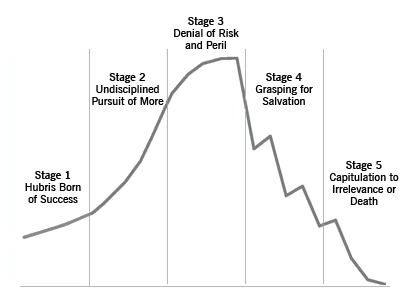
From Jim Collins, the same guy that authored Good to Great, this looks at the other side of the coin: what factors make companies fall from greatness. He comes to the conclusion that there are many different ways to fail (vs fewer to succeed) but that there are some common traits to the examples they looked at.

Like many business books, the key point can be gleaned in just a few pages. In fact, this picture says much of it in a nutshell:


However, recognizing if your company is in one of these phases (as all companies suffer from at least SOME of the symptoms) makes the book worth reading, to compared to the numerous case examples throughout the book.

The terrifying part is how often great companies are unable to see the cliff, even as they are going over it.

Monday, November 9, 2009

EA Buys Playfish

From Techcrunch today:

Electronic Arts closed it’s anticipated acquisition of social gaming startup Playfish for $275 million in cash. An additional $25 million in stock will be set aside for retaining the top talent at the startup, and another $100 million in earnouts are part of the deal as well if the business hits certain milestones. So the total value of the deal could amount to as much as $400 million when all is said and done.

Wow. $400M is a lot of money. Social games are clearly the hot ticket right now, so it makes sense for EA to jump in, but one has to wonder if that's money well spent.

The stock & earnout will retain the people for some time, which is I'm sure a big part of why they acquired the company.

Still, the titles are cheaper to develop, and there doesn't (as of yet) seem to be the same IP loyalty that there is in hardcore games (are there Farmville fanboys out there dissing Mafia Wars?).

Time will tell if it was a good call, but it certain does seem rash, especially with all of the kerfuffle around questionable sources of social game revenues. (Interesting meta-level piece on the same issue here)

Saturday, November 7, 2009

Book Review: Seize the Daylight

Seize the Daylight is a history of daylight saving time.


I'm sure most don't at first think that sounds like a particularly entertaining story, it's actually quite interesting. At one level, it's a story about an idea that one guy spent his whole life evangelizing a simple but crazy idea, at first to ridicule, then to mixed reception, and then, after his death, to acceptance.

While others, including Ben Franklin, had the idea and proposed it in various forums, it was one man, William Willett, who spent the better part of his life trying to convince society we could be more productive and efficient by getting our collective ass in gear by sunrise.

Roughly a hundred years later, a billion people follow his guidance. Along the way though, curious things happened over the course of a couple world wars, an energy crisis, and a modernization of global commerce that necesitated everyone getting in sync.

David Prerau takes what otherwise would be a boring subject about legislation and debate between competing interests, and colors it with a ton of colorful bits of history about poorly timed train crashes, terrorist bomb plots gone awry (you know those clocks you see in the movies ticking to a certain detonation time - may want to note whose clock those were set to!), etc. Hard to imagine that only a generation or two ago there was a time where different states, cities and suburbs each observed different DST policies and dates, resulting in chaos.

Anyhow, if you enjoy the history of systems, technology, and of putting big ideas into practice, you may enjoy Seize the Daylight.

Friday, November 6, 2009

Indie Pop

I've often found that some of the best lessons in marketing are those involving commodity products. No difference between Coke and Pepsi, so the marketing better get creative, right?


Well here's a great video about the Soda Pop Stop, an indie grocer that has carved out a niche for himself by combing the world for quality product, catering to only those customers that care for such, and telling Pepsi to pound sand. I love how passionate he is about his customers and his products. Awesome.


I really hope this guy has kids and/or nephews. What a great role model he'd be while sating a kid's sweet tooth.

Monday, November 2, 2009

Playstructure project

Well, it's November, and I've almost wrapped up the 'summer project' play structure. It was a sunny day yesterday so I snapped a couple pics.

An off-the-shelf structure wouldn't work because we were building on an incline and over a retaining wall, so we decided to do something custom. As usual, this led to my getting a bit carried away.

Original rough concept in Sketchup:


Same, with rough orientation in situ:


Final product (still need a few pieces of trim, a pirate flag for the mast, etc):


From the downhill side (still needs a few pieces of 'hull' planking), showing slide and climbing wall:


I'll post some more pics after getting the last bits of trim done (hopefully this year!!)