Showing posts with label MarketTrends. Show all posts

Sunday, October 14, 2012

OK it's over, but was it really a "Revolution"?

Here is a Good article by Tadhg Kelly that many others have linked to this weekend. While it's good and nails a few of the key trends at play, there's a couple things in the article that don't sit well with me. I'm not sure I can do much better, but here are a few points to consider.

Tadhg points us to the recent goldrush(es) around Social and Mobile games, specifically naming 5 trends (social customer acquisition, a 'price crash', distribution at scale, game metrics focus, and lower development cost (for mobile and social), and then goes on to knock on why each of those is coming to an end.

While he's correct about all five, it's the way they are lumped together that makes me a bit uncomfortable. In some areas they are trends affecting different areas entirely, in some areas with overlap, but by casting them all as part of this single "revolution", it's somewhat misleading.

In saying Social Stopped Working, he's correct that easy, exploitive viral channels were closed, and that customer acquisition costs went up - but it's unfair to dismiss social-viral potentiality altogether. e.g. Its a bit unfair to say that Words With Friends winning over Lexulous is entirely due to customer acquisition spend. There are design elements involved that make WWF a game with higher potential of distribution (e.g. they were quicker to add push-notification of turns, and have an end-game mechanic that leads to active-games growth)

His points about cost-of-entry going up (in terms of cost of acquisition and the points he makes about production costs) are right on the money, and are typical of any maturing market. We saw this happen in PC Casual, XBLA, heck, I remember a time when people used to say "4 guys in a garage can do it relatively cheaply!" about PC first person shooters. There's nothing new here. However, when lumping together to social vs mobile categories - what I view as two separate gold rushes with overlapping but different timelines and trends - it confuses the discussion somewhat.

In any case. It's a good article. The trends are real and should be considered when thinking about how they'll effect your business. And in the end, any attempt we make to classify them as a single market, or single trend or a single 'revolution' are all just definitions we're artificially placing on these things anyway. I'm reminded of the Richard Feynman quote:

"...although we humans cut nature up in different ways, and we have different courses in different departments, such compartmentalization is really artificial, and we should take our intellectual pleasures where we find them."
So it is here that any distinction we make into different compartments is artificial - models for us to try and understand the changes afoot. We should take lessons where we can find them, be they pleasurable ones or otherwise.


Tuesday, September 18, 2012

Console Volumes over time

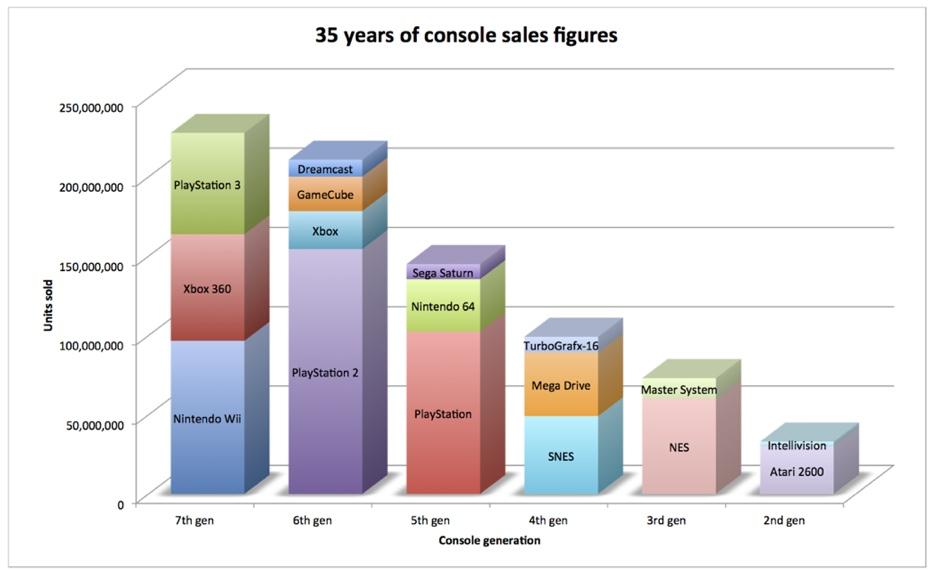
Martin Hollis tweeted a link to this very nice graph comparing the console "Generations" and their total unit volumes:


It's a nice graph, despite the chronological order being right to left.

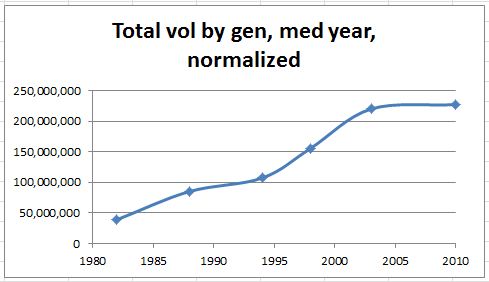
It's a rough swag to group by generation as it is, since launch dates and end-of-life dates have only some alignment. Since some liberties were already taken, and I was curious, I did two things:

- Aligned the generations by date, picking a rough data for "mid life cycle"
- Normalized to 2010 numbers for population size. I used the sum of US, Japan, UK, France, Germany, as my proxy for "first world", as that's where most consoles are sold anyhow.

The resultant graph looks like this (going left to right with time)


Sort of more telling I think. Question is whether the current plateau is an anomaly, or whether we've saturated the market for consoles. A good second question is what this would look like if you removed the portion of Wii sales that were "fad customers", and whether that's fair to do in trying to preduct the next gen numbers.

Anyhow, food for thought.

Saturday, January 7, 2012

Grading my 2011 predictions

It's always a good idea to go back and look at calls I made and see whether I was out to lunch or not. I'll keep these in brief and elaborate where necessary, so it may help to first read the original post if you are interested.

Grading: 0 if wrong, 1 if right, 0.5 if partly right, with explanation

  1. 0.5 "Bespoke design and devices of emotional attachement" - I predicted we'd see more Apple-like design and this would extend down to personalized design even to the individual level. I'm taking a half point on it because we did see some from the top down with all the laptop and camera manufacturers embracing design as a higher priority, and at the same time the bottom-up end of things like Kickstarter projects (e.g. pay a little more to get a custom color or your name engraved on it)
  2. 1.0 "Appstore fatigue" - I think I was correct on this one. I participate in a few 'behind the scenes' mail lists with developers, and many of them are comparing notes on whether an appstore for a given platform or device has proven itself before they leap in. I also get the sense that consumers are ho-hum about hearing that yet another device is including an app store with the same apps they've already bought elsewhere.
  3. 0.5 "Stereo3D will reach a point of undeniable lack of success" - Taking a half point here because there have been numerous pieces calling attention to the lack of success, but there's still an air of 'wait and see', plus some claims that they are doing well in some regions outside the US. US press seems to be acknowledging that the tech isn't moving people as expected (1, 2)
  4. 1.0 "3D Printing will take off" Though admittedly I was vague here by the "as measured by..." piece. Still shapeways, Tinkercad, MyRobotNation, 3D printable remote control cars, and numerous entries in the low-cost printer market... it's clearly a growing area of interest. Supposedly Makerbot has some big announcement coming next week at CES.
  5. 1.0 "Gamings Physical & Virtual Worlds meet" - This was already underway but has been making further progress. The examples I listed last year are still there, and new ones have been introduced, as well as existing toys getting a virtual element to them (e.g. American Girl has added an online component). Probably the best example I've seen to date is Skylanders, which my kids are currently obsessed with.
  6. 0.5 "Apple has a game platform" Apple more openly acknowledges games as a leading category in their app store, and is catering to developers with feature requests and the like. They still haven't directly taken on the consoles or handhelds with their core customers yet. 
  7. 1.0 "The Post-PC era will officially arrive". I think this is true - not in the sense that PCs are dead (they are doing great) - but in the sense that there are computing and media-consumption devices that are designed to function without PC tethering. tablets, phones, etc, seem to have made this transition.
  8. 0.5 "Brands-as-memes": There are cases of this happening, but Angry Birds is still so exceptional I can't point to it as a trend when the others are so much smaller.
  9. 0.0 "e-reader apps and services will see an explosion of innovation": I still think this could happen, but so far the leaders in e-reading have been pulling ahead based on vertical integration and digital distribution leadership (Amazon, Apple), not by building a more innovative reader. Shame.
  10. 1.0 "Cracks in gaming's walled garden": It's still early, but HTML5 games on iOS are a leading example here.
  11. 1.0. "HTML5 begets real apps": LucidChart, Tinkercad, many other examples.
  12. 0.0. "Android Consolidation": There hasn't been consolidation, and like I pointed out the app landscape while perhaps not bleak is at least very messy. Rather than consolidation though, we're seeing a few guys break out as leaders from the rest of the me-toos. e.g. Kindle Fire.
  13. 0.5. "Games market analysts will struggle to segment an amorphous landscape": I think I was right here, but in retrospect it's hard to see how to grade it.
  14. 1.0. "No official Kinect for PC": Development kits yes, but no consumer product.
  15. 1.0. "Tablets as a Producer Platform": We are seeing tablet-targeted text editors, photo apps, visualization apps, etc.
So, 10.5 out of 15. Not bad but could do better.

Tuesday, November 23, 2010

Several good reads this week around the web

A few good finds this week to read over your morning coffee, or over turkey hangover:


  • Tim Berners-Lee (inventer of The Web) in Scientific American: Long Live the Web: A Call for Continued Open Standards and Neutrality. A lengthy dissertation on open standards vs walled gardens, Net Neutrality, and Electronic Human Rights. Much of it covers known problem, but it's good to see them called out so eloquently.
  • iReaderReview has a piece examining What Impact are Kindle Exclusives Having. There are some parallels with games here. In a crowded market like books (or, say, small downloadable games), does having an exclusive on even a significant number of titles make any difference for the platform's appeal.
  • Gamasutra has a good piece up on Console Hardware Trends in the Bundle Era. I find the title a bit misleading, and would rather label it "Hey Guys, how goes the mid-life booster rocket?". Title aside, though it's interesting. The table of 360 HW sales by month is interesting, showing 2010 to be a banner year thus far, and that was BEFORE the Kinect and its bundles launched.
  • Good CNET piece on Netflix's Secret Sauce for Acquiring Content. Good lessons here on being a good partner.
Go read! Discuss!

Monday, January 26, 2009

Go Go Goo!

As Kotaku points out, lil' indie game World of Goo went to retail and made NPD's top 10 chart. Go Goo!

NPD Sales Charts January 11-17

1. WoW: Wrath of the Lich King
2. The Sims 2 Double Deluxe
3. Fallout 3
4. World Of Warcraft Battle Chest
5. Spore
6. Left 4 Dead
7. The Sims 2 Apartment Life
8. World Of Warcraft
9. Call Of Duty: World At War
10. World of Goo

Either a positive statement about Indie games, or a statement about the sorry state of PC gaming. Either way, Woot!

Friday, February 15, 2008

The (repeatedly false) reports of the death of PC Games

Over the past five years, I've read what have to amount to hundreds of articles, blog posts, analyst reports, etc, on the future of PC games, declaring them either dead, or alive and well.

The reality, of course, lies somewhere in between, or that they are both true, depending how you look at it.

This article by Rob Fahey on GamesIndustry.Biz, is the best article I've read on the subject in a long time. Rather than go for the sensationalist tactic of taking one side or the other, he paints a more accurate, nuanced view of reality:

For once, this isn't the cyclical question of whether consoles will kill the PC market - a question asked so often, and answered with such an emphatic negative, that it finally seems to have fallen out of the industry's discourse, and good riddance. Rather, it is a genuine desire, both on the creative and financial sides of the business, to understand just what shape PC gaming is going to take in the coming years.

For a long time, it was simple to categorise PC games as "hardcore", with console titles seen as more casual. It wasn't a division that was entirely accurate, but it was close enough to the mark to be useful - for a while, at least.


That's simply no longer the case. While the PC still plays host to some of the most hardcore gaming genres, such as massively multiplayer games, realistic flight simulators and real-time strategy titles, a huge new market of ultra-casual games has also opened up on the platform.

It's a good read, especially for those that aren't close enough to the business to get a sense of both side of the story.