A quick review on what Santa left under the tree:

The DeLonghi Magnifica super-autamo-espresso-robo-machine.
Here's a long review of it that I mostly agree with. Here's my short review.
It's the frikkin bomb! I so love it.
The DeLonghi Magnifica super-autamo-espresso-robo-machine.
Here's a long review of it that I mostly agree with. Here's my short review.
It's the frikkin bomb! I so love it.
There you go. Harmonix, please get right on it. I'll buy first round!
First off, let me state that I agree wholeheartedly that developers should be given credit for their work. On the other hand, I also believe that there are a handful of issues that make this more difficult than it may first seem. I like Russel and respect him but I think he's made this issue a little more cut and dried than it really is.
Before I get to the issues, let's look at an example. I'll take a favorite 'classic' (in the casual space anyway!) example of mine, Diner Dash.
Diner Dash was developed by the fine folks over at GameLab, and published by the equally fine folks over at Playfirst - two companies I love working with, and whom I have a great deal of respect for.
If I go to download Diner Dash on Reflexive's site, I get the following: I see Playfirst cited as the game's creator (incorrect), Gamelab is not mentioned. After installing the download version of the game, I get a splash screen for Reflexive, followed by the game executable putting up splash screen animations for Playfirst and Gamelab.
Installing the same game off MSN's site, I get the following: No mention of developer or publisher on the web page, and after installing, I get the same splash screen order for MSN Games, followed by Playfirst and Gamelab, but then followed by Oberon Media.
Additionally, installing the game from MSN, if you are running Windows Vista, installs an icon in the Vista Games Explorer, with metadata that cites Oberon as the publisher (wrong), and Playfirst as the developer (partially wrong).
Why is this situation so messed up?
Well, there are a handful of issues that Carroll doesn't address in his issue that make this more complicated than it may seem. These include the following:
Channel conflict.
This is a big one, and in many ways is at the root of this whole issue. Channel conflict occurs when manufacturers of goods start to perform roles that put them in direct conflict with companies that normally are partners in the distribution chain. For example, when Apple decided to start operating Apple Stores around the world, it probably didn't sit very well with their distribution and retail partners at the time.
In the digital distribution world, this is a pretty hot topic, since startup costs are relatively low, anyone can at least hang out a shingle and say "we're in the distribution/sales/etc business!".
The reality is that everyone needs to work together to provide a good selection of product to customers wherever they may be. Channel conflict does lead, though, to discussions about how company names are used, and what they imply to the consumer. For example, Are you trying to indicate "Company X makes good games, look for more games by Company X", or are you trying to say "you might get a better deal on Company X games if you bought them directly at the Company X store!".
Antiquated Labels
I believe another issue is that the labels of 'developer' and 'publisher' are rapidly becoming obsolete.
What *is* a publisher anyway? Traditionally, it was someone who provided three functions: financial backing, production assistance, and go-to-market (sales, distribution, manufacture, marketing, etc). However, we are increasingly seeing those roles changed from one title to the next. If a developer funds their own development and production and only uses a publisher for distribution of boxed product - do they deserve the same credit as a publisher who made an early bet on a risky title? What about a company that funds development, but then lets another partner do the go-to-market? Are they both listed as publisher?
The same issue exists with developers. When multiple components of games are outsourced to other companies and/or shared across titles, how do credits work then? We see some of this confusion with publishers moving large franchises from one studio to another for sequels, etc.
I think a (and not necessarily 'the') possible endpoint for all this is something more akin to what we see in the movie industry. Movies from 50 years back had labels more distinctly defined like today's games. Today if you see a movie, you'll see a barrage of company names up front that let you know the names/brands affiliated with a film, but it's not always under concise labels. (e.g. "a John Doe film", "with Company X", "from the minds of Studio Y", etc
These labels become increasingly confused when they move from physical to digital channels. Now the portal may play the role of the retailer and may have a deeper relationship with the customer than just 'a place to buy stuff' (the game may integrate with their meta-game, etc). There are distributors who provide more than just moving a cardboard box from A to B. In the casual space, Oberon media is a big player here. Do they deserve recognition in getting the game in the customer's hands? What if they provided some of the meta-game integration work?
Antiquated labels in an evolving world
The above issue is aggravated by the fact that the world is changing, and these labels that evolved out of big-budget, physically distributed, boxed product games. As muddled as it may be getting for casual games on PC, I think it's going to get far worse for flash and other lightweight web games, mobile, and other segments. We are going to increasingly run into scenarios where new mixes of attribution are going to have to be shoe-horned into existing mechanisms.
An example.
Back when I was making the push to have MSN Games be fully Vista compatible, and helping to define the mechanism by which we'd retrofit games with meta-data for the Vista Games Explorer, we had an issue, and made what I think was a good compromise.
The game meta-data has place for a developer and publisher to be listed. However, there's no concept of the distributor or retailer to be listed, and while *multiple* devs or pubs can be listed, only the first is immediately apparent in the games explorer, and only the first of each is displayed as an active hyperlink.
The compromise we made was to list the developer and publisher, but have the URLs not link to their sites, but to the MSN games site with a flag to display all the games from that one developer. The site has yet to configure itself to that custom flag but I expect at some point in the future it will. regardless, this is a good solution because while it address the competitive channel conflict issue, it doesn't do so by falsely assigning attribution for the games creation.
Multiple layers of channel
Another issue that exists is that while one player in the equation may be trying to do the right thing, its not always apparent WHO the correct attribution should be assigned to! A typical PC games portal may see five hundred different games and/or skus of games in a typical year. Often, many of those come via distributors or publishers. They have to assume that the information they are getting on attribution and credits is accurate, and don't have time to police it all. Same is true for each layer of the channel.
Losing sight of the end goal
One of the things I take away from this 'credit' discussion is that people often are losing sight of - or perhaps just overloading - who the end 'consumer of credits' is, and what the information is supposed to help them with. There are several:
Some of these have different answers (Who created this? vs Who should I return this to for a refund?) but we try to jam everything into these two labels of 'developer' and 'publisher'.
Solutions?
I don't have any easy answers. that was the main point of this post is that this is a complicated issue and not just a matter of a few big evil companies trying to keep the little guy underfoot as the GDMag article implied.
I do have a few ideas though:
1. Move into the tag-cloud age. Like the movie business, we should worry less about official 'role labels', and just start listing all those involved. Don't worry about "oh, we did the design, all they did was the mac port". Put your name on enough quality work and people will get it over time. I'm not sure the end user recognizes the difference anyway (at least outside the hardcore space).
2. Understand and communicate your intent, and that of your partners. If you are looking for attribution to promote your studio brand, great. If you are doing so hoping this will drive site traffic so you can sell direct to customers, then don't act surprised when the places those customers are currently buying aren't interested in promoting your brand. [taken to the extreme, you could argue that a commitment to NOT compete with your channel partners could be a strategic advantage, as they may give you opportunities that they may not offer your (shared) competition. This is true for every layer of the channel.]
3. Count on Karma. When in doubt whether to give an individual or a company credit, do so. This is a small industry and the person you 'left off the list' will remember it, and you'll cross paths with them again.
Parting Thought
One final thought is this. It's 'out there' enough that I don't want to list it as a possible solution, but at least food for thought.
What about separating game credits from the game itself? Let games contain URLs to their credits, and let their credits reside as a living body of work, a la wikipedia?
Have the IGDA body create a wikipedia-like 'universal game credit wiki'. it's goal to contain all contributions to all skus of all versions of all games. Games could then choose to opt in to linking directly to their entry, or including credits in the game, or doing both!
A little something to ponder over your holiday festivities. Cheers.

 a while back but only got to reading it while on vacation last week.



Good lessons for those trying to shake up the game industry, I'd say!


Food for thought.
As for the actual device - I'll let you know how it goes after I actually plug it in. :-)
For those that are curious, here's a shot of the ports on the back.

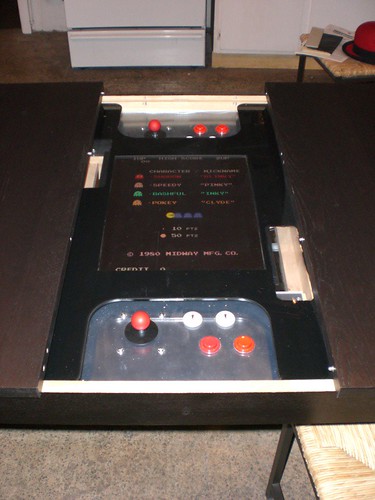 Hmm... I've been looking for a reason to buy that router attachment for my table saw...

 I picked up GH3 late last week. The title's been written up to death, so I'll give a very brief 'mini-review' of my impressions:
Bad:
That's it. If you liked GH2, you'll like GH3 is I guess the super-short review :-)

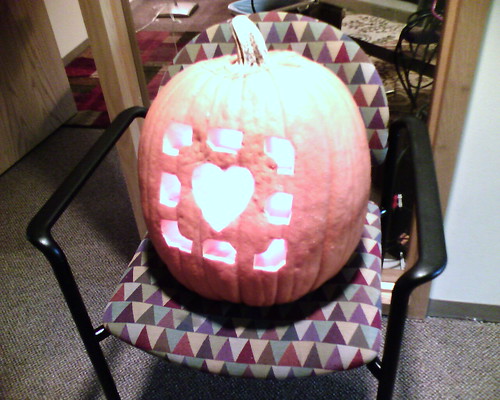
Spotted in front of a co-worker's desk this morning.
I understand this Portal game is quite the fun. Will have to play soon...


Not the worst idea I've heard of, I guess.
And hey, if they were running it within one of Shanda's MMO's, you might even be able to hook up with someone of the desired gender!
I am of course talking about Bingo!

 In which the online world is free with purchase of a plush doll.
And now you have UBFunkeys, a comparable model, but the dolls connect via usb.
And Barbiegirls, where it's more like an MMO, since you can actually communicate with other players and the like. The "doll" is also an MP3 player and connects via USB.
Next thought exercise is whether this same model could be extrapolated to 'give away' a big budget single player title or MMO with, say, the purchase of your Mercedes...